

Third-party liability
- Required by law
- As long as the registration is in your name
- Suspend the registration when not in use
The Ami spends most of its life parked in a street and is charged from an ordinary socket. That is also where most of the claims come from.
This page in another language: Nederlands
Work out for yourself what it would cost.
Enter your details; you will receive a proposal within one working day.
A premium indication, not personal advice. Prefer to talk it through? Call 072 - 509 24 56.
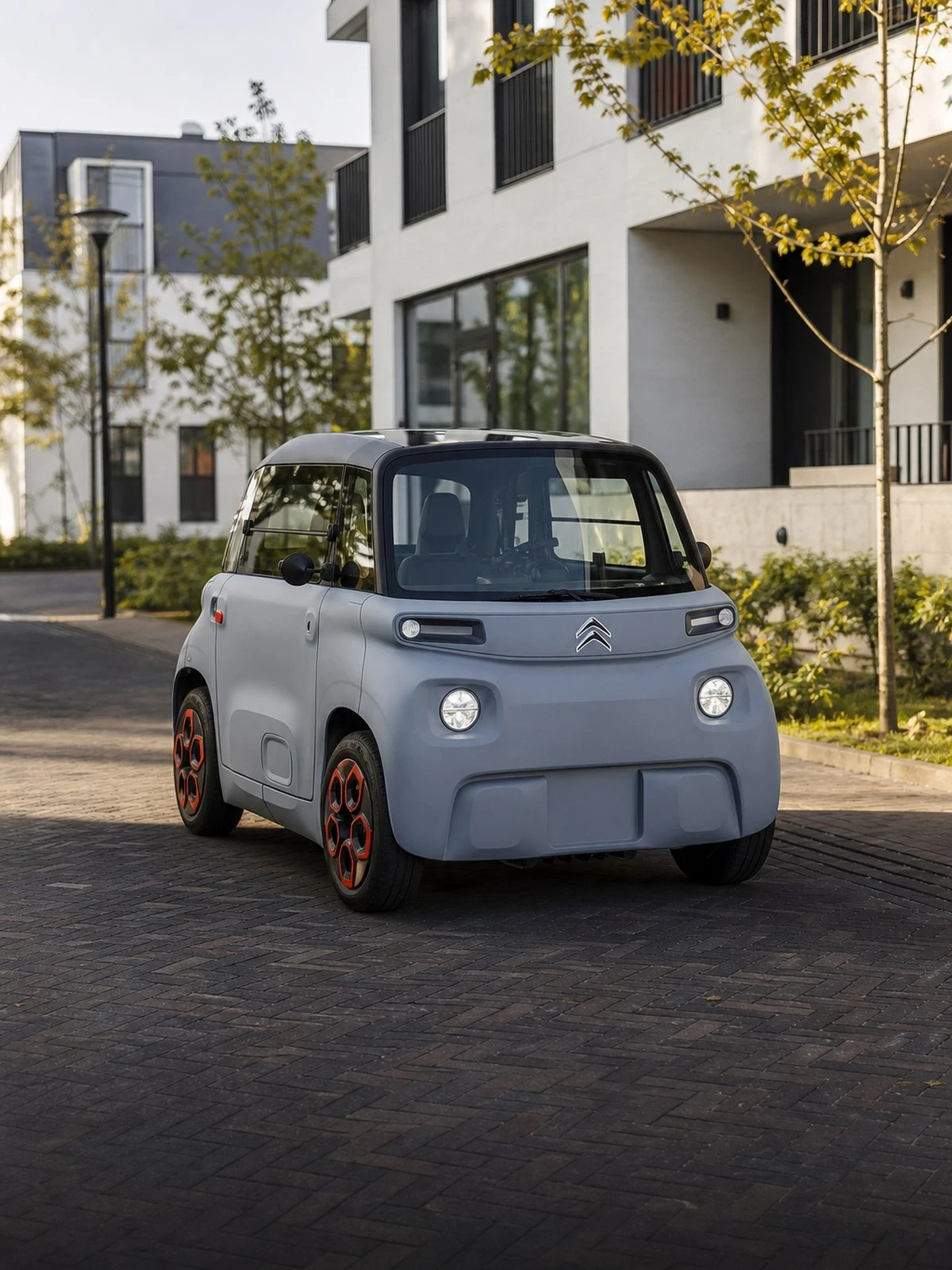
The Citroën Ami is a city vehicle. It is used for short journeys, stands among other cars on the public road and is charged from a domestic socket with the cable carried in the vehicle. That pattern of use produces a recognisable claims picture: parking damage with no known other party, vandalism and damaged body panels after a low-speed collision.
As for charging, an ordinary socket is not a charging point. Insurers set conditions on the use of extension leads and cable reels, and a fire arising from them affects not only the vehicle policy but also the buildings insurance (opstalverzekering) and home contents insurance (inboedelverzekering) at the address where charging took place. So charge from an earthed circuit and unwind a cable reel completely.
The bodywork consists of plastic panels which, when damaged, are replaced rather than beaten out. That shifts the point at which a total loss follows. How the bases of valuation relate to one another is set out at the page on light quadricycle insurance; if a sixteen-year-old drives the Ami, see insurance at the age of sixteen.
We compare your moped insurance across dozens of insurers, explain where the real differences lie, and arrange the switch from start to finish — without you having to chase it yourself.
 Moped insurance
 Compare
 Get covered
The structure of the cover in three parts, with an overview per situation below.
Damage you cause to others.
Causes beyond your control.
Including damage you cause yourself.
What is covered
| Situation | Third-party liability | Third-party, fire and theft | Comprehensive |
|---|---|---|---|
| Damage to the other party | Yes | Yes | Yes |
| Theft | No | Yes | Yes |
| Fire and storm | No | Yes | Yes |
| Damage you cause yourself | No | No | Yes |
| Wear and mechanical defects | No | No | No |
| Driving without a valid licence | No | No | No |
This overview is general in nature and is not personal advice. What is actually covered, including exclusions, limits and the excess, is set out in the policy conditions and the insurance card (verzekeringskaart) of the insurer; you receive both before you take out cover. Taking out cover without advice? Then read what execution only means for you.
Insurers weigh these details differently. That is where your saving is.
We look at the terms as well as the premium, and stay your point of contact when there is a claim.
We are not tied to one insurer and compare on the basis of an objective analysis of several companies.
You call or email someone who knows your file. No menu options, no changing call centres.
We cancel your old policy and align the start date, so you are never a day without cover.
We report the claim and monitor how it is handled. In urgent cases you can reach us on the emergency line.
Customers rate our service on four aspects: personal service, service delivery, availability and the outcome. The reviews are collected and published by NH1816 and come from customers who have actually taken out a policy with Finass Advies B.V. or reported a claim.
Four points that make the difference between a policy that pays out and one that does not.
The Ami charges through an ordinary wall socket, and that is precisely where things go wrong. A coiled cable reel, a thin extension lead or an unearthed circuit in an old garage form a real fire risk. Policies contain conditions on this. If a fire breaks out and it turns out that charging was done through a faulty installation, that affects both own-damage cover and the buildings insurance of the property where the vehicle stood.
A vehicle permanently parked in the street picks up damage whose cause has disappeared. Third party, fire and theft does not cover that damage: a collision caused by an unknown third party comes under comprehensive cover, as does vandalism under most conditions. When you weigh up the own-damage choice, look not at how you drive but at where the vehicle stands when you are not with it. Always report an unknown culprit to the police.
The body panels are plastic and are replaced as a whole when damaged. A scratch or a broken corner therefore means a new panel rather than a repair at the body shop. On a vehicle with a limited market value, those costs quickly exceed the value and the loss adjuster declares the whole a total loss. You then receive the market value less the residual value and less your excess.
Outside the cover are: loss of battery capacity through ageing, because that is wear; damage from charging through a faulty or overloaded installation; items left loose in the vehicle, even after a break-in; parking damage caused by an unknown third party where you have only third party, fire and theft; hiring out or shared use that has not been declared; and driving without an AM licence or with an altered construction.
This is what people ask us most.
Only if the installation can take it and the reel is completely unwound. A coiled reel gets hot and is a well-known cause of fire. Insurers include conditions on this, and after a fire the loss adjuster looks at the installation used. Preferably charge from an earthed circuit suitable for the purpose, and have a permanent point installed if you charge at home every day.
Only under comprehensive cover. Third party, fire and theft has a fixed list of causes such as fire, storm, theft and broken glass, and a collision caused by a third party who has disappeared is not among them. Always report it to the police and photograph the damage and the parking place. Without a known other party you cannot recover the loss and only your own-damage cover remains.
With a comprehensive claim for damage you cannot recover, the loss stays on the insurer's own account and that generally costs steps on the no-claims scale. With a third party, fire and theft claim such as broken glass or storm damage, it does not. Ask in advance how your insurer records this and work out whether paying yourself is cheaper.
As a permanent part of the vehicle, the battery comes under own-damage cover for sudden damage, such as fire or a collision. Ageing and declining capacity fall outside it. That is wear and is a matter for the supplier's warranty. Do ask whether the battery is paid at replacement value as new or at market value after a loss, because that difference is considerable.
Every situation is different. For these situations we have a separate page.
Request a quote without obligation. We will look at which insurer best matches your activities and your risk.
Prefer to call? 072 - 509 24 56, weekdays 09:00–17:00.
Claim on the road? Emergency line 06 - 55 20 40 72.
Finass Verzekert is a trading name of Finass Advies B.V. We advise on and arrange non-life insurance on the basis of an objective analysis of several insurers, and receive commission for this from the insurer, which is included in the premium. You pay no separate advice fee. Before you take out cover, we establish your wishes and needs.
You will find our licence, KvK and Kifid details and our complaints procedure at the foot of every page.
This page was compiled by Finass Verzekert (LinkedIn). Last updated on .
The information on this page is general in nature and is not personal advice.
Maandag- Vrijdag: 09:00- 17:00
We use cookies and similar technologies to improve your experience on our website.