

Liability insurance for a lifting and hoisting company
At a crane hire company the whole discussion comes down to two questions: was the crane a motor vehicle at that moment, and who had the load in their care.
- Several insurers compared objectively
- 9.5 customer rating for a new policy
- AFM licence 12016589
- Personal 072 - 509 24 56, weekdays 9–17
This page in another language: Nederlands
Work out for yourself what it would cost.
Enter your details; you will receive a proposal within one working day.
- We compare the offerings of several insurers
- An adviser checks whether the cover suits your activities
- We arrange the switch, including cancellation
A premium indication, not personal advice. Prefer to talk it through? Call 072 - 509 24 56.
- Independent advice
- Several insurers
- Switching arranged
- Help with claims
In brief
In insurance terms a mobile crane is two things at once. In traffic and when driving on a site it is a motor vehicle, for which Article 2 of the Dutch Motor Insurance Liability Act (WAM) prescribes compulsory insurance. Damage caused with or by that motor vehicle is in fact excluded on public and employers' liability insurance. The work risk of the lifting itself does belong with the AVB, but which side of that line an event falls on is the first question with every claim.
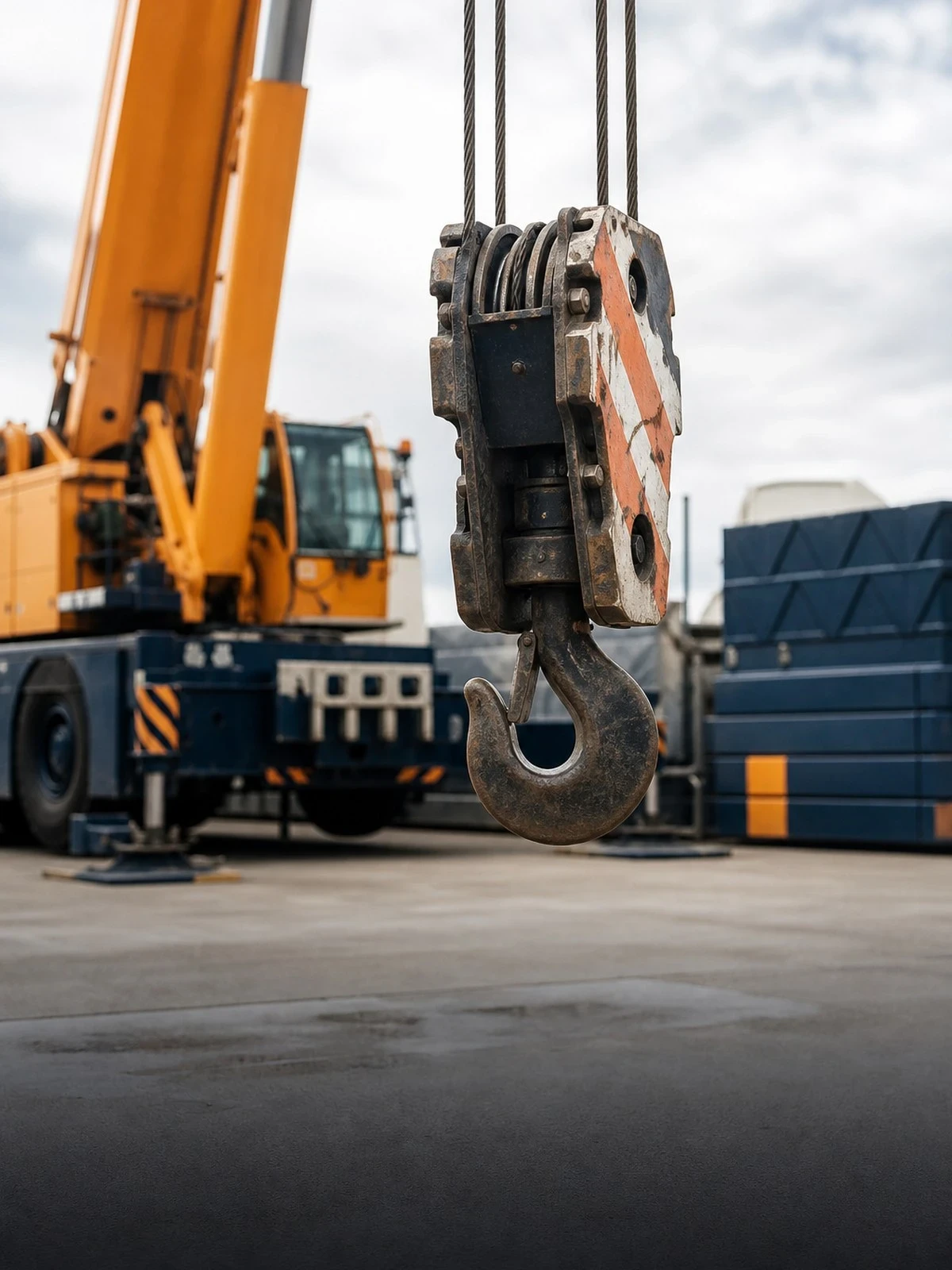
The second question concerns the load. A roof element, a precast wall or a machine on your hook is property in your care. If it falls and is destroyed, that engages the care, custody and control exclusion. If the falling load also damages the building, the site or other property, that is damage to third parties. Some insurers offer separate cover for damage to the item being lifted. You have to ask for it expressly.
The third question concerns the subsoil. If outriggers sink into ground that will not bear them, or you crush a cellar, a sewer or an underground pipe, liability under Article 6:162 of the Dutch Civil Code comes into play and the lifting plan, the outrigger loads stated and the information the client provided are examined. You do not insure your own crane and lifting gear here, but with plant and machinery insurance.
This page deals with one situation. The full overview is on Compare public and employers' liability insurance (AVB).
Independent, personal, sorted quickly
We compare your business liability insurance (AVB) across dozens of insurers, explain where the real differences lie, and arrange the switch from start to finish — without you having to chase it yourself.
 Business liability insurance (AVB)
 Compare
 Get covered
Why arrange it through Finass Verzekert?
We look at the terms as well as the premium, and stay your point of contact when there is a claim.
Independent
We are not tied to one insurer and compare on the basis of an objective analysis of several companies.
One fixed adviser
You call or email someone who knows your file. No menu options, no changing call centres.
Switching without hassle
We cancel your old policy and align the start date, so you are never a day without cover.
Help with claims
We report the claim and monitor how it is handled. In urgent cases you can reach us on the emergency line.
What to look out for
Four points that determine at lifting work which policy bears a loss.
The boundary between the WAM and the AVB
If the crane is driving, the motor vehicle risk responds. If it is standing on its outriggers lifting, the work risk is engaged. Insurers use different wording for this. Have the concurrent insurance between the two policies recorded, otherwise two insurers will point at each other when there is a large loss.
Lifting gear and inspection
Slings, chains, webbing slings and spreader beams must be inspected periodically. Where a piece of gear fails, the inspection file is the first thing requested. Carrying on with rejected or out-of-date equipment can be regarded as wilful recklessness and then falls, under Article 7:952 of the Dutch Civil Code outside the cover.
Downtime at the client
If a building site or a production line stands idle after a lifting incident, what matters is whether property damage came first. Without damaged property the delay loss is pure financial loss and not covered. Contractual penalties for overrunning a lifting slot are not covered either.
Staff on and around the crane
Operators, slingers and banksmen work under loads and within reach of moving parts. Article 7:658 of the Dutch Civil Code calls for demonstrable instruction, valid certificates and supervision of keeping the danger zone clear. Subsection 4 brings hired-in staff within it, even where the agency is formally the employer.
What does your premium depend on?
- Turnover and payroll: the yardstick for size and employers' liability
- Number and type of cranes: capacity and boom reach determine the potential loss
- Hire with or without an operator: hire without an operator moves the risk
- Type of projects: inner-city work above existing buildings weighs heavily
- Cover for the item being lifted: included or not, and up to what amount
- Claims history and inspection regime: the maintenance file counts towards acceptance
Insurers weigh these details differently. That is where your saving is.
What is covered
| Situation | AVB | BAV |
|---|---|---|
| A precast wall falls out of the sling onto the roof of a neighbouring house | Yes | No |
| An outrigger sinks into the verge and crushes the client's sewer | Yes | No |
| A passer-by is hit by a webbing sling falling from height | Yes | No |
| The machine being lifted is damaged beyond repair in that fall | Provided that | No |
| The lifting plan turns out to be based on the wrong weights and the job has to be prepared again | No | Provided that |
| The boom of your own crane buckles under overloading | No | No |
Cover for the load on the hook is a separate arrangement. Without that extension the item being lifted stays outside the policy.
Frequently asked questions
This is what people ask us most.
The load falls and is damaged beyond repair. Is that covered?
Not under the standard conditions: the load hanging on the hook is in your care and damage to property in your care is excluded. What the falling load also damages, a roof, a facade or a parked vehicle for instance, is damage to third parties. Separate cover for the item being lifted can be added with some insurers.
Our crane overturns and damages a house. Which insurance applies?
That depends on whether the crane was taking part in traffic as a motor vehicle at that moment or was functioning as a tool. The first is covered by the compulsory insurance under Article 2 of the Dutch Motor Insurance Liability Act (WAM), the second by the work risk cover. Because the wording differs from insurer to insurer, aligning the two policies is not a luxury at a crane hire company.
The client gave incorrect information about the ground conditions. Does the loss stay with us?
Not necessarily. Who had to supply which information is usually set out in the lifting plan and in the order confirmation. If the client recorded in writing that the ground was suitable, recovery is possible. Without a recorded lifting plan and without stated outrigger loads, the argument is almost always decided against you.
Is our own crane included on the AVB?
No. Liability insurance pays only for other people's losses. Own-damage cover for the crane, for lifting gear and for non-road-going plant is arranged with plant and machinery insurance, and the motor vehicle part with the compulsory cover that goes with it. Theft of webbing slings and spreader beams belongs with the equipment cover, not with liability.
Every situation is different. For these situations we have a separate page.
- Compare public and employers' liability insurance (AVB)The main page
- Liability insurance for a crane companyThe load, outrigger pressure ·. The WAM boundary
- Liability insurance for a self-employed lifting supervisorSlinging, signalling, lifting plans
- Liability insurance for a rigging companyMachinery moves, care, custody and control limit, dismantling
- Liability insurance for a self-employed crane operatorSomeone else's machine, hiring in, lifting plans
- Liability insurance for a self-employed riggerFloor loading, moving, securing
- Liability insurance for a glazing companyGlass cranes, lifting, emergency call-outs
- Liability insurance for a concrete firmFormwork, strength class, pump truck
- Liability insurance for a haulage company with lorriesLorry loader, trailer, the WAM boundary