

Liability insurance for a self-employed lifting supervisor
A lifting supervisor owns no crane but does decide how the load hangs and when it moves. That means a loss rarely falls neatly into one box.
- Several insurers compared objectively
- 9.5 customer rating for a new policy
- AFM licence 12016589
- Personal 072 - 509 24 56, weekdays 9–17
This page in another language: Nederlands
Work out for yourself what it would cost.
Enter your details; you will receive a proposal within one working day.
- We compare the offerings of several insurers
- An adviser checks whether the cover suits your activities
- We arrange the switch, including cancellation
A premium indication, not personal advice. Prefer to talk it through? Call 072 - 509 24 56.
- Independent advice
- Several insurers
- Switching arranged
- Help with claims
In brief
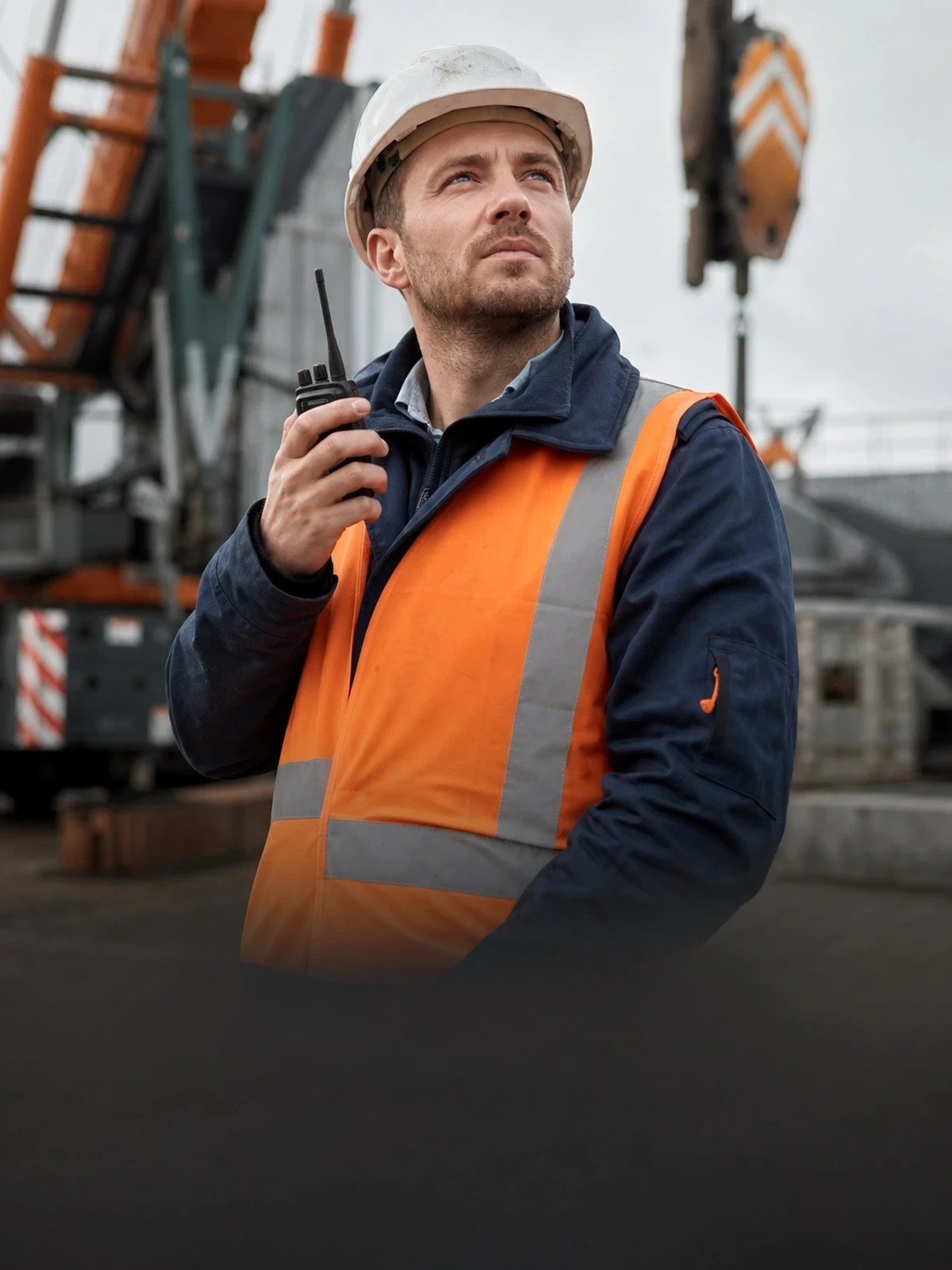
What you do is sling the load, choose and fit slings and spreader beams, judge the centre of gravity and wind loading, and give signals to the operator. If something goes wrong there, the result is injury or damaged property and the public and employers' liability insurance is the policy intended for it. Liability follows from Article 6:162 of the Dutch Civil Code: you should have acted differently from the way you did.
There is a second side to your work that is not hands-on. If you draw up a lifting plan, calculate outrigger loads or advise on the set-up position, that is intellectual work. If an error in it leads only to costs, a cancelled lifting slot or a recalculation with nothing broken for instance, that is pure financial loss. That falls outside the AVB and belongs on professional indemnity insurance. Make sure your policy states which of the two roles you perform. More about that is set out under liability insurance for riggers and lifting supervisors.
Three items stay outside this insurance. The load on the hook is property in your care as long as you are supervising it. Your your own injury: if you are standing under a load and things go wrong, the party hiring you in can, under Article 7:658(4) of the Dutch Civil Code may be liable, but your income is only secured by a disability insurance. And your your own lifting gear, which you insure separately.
This page deals with one situation. The full overview is on Compare public and employers' liability insurance (AVB).
Independent, personal, sorted quickly
We compare your business liability insurance (AVB) across dozens of insurers, explain where the real differences lie, and arrange the switch from start to finish — without you having to chase it yourself.
 Business liability insurance (AVB)
 Compare
 Get covered
Why arrange it through Finass Verzekert?
We look at the terms as well as the premium, and stay your point of contact when there is a claim.
Independent
We are not tied to one insurer and compare on the basis of an objective analysis of several companies.
One fixed adviser
You call or email someone who knows your file. No menu options, no changing call centres.
Switching without hassle
We cancel your old policy and align the start date, so you are never a day without cover.
Help with claims
We report the claim and monitor how it is handled. In urgent cases you can reach us on the emergency line.
What to look out for
Four points that are decisive in supervisory lifting work under subcontract.
Who carried the responsibility
After an incident it is established who slung the load, who gave the signals and who approved the lifting plan. As a self-employed person you stand between the crane company, the main contractor and the site owner. Record in writing which task you had; without that demarcation, liability is quickly placed with the last link in the chain.
Inspected gear
If you use your own slings or spreader beams, the inspection must be demonstrably valid. Knowingly carrying on with rejected equipment can count as wilful recklessness, which is excluded under Article 7:952 of the Dutch Civil Code. If you use someone else's equipment, note which certificate you saw.
The load is in your care, the surroundings are not
If the load itself is damaged, that engages the care, custody and control exclusion. If the swinging load hits a facade, a pipe or a parked vehicle, that is damage to third parties and does fit within cover. That difference in outcome hangs on a single movement and deserves attention when you apply.
The client's contract requirements
Crane companies and sites prescribe a minimum sum insured and include indemnities. Liability you take on outside the lawremains uncovered, and penalties are not covered either. Read those provisions before you sign and not after the crane has been set up.
What does your premium depend on?
- Annual turnover: the usual basis for a self-employed policy
- Role on the job: slinging and signalling only, or drawing up lifting plans as well
- Type of lifting work: inner-city and industrial work weigh more heavily
- Sum insured per claim: usually prescribed by the crane company or the site
- Area of cover: projects across the border call for an extension
- Certification: valid trade certificates are a condition of acceptance
Insurers weigh these details differently. That is where your saving is.
What is covered
| Situation | AVB | BAV |
|---|---|---|
| A swinging load hits the end wall of the neighbouring building while being lifted in | Yes | No |
| A bystander suffers a broken leg when a sling eye fails during hooking up | Yes | No |
| A fitter you allowed to stand in the danger zone is hit as the load is set down | Yes | No |
| Your load calculation is wrong, so the client has to hire a heavier crane | No | Yes |
| After a near miss the site stops work for a day and charges you the standing time | No | Provided that |
| You advise a set-up position where the outrigger pressure is too high and the paved courtyard collapses | Provided that | Provided that |
Whether a loss belongs with the AVB or the BAV depends on whether something was broken or someone was injured, or only money was lost.
Frequently asked questions
This is what people ask us most.
The operator carried out my signal wrongly. Am I liable then?
That depends on what happened. If the signal was unclear, too late or contrary to the agreed communication, part of the liability lies with you. If the operator carried out a movement he should have refused himself, it shifts to the crane company. A method of communication discussed and recorded in advance is your best protection here.
Does an error in my lifting plan fall under the AVB?
Only where injury or material damage results from it. If the error leads only to costs, because a lift has to be done again or a hired crane has to stay longer for instance, that is pure financial loss and the AVB is not the right policy. Anyone who draws up lifting plans needs professional indemnity cover as well.
Am I covered under the crane company's policy?
No. That insurance covers that company's liability. After an incident it will in fact seek recovery from you. Nor does the motor cover of the crane itself do anything about your conduct as a supervisor. A policy of your own with a limit matching the contract requirement is therefore practically compulsory in this trade.
What do I do immediately after a lifting incident?
Report it to your insurer as soon as you know of it. Article 7:941 of the Dutch Civil Code requires that notification, and anyone who waits risks the insurer arguing that it has been prejudiced. Do not admit liability, leave the set-up and the lifting gear untouched if possible and make sure the inspection papers for the slings used remain available.
Every situation is different. For these situations we have a separate page.
- Compare public and employers' liability insurance (AVB)The main page
- Liability insurance for a self-employed riggerFloor loading, moving, securing
- Liability insurance for a lifting and hoisting companyMotor vehicle, the load, ground conditions
- Liability insurance for a self-employed process operatorOperating, batch, alarm response
- Liability insurance for a self-employed crane operatorSomeone else's machine, hiring in, lifting plans
- Liability insurance for a crane companyThe load, outrigger pressure ·. The WAM boundary
- Liability insurance for a self-employed flange fitter or pipefitterSetting out, prefabrication, hiring in
- Liability insurance for a self-employed flange fitterTorque, calibration, sign-off
- Liability insurance for a self-employed installation engineerWater damage, combustion, certification