

Liability insurance for a crane company
With lifting work the loss is rarely small. The question is usually not whether you are liable, but which policy the loss lands on: the AVB, plant and machinery insurance or the WAM.
- Several insurers compared objectively
- 9.5 customer rating for a new policy
- AFM licence 12016589
- Personal 072 - 509 24 56, weekdays 9–17
This page in another language: Nederlands
Work out for yourself what it would cost.
Enter your details; you will receive a proposal within one working day.
- We compare the offerings of several insurers
- An adviser checks whether the cover suits your activities
- We arrange the switch, including cancellation
A premium indication, not personal advice. Prefer to talk it through? Call 072 - 509 24 56.
- Independent advice
- Several insurers
- Switching arranged
- Help with claims
In brief
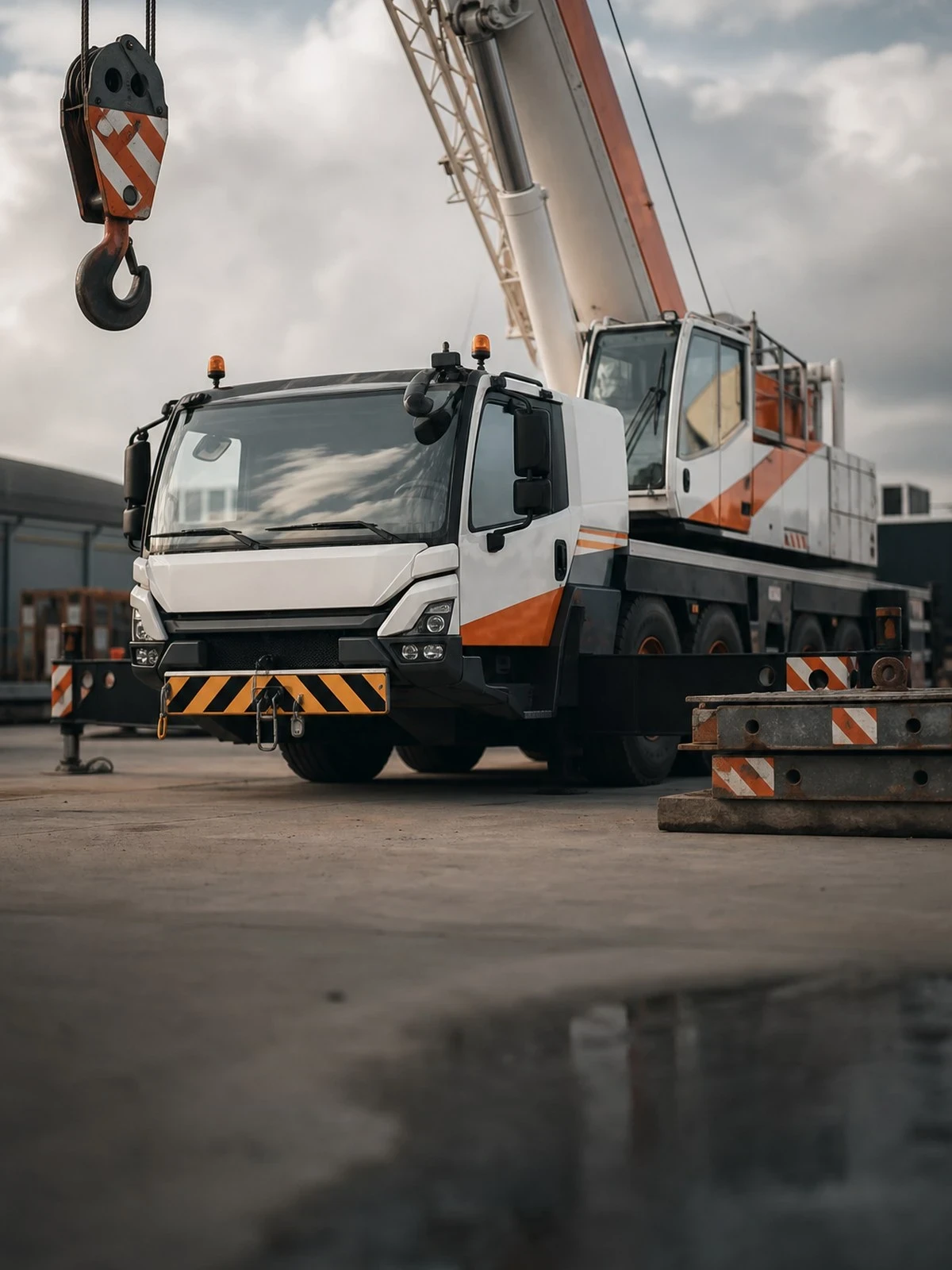
Public and employers' liability insurance (AVB) pays for injury and property damage suffered by others, under Article 6:162 of the Dutch Civil Code. At a crane company that means the load that swings and hits a facade, a boom that catches a roof edge, or an outrigger that sinks so that paving, a sewer or a cellar roof gives way. Because the machine itself is property for which you can be held liable as its possessor under Article 6:173 DCC, an insurer attaches great importance to demonstrable inspection, log checks and maintenance of the crane, ropes and lifting gear.
The most important dividing line is the motor vehicle boundary. A mobile crane or lorry loader is a motor vehicle; as long as it is taking part in traffic, the compulsory insurance of Article 2 of the Dutch Motor Insurance Liability Act (WAM) applies and the AVB does not respond. If the crane is standing on its outriggers and lifting, the machine is a tool and the loss shifts to the liability or plant and machinery insurance. Have it recorded in writing that working as a tool is included, because otherwise the motor vehicle exclusion on the AVB is wide enough to keep that loss out.
Three cost items stay outside cover as standard. The load being lifted is not yours but is in your care and therefore falls under the care, custody and control exclusion. Damage to your own crane, webbing slings and spreader beams is your own property damage and belongs on own-damage or mobile crane insurance. And turnover a client loses because work is at a standstill with nothing broken is pure financial loss.
This page deals with one situation. The full overview is on Compare public and employers' liability insurance (AVB).
Independent, personal, sorted quickly
We compare your business liability insurance (AVB) across dozens of insurers, explain where the real differences lie, and arrange the switch from start to finish — without you having to chase it yourself.
 Business liability insurance (AVB)
 Compare
 Get covered
Why arrange it through Finass Verzekert?
We look at the terms as well as the premium, and stay your point of contact when there is a claim.
Independent
We are not tied to one insurer and compare on the basis of an objective analysis of several companies.
One fixed adviser
You call or email someone who knows your file. No menu options, no changing call centres.
Switching without hassle
We cancel your old policy and align the start date, so you are never a day without cover.
Help with claims
We report the claim and monitor how it is handled. In urgent cases you can reach us on the emergency line.
Where lifting work comes unstuck
Four points that lead to a rejection more often than the level of the sum insured.
The load under the hook
A machine, facade element or rooftop plant you lift is in your care without your being the owner. That is care, custody and control and excluded on almost every AVB. If you do want that loss covered, it calls for separate care, custody and control cover with its own limit and excess. Consider for each job whether the value of the load stays within that limit.
Outrigger pressure and what lies under the mats
Sinking through insufficient bearing capacity is a classic lifting loss: a cellar floor collapsed, a main sewer broken or a gas pipe struck. Insurers expect a properly supported set-up position and a current excavation notification. For underground cables and pipes there is moreover often a separate, lower limit or an exclusion where the notification is missing.
Driving, setting up, lifting
Damage while driving falls under Article 2 of the Dutch Motor Insurance Liability Act (WAM), damage while lifting does not. It is exactly at the moment of setting up and extending the outriggers that the two run into each other. Make sure both policies are with the same broker, so that a loss does not get stuck between two insurers.
Operators, certificates and hired-in staff
A crane operator without a valid personal certificate or a crane without a valid inspection is, to the insurer, a warranty clause you have not complied with. For hired-in operators your duty of care under Article 7:658(4) of the Dutch Civil Code applies in full, even though the contract is with another company.
What does your premium depend on?
- Number and type of cranes: a tower crane weighs differently from a lorry loader
- Payroll and number of operators: decisive for employers' liability
- Hire with or without an operator: hire without an operator moves part of the risk
- Care, custody and control cover and the limit: depending on the value of what you lift
- Use of your own terms of supply: these limit your contractual exposure
- Sum insured and excess: per claim and per insurance year
Insurers weigh these details differently. That is where your saving is.
What is covered
| Situation | Basic | Extended |
|---|---|---|
| A stack of facade elements falls over beside the crane and crushes a parked van | Yes | Yes |
| A groundworker is injured when a webbing sling breaks during hooking up | Yes | Yes |
| While slewing, the counterweights damage the advertising mast of the neighbouring business | Yes | Yes |
| The air conditioning unit you are lifting onto the roof falls and is a total loss | No | Provided that |
| Your own webbing slings and spreader beam are unusable after the incident | No | No |
| The contractor recovers a lost working day from you although nothing is damaged | No | No |
Extended means a policy with separate care, custody and control cover for the load; consider for each job whether the value falls within that limit.
Frequently asked questions
This is what people ask us most.
Is damage to the load I am lifting insured?
Not on the standard AVB. The load is in your care and that damage is excluded, even though you are liable for it in law. Separate care, custody and control cover can pick this up, with its own limit and excess. Consider for each job whether the value of the load fits within that limit and record the arrangement with the client in writing.
Does a collision with the crane fall under the AVB?
No. As soon as the crane takes part in traffic as a motor vehicle, the compulsory liability insurance of Article 2 of the Dutch Motor Insurance Liability Act (WAM) applies. The AVB has a motor vehicle exclusion for it. If the damage occurs while the machine is on its outriggers and being used as a tool, the liability policy does respond, provided that cover is expressly included.
What if the crane itself falls over and is a total loss?
Damage to your own machine is not a liability loss but your own property damage. That belongs on plant and machinery or own-damage cover. The AVB only comes into play for what the falling crane does to others: the building hit, the cars damaged and injury to bystanders.
Do I have to report a lifting loss straight away?
Yes. Article 7:941 of the Dutch Civil Code requires you to report the loss as soon as you are reasonably aware of it. Report an incident where there is no claim yet as well, a facade that has been hit with nothing said about it for instance. Have the situation recorded with photographs and the lifting plan before anything is cleared up. Those documents determine the argument about what happened later.
Every situation is different. For these situations we have a separate page.
- Compare public and employers' liability insurance (AVB)The main page
- Liability insurance for a lifting and hoisting companyMotor vehicle, the load, ground conditions
- Liability insurance for a rigging companyMachinery moves, care, custody and control limit, dismantling
- Liability insurance for a self-employed lifting supervisorSlinging, signalling, lifting plans
- Liability insurance for a self-employed crane operatorSomeone else's machine, hiring in, lifting plans
- Liability insurance for a self-employed riggerFloor loading, moving, securing
- Liability insurance for a haulage company with lorriesLorry loader, trailer, the WAM boundary
- Liability insurance for an assembly companyWork at third parties' premises, commissioning, territorial scope
- Liability insurance for a concrete firmFormwork, strength class, pump truck