

Liability insurance for a rigging company
A rigging company takes on objects that are often worth more than its own equipment. Whether that value falls within the policy depends on one section that is precisely what the standard cover excludes.
- Several insurers compared objectively
- 9.5 customer rating for a new policy
- AFM licence 12016589
- Personal 072 - 509 24 56, weekdays 9–17
This page in another language: Nederlands
Work out for yourself what it would cost.
Enter your details; you will receive a proposal within one working day.
- We compare the offerings of several insurers
- An adviser checks whether the cover suits your activities
- We arrange the switch, including cancellation
A premium indication, not personal advice. Prefer to talk it through? Call 072 - 509 24 56.
- Independent advice
- Several insurers
- Switching arranged
- Help with claims
In brief
The central problem in this trade is the value of the object. A press, print line, transformer or turbine that you dismantle, move and reassemble is under your control for the whole job. That is care, custody and control, and excluded on virtually every public and employers' liability insurance. What the standard cover does pick up is the damage around it: a floor that has given way, a damaged facade opening, an installation struck in the client's building, and injury to people who are not your employees. For the object itself you need separate care, custody and control cover, with a limit matched to your largest job.
Equipment and transport are involved as well. Your own cranes, aerial platforms and forklifts fall as motor vehicles under Article 2 of the Dutch Motor Insurance Liability Act (WAM) as soon as they are used on the road, and not under the AVB; damage to that equipment itself belongs on plant and machinery insurance. Road transport of a dismantled machine is a goods risk and not a liability risk. If you also work with mobile cranes, compare the arrangement at a crane hire company.
Also outside the cover are the client's standstill where a line runs later than planned, the contractual penalty for a missed completion date, and putting right or redoing your own your own work. Those are precisely the items a client raises first when a move overruns, and none of the three is property damage within the meaning of the policy.
This page deals with one situation. The full overview is on Compare public and employers' liability insurance (AVB).
Independent, personal, sorted quickly
We compare your business liability insurance (AVB) across dozens of insurers, explain where the real differences lie, and arrange the switch from start to finish — without you having to chase it yourself.
 Business liability insurance (AVB)
 Compare
 Get covered
Why arrange it through Finass Verzekert?
We look at the terms as well as the premium, and stay your point of contact when there is a claim.
Independent
We are not tied to one insurer and compare on the basis of an objective analysis of several companies.
One fixed adviser
You call or email someone who knows your file. No menu options, no changing call centres.
Switching without hassle
We cancel your old policy and align the start date, so you are never a day without cover.
Help with claims
We report the claim and monitor how it is handled. In urgent cases you can reach us on the emergency line.
What to look out for
Four points that make the difference between cover and argument in machinery moves and industrial rigging.
Care, custody and control limit against object value
Care, custody and control cover with a limit far below the value of the machine to be moved gives false security. Assess for each job whether the limit is sufficient and whether a project increase is needed. Insurers work here with an excess per event and sometimes with a maximum per insurance year.
Dismantling, storage and reassembly
Between removal and reassembly there is often a period of storage. A client's property in your shed falls under the same care, custody and control exclusion as on site, while your own fire policy generally does not cover it because it is not yours. Set out in the contract who carries the risk during storage and insure that accordingly.
Inspection of lifting and moving equipment
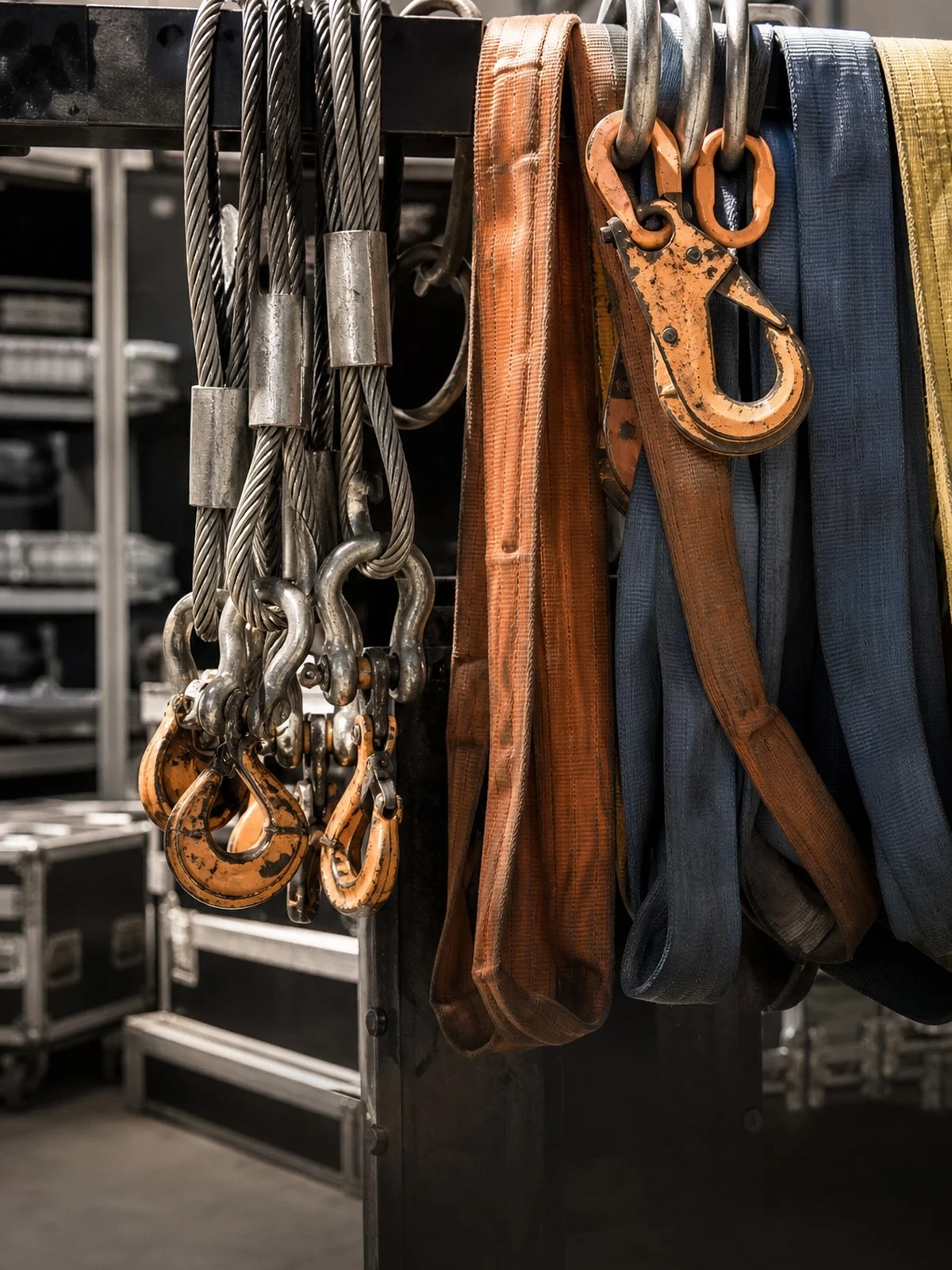
Jacks, gantries, slings, winches and spreader beams are subject to inspection. After a failure the inspection file is the first thing requested. Continuing to work with rejected or out-of-date equipment can count as wilful recklessness and fall outside the cover under Article 7:952 of the Dutch Civil Code.
Staff under and beside the load
Riggers work in confined spaces, under loads in tension and with hydraulic pressure. Article 7:658 of the Dutch Civil Code places the burden of proof on you: you must show that instruction, supervision and equipment were in order. For hired-in workers and subcontractors, subsection 4 of that article applies, whoever holds their contract.
What does your premium depend on?
- Turnover and payroll: the basis for the public and employers' liability sections
- Average and maximum object value: determines the care, custody and control limit needed
- Your own equipment: number and type of cranes, aerial platforms and transport equipment
- Type of assignments: work in operating factories weighs more heavily than a newly built hall
- Subcontracting and hired-in labour: the extent of it and the insurance requirements you impose on those parties
- Area of cover: moves across the border are assessed separately
Insurers weigh these details differently. That is where your saving is.
What is covered
| Situation | Basic | Extended |
|---|---|---|
| While a press is being driven in, the client's factory floor gives way | Yes | Yes |
| An engineer from the client is trapped while the machine is being aligned | Yes | Yes |
| A dismantled print line is damaged while in storage in your shed | No | Provided that |
| Your aerial platform hits a parked van on the site | No | No |
| The client charges the contractual penalty for a missed start-up date | No | No |
| You have to redo the reassembly because the alignment turns out not to be correct | No | No |
Extended here means a policy with care, custody and control cover for the object, including during storage between dismantling and reassembly.
Frequently asked questions
This is what people ask us most.
Why is the machine we are moving not insured as standard?
Because liability insurance is designed for damage you happen to cause to third parties' property, and not for property you deliberately take under your control. The latter is a business risk that insurers assess and price separately. Care, custody and control cover makes it insurable, with its own limit, its own excess and sometimes conditions about working methods.
We are moving a production line and the start-up overruns. Is the client's loss covered?
Only if property damage preceded it. If the schedule overruns without anything being damaged, the client is claiming pure financial loss and that falls outside the cover. If his property was damaged through your mistake, the standstill flowing from that can be included. A penalty clause in the contract remains uninsured in both cases.
Does our plant and machinery insurance do the same as the AVB?
No. Plant and machinery insurance concerns your own machines: own damage, theft and sometimes the liability connected with using the machine. The AVB concerns injury and property damage suffered by others. Make sure both policies are known to the same broker, so that no gap opens up where they meet.
An employee of the client is injured while we are working. Who is liable?
That depends on who barriered off the working area and who let him in. If he is working under your supervision, he may fall under Article 7:658(4) of the Dutch Civil Code and therefore under your duty of care. If he is working for his own employer inside your barriered zone, the question is whether that barrier was adequate. Record the situation immediately and report it to your insurer.
Every situation is different. For these situations we have a separate page.
- Compare public and employers' liability insurance (AVB)The main page
- Liability insurance for a self-employed riggerFloor loading, moving, securing
- Liability insurance for a crane companyThe load, outrigger pressure ·. The WAM boundary
- Liability insurance for a lifting and hoisting companyMotor vehicle, the load, ground conditions
- Liability insurance for an assembly companyWork at third parties' premises, commissioning, territorial scope
- Liability insurance for a self-employed lifting supervisorSlinging, signalling, lifting plans
- Liability insurance for a pipe fitting companyPrefabrication, spools supplied, subcontracting
- Liability insurance for a railway construction companyLine possessions, delay, overhead line
- Liability insurance for a painting and decorating firmOccupied buildings, key management, risk of falls