

Own-damage cover
- Theft with a coupling lock fitted
- Collision and overturning
- Storm and fire
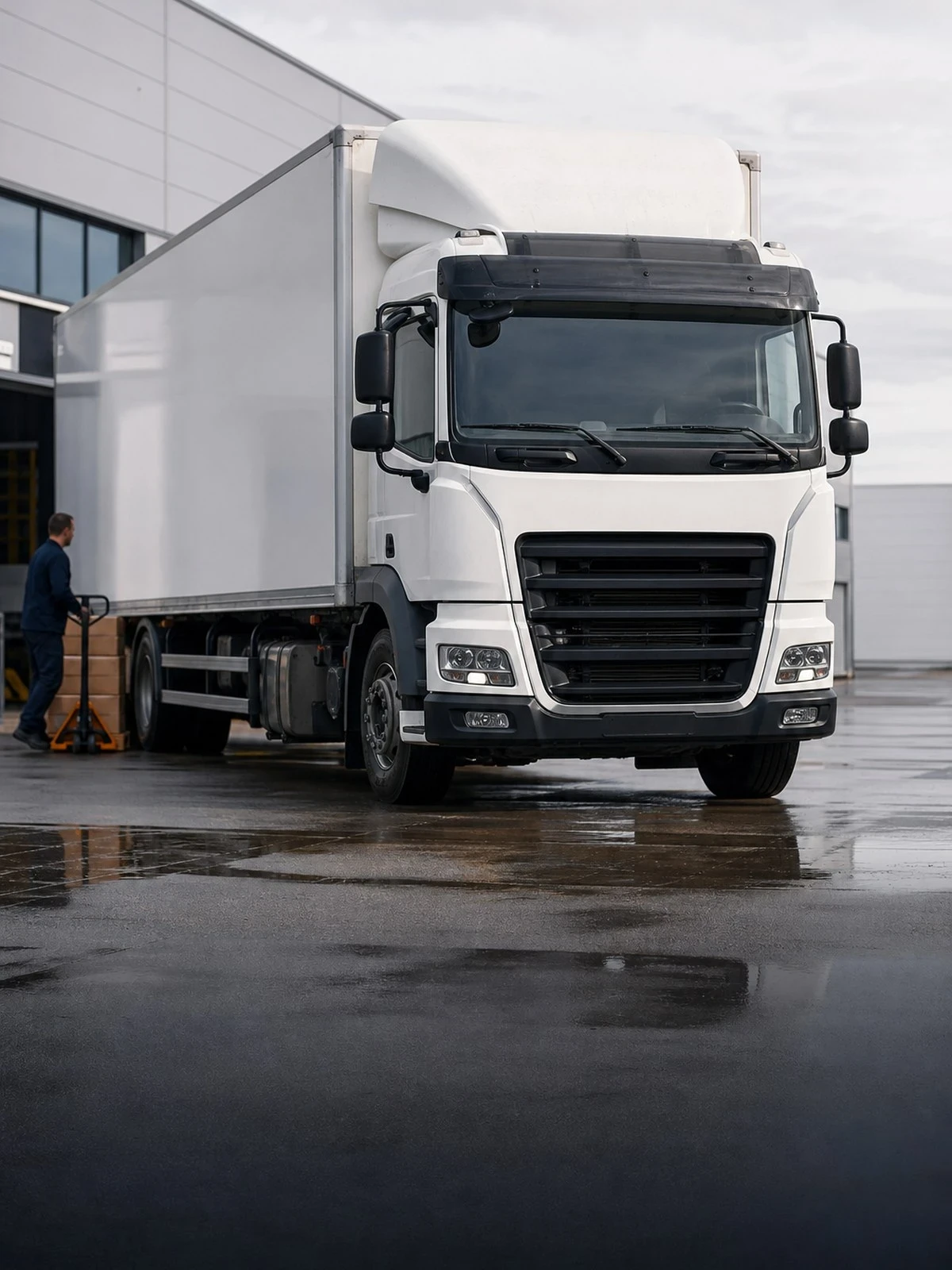
With a rigid lorry you buy a chassis cab and have a body fitted to it. The insurer knows only that chassis, unless you declare the bodywork and the tail lift yourself.
This page in another language: Nederlands · Deutsch
Work out for yourself what it would cost.
Enter your details; you will receive a proposal within one working day.
A premium indication, not personal advice. Prefer to talk it through? Call 072 - 509 24 56.
A rigid lorry is one motorised vehicle with a fixed body, and that makes it something different from a tractor unit with swap loads in insurance terms. The list price the insurer takes from the registration data is usually the value of the chassis with cab. The body, the refrigeration unit, the tail lift and any lorry-mounted crane have been built onto it by a bodybuilder and are not included in that amount. If you do not declare them separately, you only find out at the point of total loss.
The second feature specific to a rigid lorry is the tail lift. That is not an accessory but a work appliance that must be inspected periodically. If someone goes under it or an employee is trapped during loading, you do not end up at the motor insurance but at employer's liability under Article 7:658 of the Dutch Civil Code. If the inspection certificate is missing, the duty of care is hard to defend.
Also, the load in the body falls outside every vehicle cover. If you carry your own goods, that belongs with transport of your own goodscover. If you carry for third parties, carriers' liability applies, with the per-kilogram limits from the AVC conditions or CMR.
We compare your truck insurance across dozens of insurers, explain where the real differences lie, and arrange the switch from start to finish — without you having to chase it yourself.
 Truck insurance
 Compare
 Get covered
The structure of the cover in three parts, with an overview per situation below.
Damage, theft, fire and storm, on the road and in storage.
What is fitted on or to it and is not in the list price.
What you carry falls outside every vehicle policy.
What is covered
| Situation | Car insurance | Your own policy |
|---|---|---|
| Liability while driving, coupled | Yes | No |
| Damage to the object itself | No | Yes |
| Theft while uncoupled on the site | No | Sometimes |
| Overturning while driving | No | Yes |
| The load you carry | No | No |
| Overloading or inadequate securing | No | No |
This overview is general in nature and is not personal advice. What is actually covered, including exclusions, limits and the excess, is set out in the policy conditions and the insurance card (verzekeringskaart) of the insurer; you receive both before you take out cover. Taking out cover without advice? Then read what execution only means for you.
Insurers weigh these details differently. That is where your saving is.
We look at the terms as well as the premium, and stay your point of contact when there is a claim.
We are not tied to one insurer and compare on the basis of an objective analysis of several companies.
You call or email someone who knows your file. No menu options, no changing call centres.
We cancel your old policy and align the start date, so you are never a day without cover.
We report the claim and monitor how it is handled. In urgent cases you can reach us on the emergency line.
Customers rate our service on four aspects: personal service, service delivery, availability and the outcome. The reviews are collected and published by NH1816 and come from customers who have actually taken out a policy with Finass Advies B.V. or reported a claim.
Four points that make the difference between a policy that pays out and one that does not.
A box body, a refrigeration unit, a curtainsider or a tilt body is fitted after the chassis is delivered. Its value appears on a separate invoice and must be provided when you take out the policy, including the tail lift and any crane. If you do not do that, in the event of a total loss or fire the insurer will cover only the bare chassis with cab, while the body often represents a large part of the replacement value.
A hydraulic tail lift falls under the inspection requirement for lifting equipment. Where an employee is injured during loading or unloading, an insurer will check whether the inspection record is up to date and whether instruction has been given. Without those documents your position is weak under Article 7:658 of the Dutch Civil Code, where the burden of proof lies with the employer. Note too that damage caused by poor maintenance or wear of the lift itself is excluded from the own-damage cover.
Rigid lorries travel at a fixed height that the driver cannot see. Collisions with a viaduct, a car park beam or a canopy at a loading dock are the most common own-damage claim on this type of vehicle. That damage is covered under comprehensive cover, but the consequential damage to the customer's building runs through your liability cover and not through the third-party liability cover on the vehicle. Display the vehicle's height clearly in the cab.
Three exclusions recur as standard. The cargo in the body, whether it belongs to you or to a customer. Damage caused by overloading or incorrect weight distribution across the axles, including where the lorry itself is damaged as a result. And damage to third-party property that you had in your care during loading and unloading, the so-called care, custody and control situation, which in most liability insurance must be arranged separately.
A heavier trailer has its own registration number. Also check that the driving licence is adequate for the combination.
As long as the item is coupled, liability runs through the towing vehicle. Once uncoupled that no longer applies, and damage to the item itself was never covered in any case. Insurers therefore require an approved coupling lock and a declared storage location. For higher values, a tracker as well.
This is what people ask us most.
No. The insurer works from the details of the chassis with cab as registered with the RDW (the Dutch vehicle authority). The body, refrigeration, tail lift and crane were built onto it later and appear on a separate invoice from the bodybuilder. Provide those amounts when you take out the policy, otherwise only the bare vehicle will be covered in the event of a total loss.
Only where it counts as traffic-related injury under the third-party liability cover, and during loading and unloading on your own premises that is usually not the case. If an employee is injured, employer's liability under Article 7:658 of the Dutch Civil Code comes into play. The insurer will then look at the inspection of the lift, instruction and supervision. Separate public and employers' liability insurance (AVB) is the appropriate route for this.
The damage to your own vehicle falls under comprehensive cover, provided you have that cover. The damage to the structure is damage to a third party and in principle runs through the third-party liability cover on the motor vehicle. If it happens at a loading dock on private premises, the road authority or owner can hold you liable under Article 6:162 of the Dutch Civil Code and your business liability cover comes into play.
No, under no vehicle cover. If you carry your own tools or trading stock, you insure that with own-goods transit cover. If you carry goods for clients, carrier's liability applies with a limit per kilogram from the AVC conditions or CMR, and only a goods-in-transit insurance covers the actual value of the consignment.
Every situation is different. For these situations we have a separate page.
Request a quote without obligation. We will look at which insurer best matches your activities and your risk.
Prefer to call? 072 - 509 24 56, weekdays 09:00–17:00.
Claim on the road? Emergency line 06 - 55 20 40 72.
Finass Verzekert is a trading name of Finass Advies B.V. We advise on and arrange non-life insurance on the basis of an objective analysis of several insurers, and receive commission for this from the insurer, which is included in the premium. You pay no separate advice fee. Before you take out cover, we establish your wishes and needs.
You will find our licence, KvK and Kifid details and our complaints procedure at the foot of every page.
This page was compiled by Finass Verzekert (LinkedIn). Last updated on .
The information on this page is general in nature and is not personal advice.
Maandag- Vrijdag: 09:00- 17:00
We use cookies and similar technologies to improve your experience on our website.