

Own-damage cover
- Theft with a coupling lock fitted
- Collision and overturning
- Storm and fire
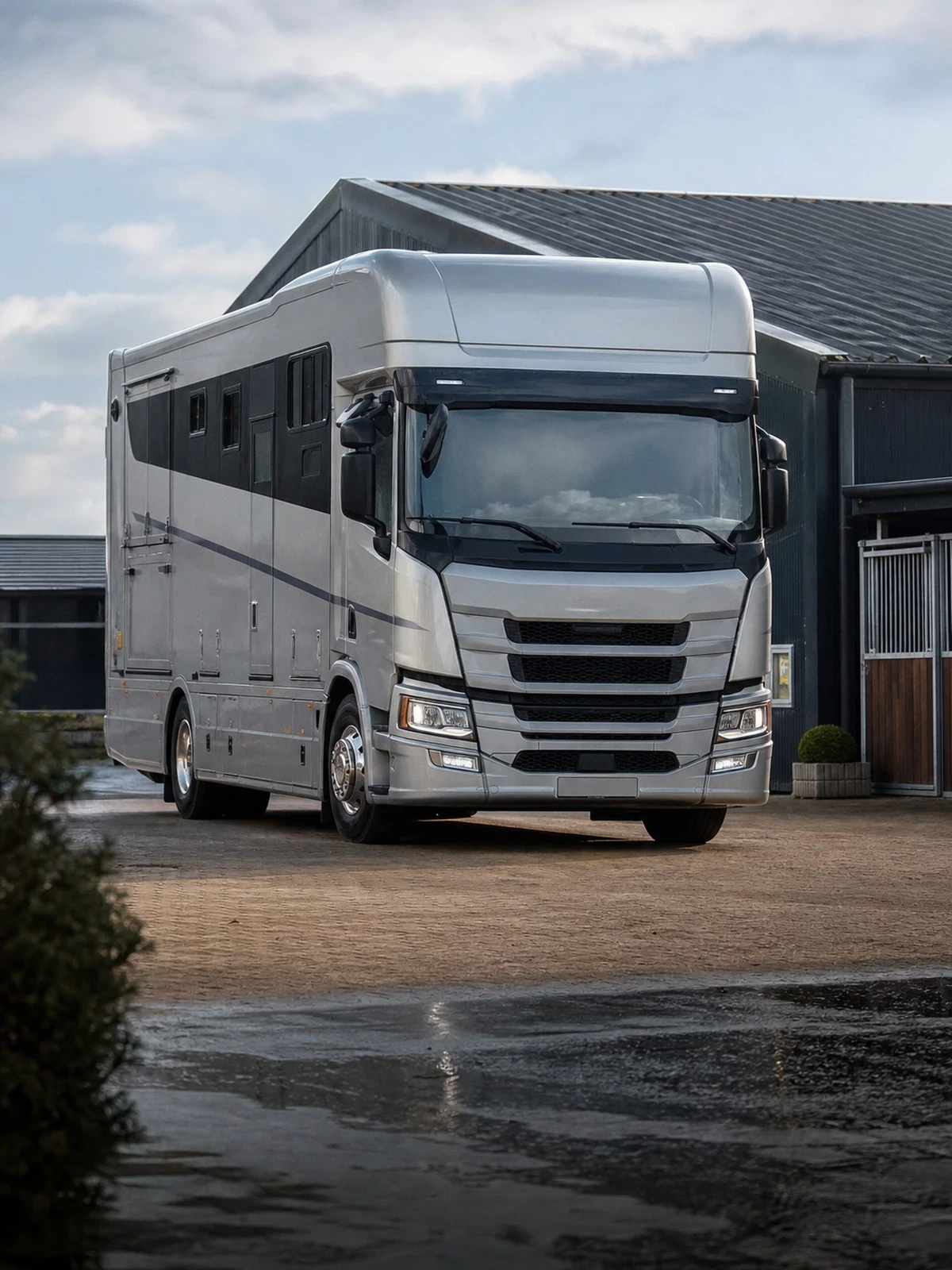
To the insurer, a horsebox lorry is three things at once: a motor vehicle, living accommodation with contents, and a means of transport for live animals.
This page in another language: Nederlands
Work out for yourself what it would cost.
Enter your details; you will receive a proposal within one working day.
A premium indication, not personal advice. Prefer to talk it through? Call 072 - 509 24 56.
Most owners of a horsebox lorry do not drive it every day. The vehicle is in storage for most of the year and goes to competitions and training during the season. That pattern of use calls for a policy that takes the risk while stationary seriously: fire in storage, damage caused by martens, damp in the horse compartment. At the same time the cover must suit the driving itself, where the weight and the licence category determine acceptance.
The second distinctive feature is the living area. The seating and sleeping area, the kitchen, the tack room and their contents do not automatically fall under the vehicle's own-damage cover. Saddles, bridles, rugs and equipment must be declared separately, and many insurers set requirements about locking the tack room and about what is left in the vehicle overnight.
And then the animals. The horse is never covered by the vehicle policy; separate horse insurance exists for that. Your liability does run through the vehicle, though: if a horse breaks loose after an accident and causes damage, you are liable as the keeper under Article 6:179 of the Dutch Civil Code. If you carry other people's horses, a care, custody and control question is added to that.
We compare your truck insurance across dozens of insurers, explain where the real differences lie, and arrange the switch from start to finish — without you having to chase it yourself.
 Truck insurance
 Compare
 Get covered
The structure of the cover in three parts, with an overview per situation below.
Damage, theft, fire and storm, on the road and in storage.
What is fitted on or to it and is not in the list price.
What you carry falls outside every vehicle policy.
What is covered
| Situation | Car insurance | Your own policy |
|---|---|---|
| Liability while driving, coupled | Yes | No |
| Damage to the object itself | No | Yes |
| Theft while uncoupled on the site | No | Sometimes |
| Overturning while driving | No | Yes |
| The load you carry | No | No |
| Overloading or inadequate securing | No | No |
This overview is general in nature and is not personal advice. What is actually covered, including exclusions, limits and the excess, is set out in the policy conditions and the insurance card (verzekeringskaart) of the insurer; you receive both before you take out cover. Taking out cover without advice? Then read what execution only means for you.
Insurers weigh these details differently. That is where your saving is.
We look at the terms as well as the premium, and stay your point of contact when there is a claim.
We are not tied to one insurer and compare on the basis of an objective analysis of several companies.
You call or email someone who knows your file. No menu options, no changing call centres.
We cancel your old policy and align the start date, so you are never a day without cover.
We report the claim and monitor how it is handled. In urgent cases you can reach us on the emergency line.
Customers rate our service on four aspects: personal service, service delivery, availability and the outcome. The reviews are collected and published by NH1816 and come from customers who have actually taken out a policy with Finass Advies B.V. or reported a claim.
Four points that make the difference between a policy that pays out and one that does not.
A horsebox lorry is fitted out by a coachbuilder with living space, a kitchen, washing facilities and a tack room. That fit-out and the belongings in it are not in the registration data and therefore not in the standard sum insured. Declare the fit-out value and the contents separately, and note the condition many insurers impose: saddles and tack are only covered against theft if the tack room was actually locked and the vehicle was at the location declared.
If the vehicle is involved in an accident and a horse gets loose on the carriageway, further damage is a real scenario. As the keeper of the animal you are liable under Article 6:179 of the Dutch Civil Code, even without fault on your part. That liability does not run through the own-damage cover but through liability insurance. Check whether your policy covers the keeping of horses. For commercial use, private cover is not sufficient.
Below 3,500 kilograms you may drive on a category B licence; above that a C1 or C licence is needed. Insurers check that, and driving without the required entitlement is a strict exclusion. Just as important is that the unladen weight of a fitted-out vehicle with living accommodation is high, which quickly leaves little payload for two horses plus tack. If you exceed the permitted mass, damage arising from that falls outside the cover.
Three things are structurally excluded. The horse itself, including injury or death during transport. That is a matter for horse insurance. Third-party horses that you carry for payment, because you are then in the sphere of care, custody and control, and commercial animal transport is often excluded altogether. And damage caused by inadequate securing or by not using the partition bars, in which case both the damage to the compartment and the further damage remain at your own expense.
A heavier trailer has its own registration number. Also check that the driving licence is adequate for the combination.
As long as the item is coupled, liability runs through the towing vehicle. Once uncoupled that no longer applies, and damage to the item itself was never covered in any case. Insurers therefore require an approved coupling lock and a declared storage location. For higher values, a tracker as well.
This is what people ask us most.
No. A vehicle policy covers the vehicle and the body, not live animals. You insure injury to or death of your horse during transport with horse insurance that provides accident or life cover. The associated damage to the horse compartment can fall under the own-damage cover, if the cause is a covered event such as a collision.
Only if the maximum authorised mass does not exceed 3,500 kilograms. Because of the fit-out with living accommodation, the unladen weight of such a vehicle is high, which leaves little remaining payload for two horses with tack. If you drive something heavier than your licence permits, that is an exclusion on virtually every policy and the own-damage cover lapses in the event of a claim.
Only if you have declared the contents of the tack room separately and the insurer has included a limit for them. That usually comes with the condition that the tack room was locked and the vehicle was at the storage location declared. If expensive equipment is left in the vehicle overnight at a competition ground, a lower limit or no cover often applies.
That changes the risk fundamentally. You then have someone else's animals in your care, and the usual care, custody and control clause excludes damage to such property. Also, many insurers regard commercial animal transport as a different form of use that must be reported in advance. If you do not report it, that affects the duty of disclosure and the insurer can reduce the payment.
Every situation is different. For these situations we have a separate page.
Request a quote without obligation. We will look at which insurer best matches your activities and your risk.
Prefer to call? 072 - 509 24 56, weekdays 09:00–17:00.
Claim on the road? Emergency line 06 - 55 20 40 72.
Finass Verzekert is a trading name of Finass Advies B.V. We advise on and arrange non-life insurance on the basis of an objective analysis of several insurers, and receive commission for this from the insurer, which is included in the premium. You pay no separate advice fee. Before you take out cover, we establish your wishes and needs.
You will find our licence, KvK and Kifid details and our complaints procedure at the foot of every page.
This page was compiled by Finass Verzekert (LinkedIn). Last updated on .
The information on this page is general in nature and is not personal advice.
Maandag- Vrijdag: 09:00- 17:00
We use cookies and similar technologies to improve your experience on our website.