

Third-party liability
- Damage to property and injury to third parties
- No cover for your own vehicle
- Compulsory under Article 2 of the Dutch Motor Insurance Liability Act (WAM)
- Applies as long as the registration has not been suspended
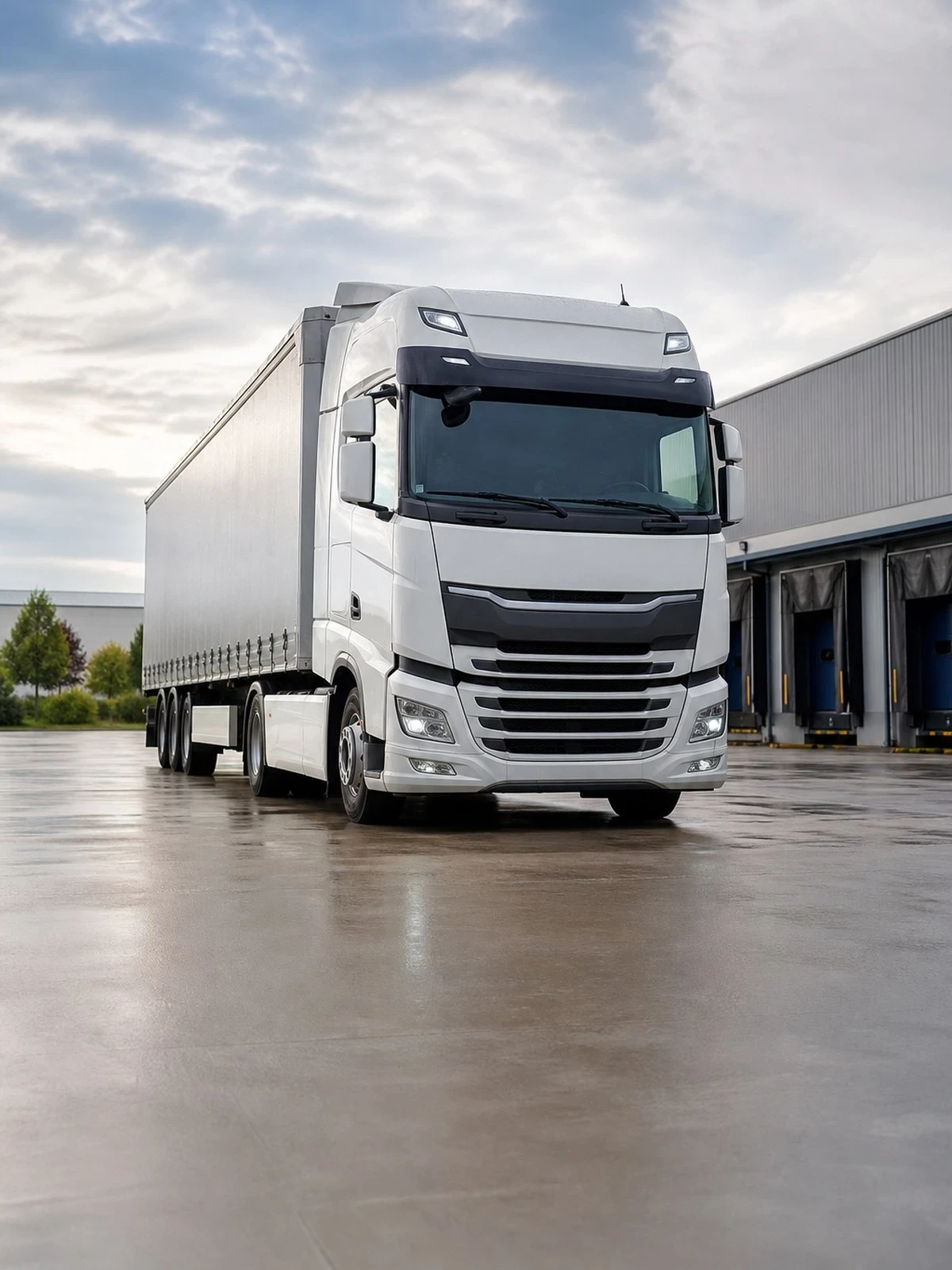
Insuring a truck is rarely a single policy. There are three forms of cover on the vehicle and, alongside them, a range of covers for the load, the semi-trailer, the driver and liability.
This page in another language: Nederlands
Work out for yourself what it would cost.
Enter your details; you will receive a proposal within one working day.
A premium indication, not personal advice. Prefer to talk it through? Call 072 - 509 24 56.
Anyone looking for truck insurance soon comes across a series of terms: third-party liability, third-party fire and theft, comprehensive, own-account transport, goods in transit, carrier's liability, plant and machinery and driver covers. Those terms belong to three different types of risk: damage to others, damage to the vehicle itself, and damage to or caused by the load. They rarely fall under one policy.
The basis is always the same. Third-party liability cover is compulsory under Article 2 of the Dutch Motor Insurance Liability Act (WAM) and covers only damage you cause to someone else with the vehicle. Damage to your own truck falls under own-damage cover, in the form of third-party, fire and theft or comprehensive cover. Around that you build the covers that suit your use: a hobby driver needs different additions from a transport business or a self-employed driver.
The most common misunderstanding concerns the load. The load almost never falls under the own-damage cover on the vehicle. If you carry your own goods, own-goods transit insurance goes with that. If you carry third-party goods for payment, it is a matter of carrier's liability, with the AVC conditions as the framework domestically and the CMR Convention internationally.
We compare your truck insurance across dozens of insurers, explain where the real differences lie, and arrange the switch from start to finish — without you having to chase it yourself.
 Truck insurance
 Compare
 Get covered
These three forms determine what happens to the truck itself. The additions follow after that.
The legally required cover for damage you cause to others with the vehicle.
Alongside third-party liability, a fixed list of events named in the policy.
Also damage to your own vehicle through your own doing or with no other party involved.
What is covered
| Situation | Third-party liability | Comprehensive |
|---|---|---|
| Damage you cause to someone else with the lorry | Yes | Yes |
| Fire or theft of the lorry | No | Yes |
| Damage to your own vehicle after a single-vehicle collision | No | Yes |
| Loss of or damage to the load carried | No | No |
| Damage to a coupled trailer or semi-trailer | Provided that | Provided that |
| Injury to the employed driver | No | No |
What is actually covered, including exclusions, limits and the excess, is set out in the policy conditions and the insurance card (verzekeringskaart) that you receive before you take out cover.
Insurers weigh these details differently. That is where your saving is.
We look at the terms as well as the premium, and stay your point of contact when there is a claim.
We are not tied to one insurer and compare on the basis of an objective analysis of several companies.
You call or email someone who knows your file. No menu options, no changing call centres.
We cancel your old policy and align the start date, so you are never a day without cover.
We report the claim and monitor how it is handled. In urgent cases you can reach us on the emergency line.
Customers rate our service on four aspects: personal service, service delivery, availability and the outcome. The reviews are collected and published by NH1816 and come from customers who have actually taken out a policy with Finass Advies B.V. or reported a claim.
Four groups of cover that come into play with a truck as soon as you look beyond the vehicle.
This is where the main dividing line runs. If you carry your own property — materials, machinery, stock belonging to your own business — you insure it with own-goods transit insurance. Do you carry third-party goods carried for payment, you are a carrier and it is a matter of your liability as a carrier. Domestically, reference is usually made to the AVC conditions; internationally the CMR Convention applies, which limits liability per kilogram. Goods-in-transit insurance covers the goods themselves; carrier's liability insurance covers what you owe by law or under contract.
For third-party liability cover, a coupled trailer or semi-trailer usually falls under the towing vehicle as long as it is attached. For own damage to the semi-trailer itself that is not the case: it needs its own cover, with its own value on the policy. The same applies to a demountable body, a refrigeration unit, a tail lift or a crane. State them separately in the application, because an insurer only covers what is described on the policy.
The WAM cover protects third parties, not the driver. There are separate solutions for injury to the driver: a occupants' accident insurance or a personal accident insurance. If you work with employed drivers, employer's liability also comes into play: under Article 7:658 of the Dutch Civil Code and the duty of care of Article 7:611 of the Dutch Civil Code, an employer is expected to arrange proper insurance for employees who take part in traffic in the course of their work. WEGAS and WEGAM covers exist for that.
Some risks remain outside all the covers mentioned. Wear, corrosion and mechanical defects are not an external event and are not covered; at most a separate warranty or machinery breakdown cover exists for those. Damage caused by incorrect loading, stowing or securing of the load is regularly excluded or limited. Overloading, driving without the required licence and driving under the influence lead to loss of own-damage cover and to recovery in the event of a third-party liability claim. Intent and recklessness are excluded under Article 7:952 of the Dutch Civil Code.
This is what people ask us most.
Only the third-party liability cover. Article 2 of the WAM requires the registered keeper of every motor vehicle to have liability insurance, including for a truck that is rarely driven. The requirement is linked to the registration and not to the use. It only lapses once the registration is suspended. Own-damage cover, load cover and driver covers are voluntary, but are often required by clients under contract.
No. The own-damage cover concerns the vehicle and not what is in or on it. For your own goods you choose own-goods transit insurance. If you carry third-party goods for payment, it is a matter of your liability as a carrier, for which the AVC conditions form the framework domestically and the CMR Convention internationally. Without that separate cover you bear the load risk yourself.
With own-account transport you move goods belonging to your own business, for instance materials to a building site. With carriage for hire and reward you carry other people's goods for payment. That distinction determines not only which insurance is appropriate, but also whether you need a licence and which liability rules apply. Insurers always ask the question. An incorrect answer affects the cover.
For statutory liability it usually does, as long as the semi-trailer is coupled. For own damage to the semi-trailer itself it does not: that needs its own cover and its own sum insured. An uncoupled semi-trailer that causes damage also often falls outside the tractor unit's cover. Have it recorded in the policy which semi-trailers and trailers are covered.
Yes. A private or hobby owner usually needs no more than third-party liability with own-damage cover on a valued amount, and pays particular attention to storage and mileage. A transport business also needs load cover, carrier's liability, covers for drivers and often business interruption cover. The basis for the premium differs too: hobby use involves limited mileage, carriage for hire and reward does not.
Every situation is different. For these situations we have a separate page.
Request a quote without obligation; together we determine which covers you need and which you can do without.
Prefer to call? 072 - 509 24 56, weekdays 09:00–17:00.
Claim on the road? Emergency line 06 - 55 20 40 72.
Finass Verzekert is a trading name of Finass Advies B.V. We advise on and arrange non-life insurance on the basis of an objective analysis of several insurers, and receive commission for this from the insurer, which is included in the premium. You pay no separate advice fee. Before you take out cover, we establish your wishes and needs.
You will find our licence, KvK and Kifid details and our complaints procedure at the foot of every page.
This page was compiled by Finass Verzekert (LinkedIn). Last updated on .
The information on this page is general in nature and is not personal advice.
Maandag- Vrijdag: 09:00- 17:00
We use cookies and similar technologies to improve your experience on our website.