

Insuring a self-employed professional's motorcycle
For the duty to insure it makes no difference whether you ride for business or privately. For your policy it does, and the biggest gap is not in the machine but in you.
- Several insurers compared objectively
- 9.5 customer rating for a new policy
- AFM licence 12016589
- Personal 072 - 509 24 56, weekdays 9–17
This page in another language: Nederlands
Work out for yourself what it would cost.
Enter your details; you will receive a proposal within one working day.
- We compare the offerings of several insurers
- An adviser checks whether the cover suits your activities
- We arrange the switch, including cancellation
A premium indication, not personal advice. Prefer to talk it through? Call 072 - 509 24 56.
- Independent advice
- Several insurers
- Switching arranged
- Help with claims
In brief
Article 2 of the Dutch Motor Insurance Liability Act (WAM) requires you to have liability cover for as long as the registration is in your name and has not been suspended; winter storage makes no difference to that. Above it you choose third-party, fire and theft or comprehensive. How those forms of cover are built up, and the usual valuation bases, are set out on the page motorcycle insurance, and the version in a company's name under the business motorcycle insurance.
What sets a self-employed professional apart is the description of use. If you ride only in your free time, a private policy is appropriate. If you use the machine to visit clients, collect materials or move between sites, that is business use and belongs on the application. Delivery for payment is a third category and falls outside the cover under virtually every ordinary motorcycle policy. An incorrect declaration engages Article 7:928 of the Dutch Civil Code and can, through Article 7:930 of the Dutch Civil Code, lead to a reduced payment or none at all.
The point self-employed professionals most often overlook is that they are not insured themselves. Third-party liability cover pays the other party's loss. If you come off with no other party involved, there is no employer with a duty of care under Article 7:658 of the Dutch Civil Code who is liable, and no liability insurance covering your own injury. Anyone who rides to earn their turnover arranges that through a personal accident insurance or a disability insurance.
This page deals with one situation. The full overview is on Compare motorcycle insurance.
Independent, personal, sorted quickly
We compare your motorcycle insurance across dozens of insurers, explain where the real differences lie, and arrange the switch from start to finish — without you having to chase it yourself.
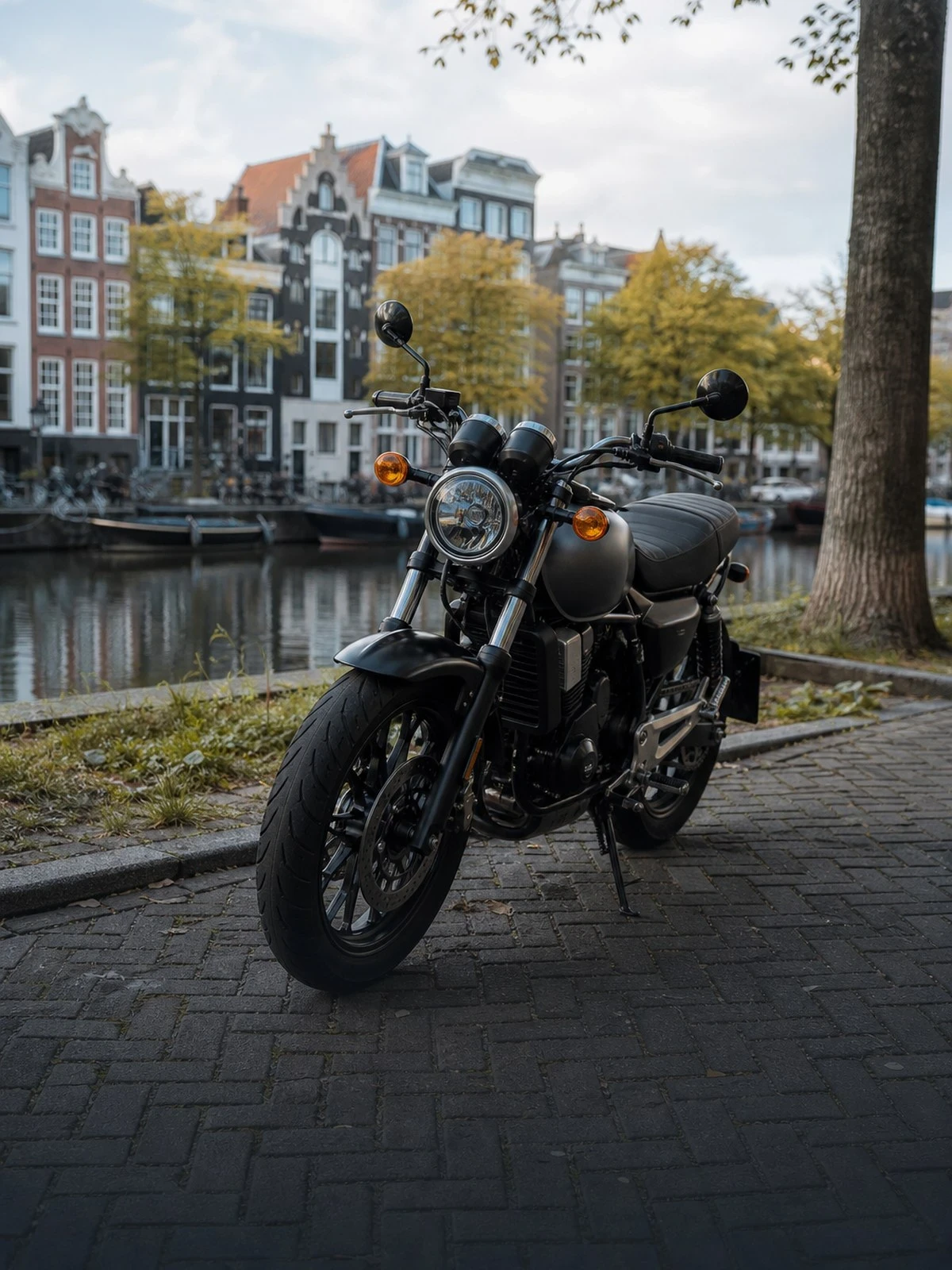 Motorcycle insurance
 Compare
 Get covered
Why arrange it through Finass Verzekert?
We look at the terms as well as the premium, and stay your point of contact when there is a claim.
Independent
We are not tied to one insurer and compare on the basis of an objective analysis of several companies.
One fixed adviser
You call or email someone who knows your file. No menu options, no changing call centres.
Switching without hassle
We cancel your old policy and align the start date, so you are never a day without cover.
Help with claims
We report the claim and monitor how it is handled. In urgent cases you can reach us on the emergency line.
What to look out for
Four points that weigh more heavily on a self-employed professional's machine than the list price does.
Business use belongs on the application
Commuting, client visits and trips between projects are not private kilometres. Most companies accept it without objection, provided it has been reported. It affects the description of use and the mileage. If you register the machine to the business, the valuation arrangement also changes, as does the question of who else may ride it.
As rider you are outside the cover yourself
A single-vehicle accident with no liable other party yields nothing under a third-party liability or own-damage policy for your injury or your loss of income. For a motorcyclist there is no broad occupant cover as there is on a car. So discuss in advance which part you want to meet through accident or disability cover.
Storage and security are not a formality
Theft cover stands or falls on the prevention condition: an approved lock, an alarm of the required class and storage in a locked space at the address declared. If the machine regularly stands on the street or at an address other than the one declared, report it. If the requirement is not complied with, a theft claim is in general not covered.
Clothing, panniers and accessories
Helmet, suit, gloves and luggage do not automatically fall under the own-damage cover. A separate sub-limit or an exclusion often applies. The same goes for pannier sets, fairing panels, exhaust and satnav fitted afterwards. Have it stated what is included and keep the purchase receipts.
What does your premium depend on?
- Engine capacity and power: together with the list price, the basis of the premium
- Age and riding experience of the rider: how long you have held the category A licence and which no-claims years you bring with you
- Description of use and mileage: private, business or seasonal only
- Type of cover and excess: third-party liability, third-party, fire and theft or comprehensive with the corresponding valuation basis
- Storage address and security: lock class, alarm and whether the machine is kept indoors
- Accessories covered: clothing, panniers and parts fitted afterwards
Insurers weigh these details differently. That is where your saving is.
What is covered on your machine
| Situation | Third-party liability | Comprehensive |
|---|---|---|
| You slide out on an oil patch and damage your machine | No | Yes |
| Your motorcycle clothing and helmet are damaged beyond repair in that same fall | No | Provided that |
| You catch the mirror of a car beside you as you pull away | Yes | Yes |
| Your motorcycle is stolen from a locked garage | No | Yes |
| You sustain damage during circuit training | No | No |
| The frame shows rust after the machine has stood outside all winter | No | No |
Riding off the public road, such as on a circuit, falls outside the cover as standard.
Frequently asked questions
This is what people ask us most.
Am I better off putting the machine on the business or in private ownership?
That is first a tax consideration and only then an insurance question. For the policy, what counts above all is the use: if you ride it for business, that has to be declared, whoever the registered keeper is. If the machine is owned by the business, a business valuation basis is more often used and the insurer looks more closely at who else rides it.
Am I insured if I ride the machine to a client?
Yes, provided business use appears on the policy. If it shows private use only, the insurer can fall back on the duty of disclosure in Article 7:928 of the Dutch Civil Code when a claim is made. Third-party liability cover stands up towards an injured third party, because the WAM provides that protection, but the insurer can then recover the payment from you.
Does my public and employers' liability insurance cover damage involving the machine?
No. A public and employers' liability insurance excludes damage caused with or by a motor vehicle as standard. That is precisely what the compulsory third-party liability cover exists for. Only in special situations, such as loading and unloading, do some policies provide a limited fallback. Do not assume it is there.
I am thinking of doing meal or parcel delivery with it. Is that possible?
Not on an ordinary motorcycle policy. Carriage of goods or persons for hire or reward is an excluded use and calls for separate underwriting or a different type of policy. If you take up that activity, report it before the first run; reporting afterwards no longer helps if something happens in the meantime.
Every situation is different. For these situations we have a separate page.
- Compare motorcycle insuranceThe main page
- Insuring a motorcycle registered to the companyGroup of riders, employers' liability, cancellation statement
- Business motorcycle insuranceRegistered keeper, changing riders, employer's risk
- Choosing motorcycle insurance that suits your motorcycleForm of cover, licence category, modifications
- Insuring a motorcycle for business use: purpose of use and securityUse, delivery, riders
- The cover provided by motorcycle insuranceThird-party, third-party, fire and theft, comprehensive
- Insuring your motorcycleThird-party liability compulsory, own-damage cover, theft protection
- Insuring a BMW MotorradR, S and F series, accessories, theft protection