

Third-party liability
- Damage to property and injury to third parties
- No cover for your own vehicle
- Compulsory under Article 2 of the Dutch Motor Insurance Liability Act (WAM)
- No cover for the load
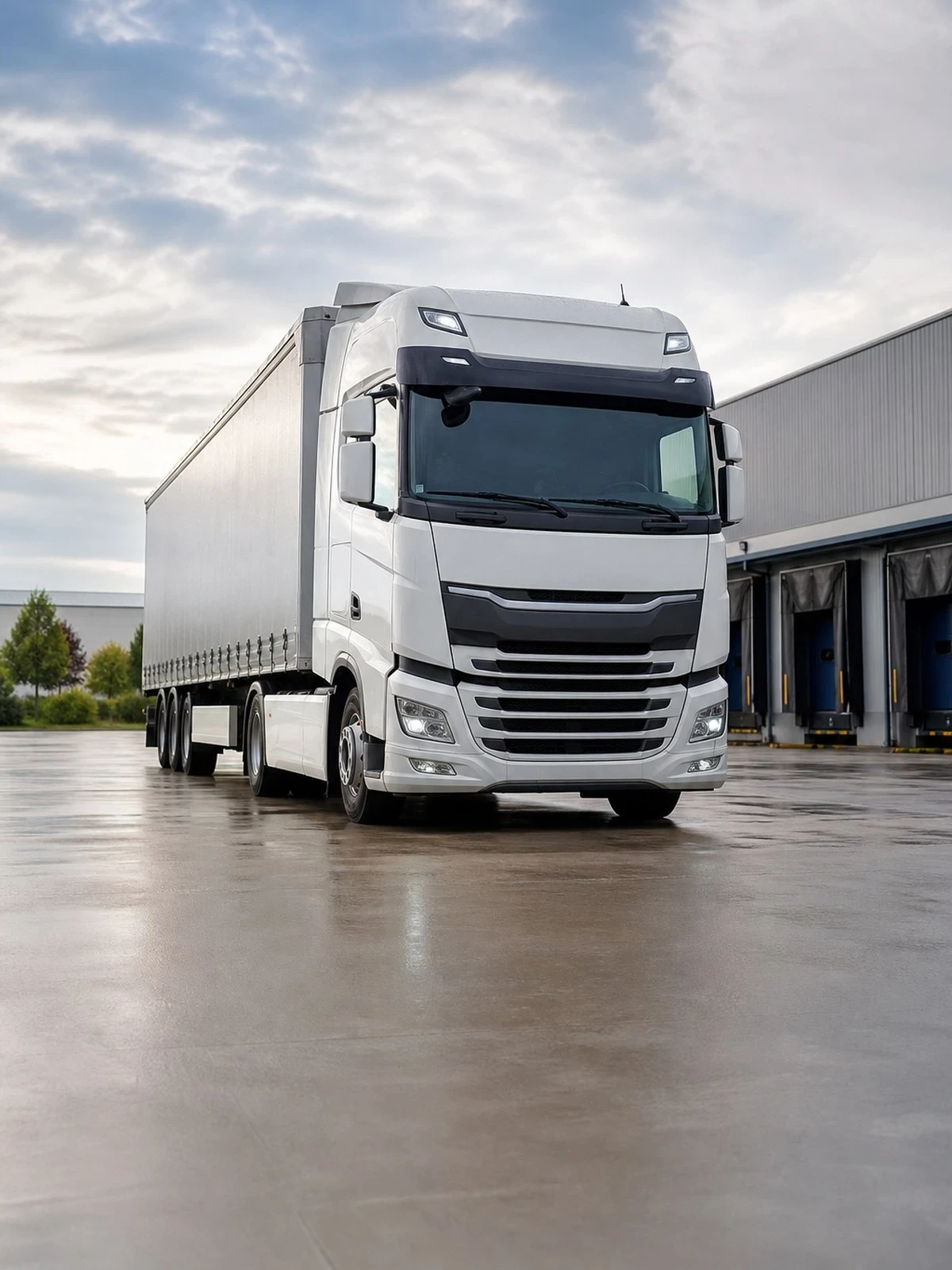
As a self-employed professional (zzp'er) with a truck, the vehicle is what you earn from. That makes not only the own-damage cover important, but also the question of who carries the load risk and what happens if you are off the road.
This page in another language: Nederlands
Work out for yourself what it would cost.
Enter your details; you will receive a proposal within one working day.
A premium indication, not personal advice. Prefer to talk it through? Call 072 - 509 24 56.
For a self-employed professional with a truck, the first question is what kind of transport you do. If you move your own property — machinery, materials or stock belonging to your own business — that is own goods in transit. Do you carry third-party goods carried for payment, for instance as a charter haulier for a transport company, you are a carrier for hire and reward. That distinction determines the licensing requirement, the liability rules and the structure of your insurance package.
The vehicle cover is built up in the same way in both cases: Third-party liability insurance is compulsory under Article 2 of the Dutch Motor Insurance Liability Act (WAM), and above that you choose third-party, fire and theft or comprehensive cover. What differs is everything around the vehicle. As a carrier for hire and reward you have to deal with carriers' liability, domestically usually under the AVC conditions and internationally under the CMR Convention, which limits liability per kilogram.
The misunderstanding that costs self-employed professionals most is about the load. The load does not fall under motor own-damage insurance. If you damage or lose a client's goods, the claim goes through your carrier's liability. If they are your own goods, it goes through own-goods transit insurance. It is not on the truck policy, however extensive the cover there may be.
We compare your truck insurance across dozens of insurers, explain where the real differences lie, and arrange the switch from start to finish — without you having to chase it yourself.
 Truck insurance
 Compare
 Get covered
Three forms of cover on the vehicle, with situations that arise in day-to-day work set out beneath them.
The legally required cover for damage you cause to others with the lorry.
On top of that to third-party liability, a fixed list of events, including fire and theft.
Damage to your own vehicle as well, often with a replacement vehicle as an addition.
What is covered
| Situation | Third-party liability | Comprehensive |
|---|---|---|
| Damage you cause to someone else with the lorry | Yes | Yes |
| Fire or theft of the lorry | No | Yes |
| Damage to your own vehicle while loading or manoeuvring | No | Yes |
| Damage to a client's load | No | No |
| Loss of turnover because you are off the road | No | Provided that |
| Injury to yourself as the driver | No | No |
What is actually covered, including exclusions, limits and the excess, is set out in the policy conditions and the insurance card (verzekeringskaart) that you receive before you take out cover.
Insurers weigh these details differently. That is where your saving is.
We look at the terms as well as the premium, and stay your point of contact when there is a claim.
We are not tied to one insurer and compare on the basis of an objective analysis of several companies.
You call or email someone who knows your file. No menu options, no changing call centres.
We cancel your old policy and align the start date, so you are never a day without cover.
We report the claim and monitor how it is handled. In urgent cases you can reach us on the emergency line.
Customers rate our service on four aspects: personal service, service delivery, availability and the outcome. The reviews are collected and published by NH1816 and come from customers who have actually taken out a policy with Finass Advies B.V. or reported a claim.
Four points that determine whether your package really holds together when you claim.
If you drive only with your own property, own-goods transit insurance alongside the vehicle cover is usually sufficient. If you carry third-party goods carried for payment, you are a carrier and different rules apply: for domestic road transport, reference is made in practice to the AVC conditions, and for cross-border road transport the CMR Convention applies, with liability limited per kilogram of damaged or lost cargo. For commercial carriage of goods with heavy vehicles a licence is also required. State exactly what you do with your application. An incorrect statement affects the cover.
An own-damage claim is manageable, but the real loss lies in the days you do not drive. So look at additions that cover the income risk: replacement transport following a covered claim, and for longer periods off the road a business interruption or downtime arrangement. If you yourself are off work through illness or an accident, no vehicle cover helps; disability insurance (AOV) and accident insurance exist for that. Without those two, your turnover depends on your own health.
Charter agreements often contain provisions about insurance cover: a minimum sum insured for carrier's liability, public and employers' liability insurance, or additional requirements for carrying valuable or dangerous goods. A client can also place liability on you under contract that goes beyond the statutory limits. Uninsured contractual liability is a well-known pitfall: insurers regularly exclude liability that arises solely from a contract. Compare the contract with your policy in advance.
The following, among others, are outside the cover: the load itself on the own-damage policy; damage caused by incorrect loading, stowing or securing, which many policies exclude or limit; overloading and damage while the vehicle is used as a piece of equipment, for instance during lifting work with a lorry-mounted crane without plant and machinery cover; and wear and tear and mechanical faults without an external event. Driving without the required licence or without the required professional competence, driving under the influence and damage caused by intent or recklessness are excluded. The last of these follows from Article 7:952 of the Dutch Civil Code. Report claims in good time under Article 7:941 of the Dutch Civil Code.
This is what people ask us most.
No. The own-damage cover applies solely to the vehicle. If you damage or lose a client's goods, they will address you as the carrier. You need carrier's liability insurance for that, aligned with the AVC conditions for domestic transport and with the CMR Convention for international road transport. If you carry your own goods, own-goods transit insurance goes with that.
The CMR Convention governs international road carriage of goods for payment and limits the carrier's liability to an amount per kilogram of damaged or lost cargo. With light but valuable goods that limit often does not cover the actual value. Clients then ask for additional cover or for a declaration of a higher value. Discuss that in advance, because afterwards it can no longer be put right.
The own-damage cover pays for the repair, not for your lost turnover. Some policies offer a replacement vehicle following a covered claim, usually for a maximum number of days. For longer periods off the road there is a business interruption arrangement. If you yourself are off work through illness or an accident, only disability insurance (AOV) or accident insurance helps. The vehicle policy provides no cover for that.
Not under the WAM. That protects third parties to whom you cause damage, not yourself. For your own injury there is occupants' insurance and accident insurance. If you drive with a passenger or colleague, check whether they are covered as an occupant. If you employ staff, employer's liability also comes into play and WEGAS and WEGAM covers become relevant.
No, not without amending the policy. A private policy assumes non-commercial use and excludes carriage for payment and carriage of trading goods. If you do use the vehicle for business, the insurer can rely on the use clause and on Article 7:930 of the Dutch Civil Code when you claim. Report the actual use and have the cover aligned with it.
Often yes. Charter agreements state a minimum sum insured for carrier's liability and sometimes ask for public and employers' liability insurance. Watch out for contractual liability that goes beyond the statutory or treaty limits: that is not always insurable. Compare the contract with your policy conditions before you sign, or have that done.
Every situation is different. For these situations we have a separate page.
Request a quote without obligation. We align the vehicle cover, the load risk and the contractual requirements.
Prefer to call? 072 - 509 24 56, weekdays 09:00–17:00.
Claim on the road? Emergency line 06 - 55 20 40 72.
Finass Verzekert is a trading name of Finass Advies B.V. We advise on and arrange non-life insurance on the basis of an objective analysis of several insurers, and receive commission for this from the insurer, which is included in the premium. You pay no separate advice fee. Before you take out cover, we establish your wishes and needs.
You will find our licence, KvK and Kifid details and our complaints procedure at the foot of every page.
This page was compiled by Finass Verzekert (LinkedIn). Last updated on .
The information on this page is general in nature and is not personal advice.
Maandag- Vrijdag: 09:00- 17:00
We use cookies and similar technologies to improve your experience on our website.