

Liability
- Cables and pipes
- Damage to crops or buildings
- Injury to bystanders
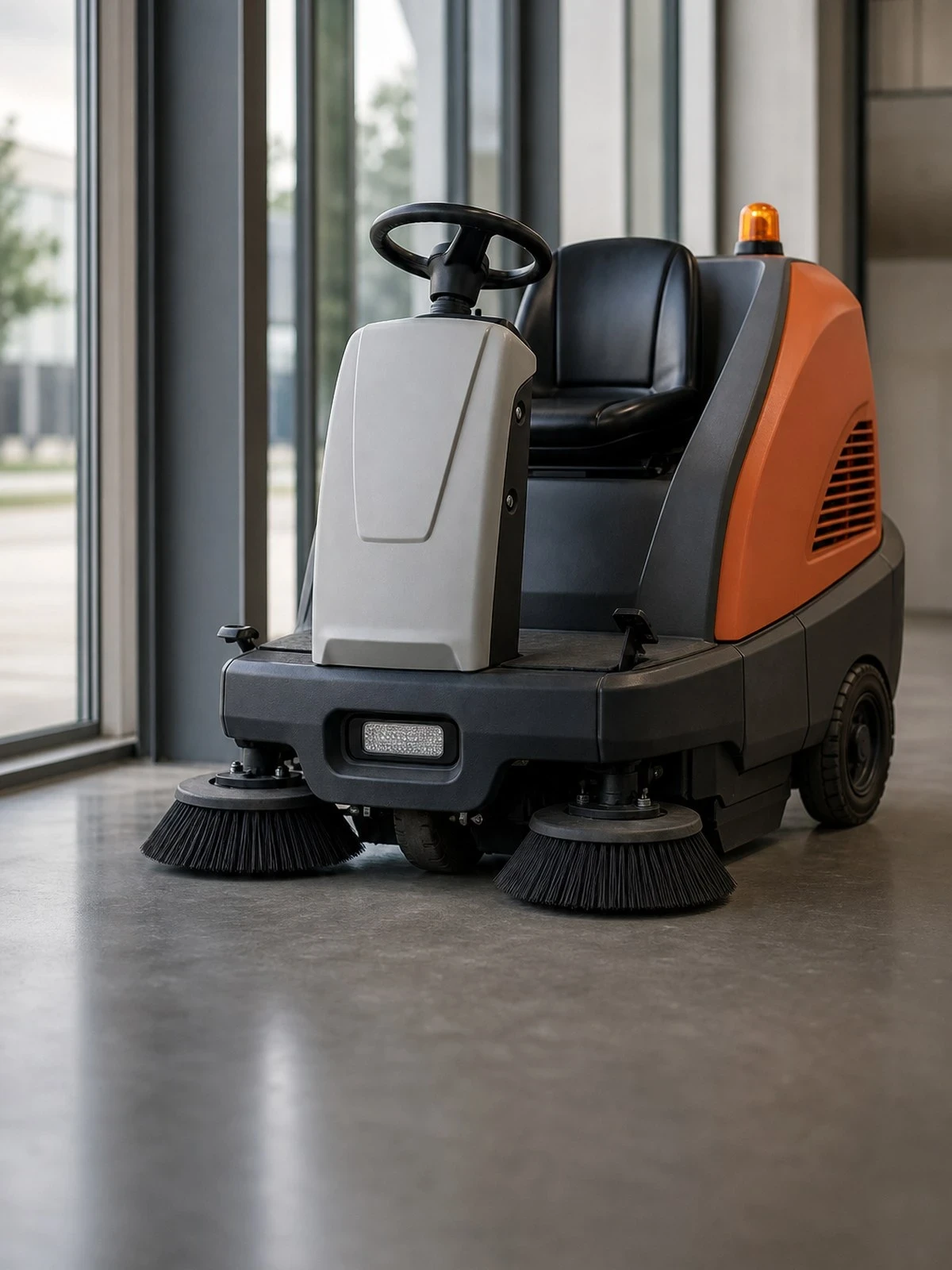
A scrubber dryer leaves a wet floor behind in a space where the public walks, and that slip risk weighs more heavily than all the damage to the machine put together.
This page in another language: Nederlands · Deutsch
Work out for yourself what it would cost.
Enter your details; you will receive a proposal within one working day.
A premium indication, not personal advice. Prefer to talk it through? Call 072 - 509 24 56.
Sweepers and scrubber dryers work in shops, care institutions, sports halls, car parks and on business premises. The machine itself is of limited value; the risk lies in the surroundings in which the work takes place: the public, vulnerable floor finishes and interiors. The policy combines own-damage cover with liability cover tailored to that use.
A fall on a wet floor leads to injury and to a claim under Article 6:162 of the Dutch Civil Code; if the building manager is held liable, Article 6:174 of the Dutch Civil Code also comes into play for the structure. If your employee is working at a customer's premises and causes it, that mistake is attributed to you under Article 6:170 of the Dutch Civil Code.
The second peculiarity is the floor itself. The surface you clean is property in your care: scratches on parquet, an attacked resin floor or dull patches in marble from the wrong product therefore fall in a different section from damage to a shelving unit or a shop window. See also the plant and machinery insurance.
We compare your plant and machinery insurance across dozens of insurers, explain where the real differences lie, and arrange the switch from start to finish — without you having to chase it yourself.
 Plant and machinery insurance
 Compare
 Get covered
The structure of the cover in three parts, with an overview per situation below.
Damage you cause to others with the machine.
Damage, theft and usually inherent defect as well.
What matters besides the machine itself.
What is covered
| Situation | Liability | Own-damage cover |
|---|---|---|
| Damage to crops, buildings or pipes and cables | Yes | No |
| Theft of the machine | No | Sometimes |
| Fire or storm damage | No | Yes |
| Inherent defect or operating error | No | Sometimes |
| Blades, teeth and tyres worn out | No | No |
| Deferred maintenance | No | No |
This overview is general in nature and is not personal advice. What is actually covered, including exclusions, limits and the excess, is set out in the policy conditions and the insurance card (verzekeringskaart) of the insurer; you receive both before you take out cover. Taking out cover without advice? Then read what execution only means for you.
Insurers weigh these details differently. That is where your saving is.
We look at the terms as well as the premium, and stay your point of contact when there is a claim.
We are not tied to one insurer and compare on the basis of an objective analysis of several companies.
You call or email someone who knows your file. No menu options, no changing call centres.
We cancel your old policy and align the start date, so you are never a day without cover.
We report the claim and monitor how it is handled. In urgent cases you can reach us on the emergency line.
Customers rate our service on four aspects: personal service, service delivery, availability and the outcome. The reviews are collected and published by NH1816 and come from customers who have actually taken out a policy with Finass Advies B.V. or reported a claim.
Four points that make the difference between a policy that pays out and one that does not.
Scrubbing in a shop or hospital means that a slippery zone temporarily arises where people walk. If the warning signs are missing or stand too far from the wet zone, the fall is attributable to you. Injury claims are the most expensive type of loss here and run on for a long time. Insurers ask about your working protocol: barriers, signage, working outside opening hours and the use of machines with a squeegee that dries immediately.
An overly aggressive pad on a resin floor, the wrong cleaning product on natural stone or a scrubber dryer on untreated wood leaves permanent damage. That is damage to property in your care, custody and control, and that section is excluded or restricted on most liability policies. Ask the client in writing for the floor specification and the recommended cleaning regime. Without that record you are left empty-handed in a claim.
Ride-on scrubber dryers and compact sweepers hit shelving, glazed frontages, door posts and loading dock edges. That is ordinary damage to a third party's property and covered under liability. It becomes critical where a sprinkler head or pipe in a car park is struck, because water damage then follows over a large area. The business interruption losses of the client that results from it is restricted or excluded altogether on many policies.
Batteries are charged overnight, often in a plant room or a corner of a warehouse; charging fires are a real and well-known cause. Insurers set requirements for the charging place and the use of the original charger. Never covered are brushes, pads, rubbers, squeegees and battery capacity: that is wear. If a sweeper goes onto the public road, the insurance obligation under Article 2 of the Dutch Motor Insurance Liability Act (WAM).
For higher values, insurers require a tracker and agreements on where the machine is kept outside working hours.
Blades, teeth, cutting edges, tracks and tyres are wearing parts and are not insured anywhere; only sudden damage is covered. Deferred maintenance is also a ground for exclusion. A demonstrable maintenance regime with a logbook is therefore not only good management but also strengthens your position in a claim.
This is what people ask us most.
Whoever allowed the slippery situation to arise and gave insufficient warning. If you work to order, you are usually held liable under Article 6:162 of the Dutch Civil Code, and the building manager in addition under Article 6:174 of the Dutch Civil Code. Warning signs that can be shown to have been placed and a recorded working protocol are the defence that in practice makes the difference between sharing the loss and bearing it in full.
Not without an extension. The surface to be cleaned is property in your care and that section is excluded or restricted as standard. Scratches from the wrong pad, attack from an overly aggressive product or dull patches in natural stone fall under it. If you want this covered, care, custody and control cover with a suitable limit has to be expressly included.
No. Brushes, pads, squeegee rubbers and the loss of capacity of a battery are wearing parts and fall outside the cover on every policy. Sudden damage is covered, for instance a battery damaged in a collision or fire damage to the machine. In a claim, have the repairer distinguish expressly between wearing parts and consequential damage, otherwise the whole invoice is rejected.
Yes. As soon as the machine goes onto a road accessible to the public, the insurance obligation under Article 2 of the Dutch Motor Insurance Liability Act (WAM) and a registration number is required. If the machine stays indoors or on a closed site, that obligation falls away, but not your liability for injury and damage to property. State clearly on the application where the machine is used.
Every situation is different. For these situations we have a separate page.
Request a quote without obligation. We will look at which insurer best matches your activities and your risk.
Prefer to call? 072 - 509 24 56, weekdays 09:00–17:00.
Claim on the road? Emergency line 06 - 55 20 40 72.
Finass Verzekert is a trading name of Finass Advies B.V. We advise on and arrange non-life insurance on the basis of an objective analysis of several insurers, and receive commission for this from the insurer, which is included in the premium. You pay no separate advice fee. Before you take out cover, we establish your wishes and needs.
You will find our licence, KvK and Kifid details and our complaints procedure at the foot of every page.
This page was compiled by Finass Verzekert (LinkedIn). Last updated on .
The information on this page is general in nature and is not personal advice.
Maandag- Vrijdag: 09:00- 17:00
We use cookies and similar technologies to improve your experience on our website.