

Third-party liability
- Compulsory from registration onwards
- A trailer while coupled
- Also for private use
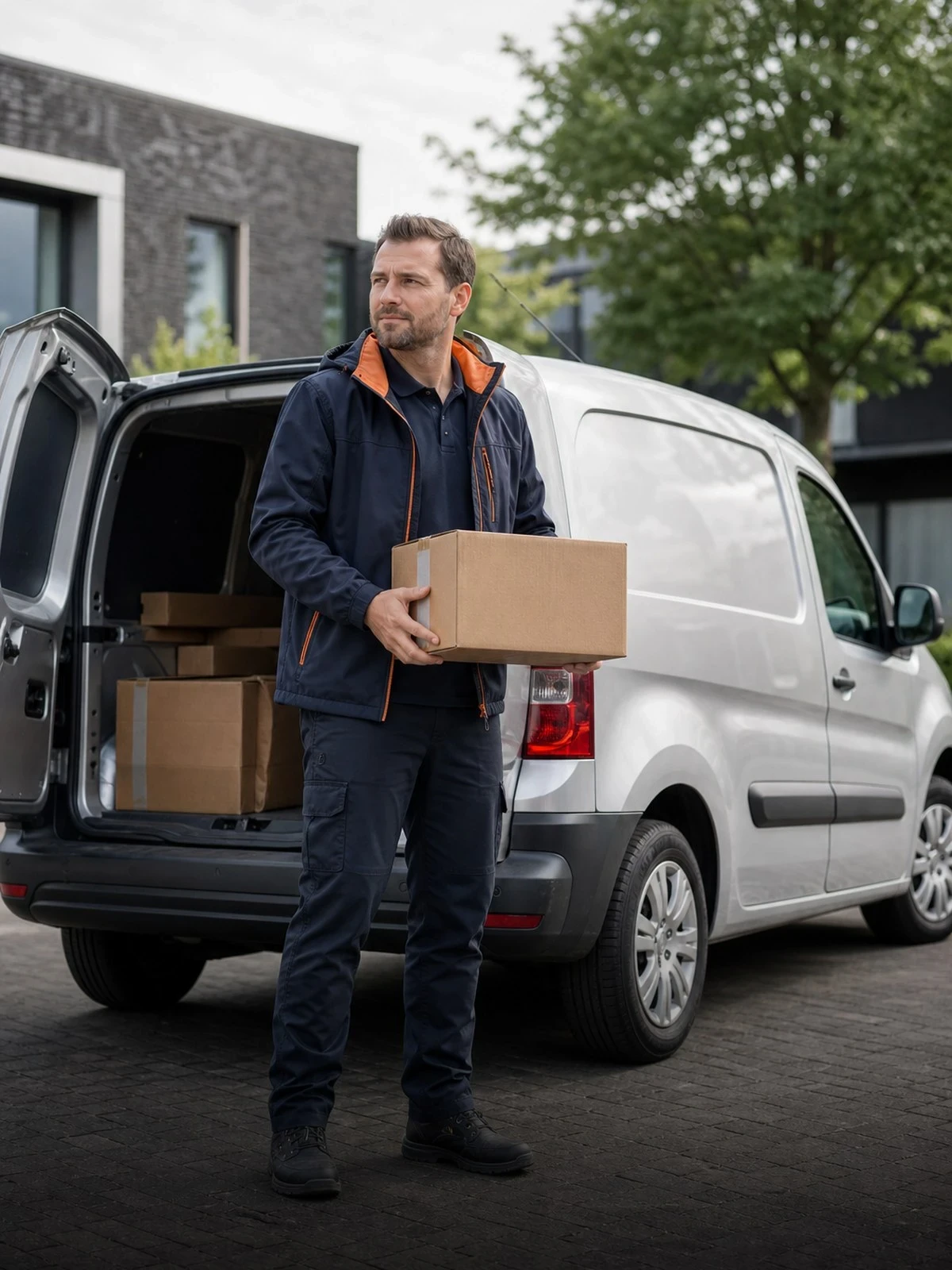
Courier work stacks three risks on top of each other: hundreds of stops a day, a load space that is open again and again, and someone else's parcels that you lose on the way.
This page in another language: Nederlands
Work out for yourself what it would cost.
Enter your details; you will receive a proposal within one working day.
A premium indication, not personal advice. Prefer to talk it through? Call 072 - 509 24 56.
For insurers, delivery work is a risk class of its own. Not because of the mileage but because of the density of stops: brief stops in residential areas, reversing in narrow streets, double parking and constantly getting in and out. The claims are rarely large but they are numerous, and it is precisely those many small parking and manoeuvring claims that steer the premium. A policy taken out for service use does not fit this pattern.
So declare the form of use literally as courier or delivery work. A van shown on the application as a service van but actually delivering parcels departs from what the insurer has accepted. In the event of a claim, that leads to reliance on Article 7:928 of the Dutch Civil Code and the payout can be reduced under Article 7:930 of the Dutch Civil Code. It also makes no difference at all while things go well: it only goes wrong at the moment you need the cover.
The third theme is the consignment itself. If you carry parcels for clients, you are a carrier and your liability is capped per kilogram under AVC for domestic carriage or CMR internationally. With light, valuable consignments that limit is far below the actual value. For this, see the carriers' liability insurance and the transport insurance for couriers.
We compare your van insurance across dozens of insurers, explain where the real differences lie, and arrange the switch from start to finish — without you having to chase it yourself.
 Van insurance
 Compare
 Get covered
The structure of the cover in three parts, with an overview per situation below.
Damage you cause to others with the van.
Theft, break-in damage, fire, storm and glass.
Tools, materials and the fit-out in the load space.
What is covered
| Situation | Third-party liability | Third-party, fire and theft | Comprehensive |
|---|---|---|---|
| Collision with another vehicle | Yes | Yes | Yes |
| Break-in damage to doors and locks | No | Yes | Yes |
| Tools stolen from the load space | No | No | No |
| Damage you cause yourself while reversing | No | No | Yes |
| Racking system and load floor | No | Sometimes | Sometimes |
| Damage to third-party goods during loading and unloading | No | No | No |
This overview is general in nature and is not personal advice. What is actually covered, including exclusions, limits and the excess, is set out in the policy conditions and the insurance card (verzekeringskaart) of the insurer; you receive both before you take out cover. Taking out cover without advice? Then read what execution only means for you.
Insurers weigh these details differently. That is where your saving is.
We look at the terms as well as the premium, and stay your point of contact when there is a claim.
We are not tied to one insurer and compare on the basis of an objective analysis of several companies.
You call or email someone who knows your file. No menu options, no changing call centres.
We cancel your old policy and align the start date, so you are never a day without cover.
We report the claim and monitor how it is handled. In urgent cases you can reach us on the emergency line.
Customers rate our service on four aspects: personal service, service delivery, availability and the outcome. The reviews are collected and published by NH1816 and come from customers who have actually taken out a policy with Finass Advies B.V. or reported a claim.
Four points that make the difference between a policy that pays out and one that does not.
Under the AVC and CMR, your liability as a carrier is capped at an amount per kilogram of damaged or lost weight. With a box of electronics weighing a few kilos, that covers a fraction of the actual value. Clients try to stretch this contractually with departing clauses. If you accept those, your standard policy does not insure the excess. Have contracts checked for this and insure a higher value only where you genuinely take on that liability.
In delivery work the drivers change, certainly in peak periods with hired hands and self-employed professionals. Declare the circle of drivers and the ages; young drivers weigh heavily and an unreported driver is the first point of dispute when there is a claim. For your own staff, you are also liable as the employer for their mistakes under Article 6:170 of the Dutch Civil Code. From about three vans onwards, a fleet insurance is usually more suitable.
While delivering, the side door or rear door stands open while the driver is at the front door. For insurers, theft from an open van is not a break-in but taking without forced entry, and that is excluded as standard excluded. The parcels themselves also fall outside every vehicle cover. So work with a locking procedure at each stop and put it in writing. When you claim on the load cover, that exact procedure is what you will be asked about.
Delivery routes are driven to the clock, and time pressure translates into hurried manoeuvring and into accidents. If a delivery driver on the payroll is injured in traffic, you as the employer are required to arrange proper insurance under Article 7:611 of the Dutch Civil Code. If that is missing, the loss can still be recovered from you. A road traffic accident insurance for employees is the usual solution for this.
What is in the load compartment is not part of the vehicle. Own-damage cover does not pay for its theft, not even under comprehensive cover. That calls for separate goods-in-transit insurance, with conditions attached: usually a locked garage, or emptying the van outside working hours.
A racking system, load floor, roof rack, tow bar or refrigeration unit raises the value but is not included in the list price. Without a declaration, only the bare vehicle is paid out in the event of a total loss, while the fit-out easily represents several thousand euros.
This is what people ask us most.
No. No vehicle insurance covers the load. If you carry goods for clients, your carrier's liability applies, with a limit per kilogram under the AVC or CMR. If the client wants the actual value paid, goods-in-transit insurance is needed. Those are two different policies with different insured parties and different bases of settlement.
Then the actual use departs from the declaration on which the insurer accepted the risk. In the event of a claim, that leads to reliance on the duty of disclosure under Article 7:928 of the Dutch Civil Code, with reduction or refusal of the payout under Article 7:930 DCC. Better to correct the form of use now than after the first collision. An interim amendment is an administrative step.
There is no damage to the vehicle, and as for the consignment, taking without signs of forced entry is excluded in virtually all policy conditions. Insurers require the load space to be locked during the stop. So work with a fixed locking procedure at each stop and set it down in writing, because that is the first thing you will be asked about when you claim on the load cover.
Yes. An employer must make proper arrangements for employees who take part in traffic in the course of their work. That follows from Article 7:611 of the Dutch Civil Code. If those arrangements are missing and a delivery driver is injured, he can recover the loss from you even where you made no mistake. Road traffic injury insurance for employees or an occupants' cover fills that gap.
Every situation is different. For these situations we have a separate page.
Request a quote without obligation. We will look at which insurer best matches your activities and your risk.
Prefer to call? 072 - 509 24 56, weekdays 09:00–17:00.
Claim on the road? Emergency line 06 - 55 20 40 72.
Finass Verzekert is a trading name of Finass Advies B.V. We advise on and arrange non-life insurance on the basis of an objective analysis of several insurers, and receive commission for this from the insurer, which is included in the premium. You pay no separate advice fee. Before you take out cover, we establish your wishes and needs.
You will find our licence, KvK and Kifid details and our complaints procedure at the foot of every page.
This page was compiled by Finass Verzekert (LinkedIn). Last updated on .
The information on this page is general in nature and is not personal advice.
Maandag- Vrijdag: 09:00- 17:00
We use cookies and similar technologies to improve your experience on our website.