

Third-party liability for plant and machinery
- Compulsory on public roads
- Also during work
- Cables and pipes separately
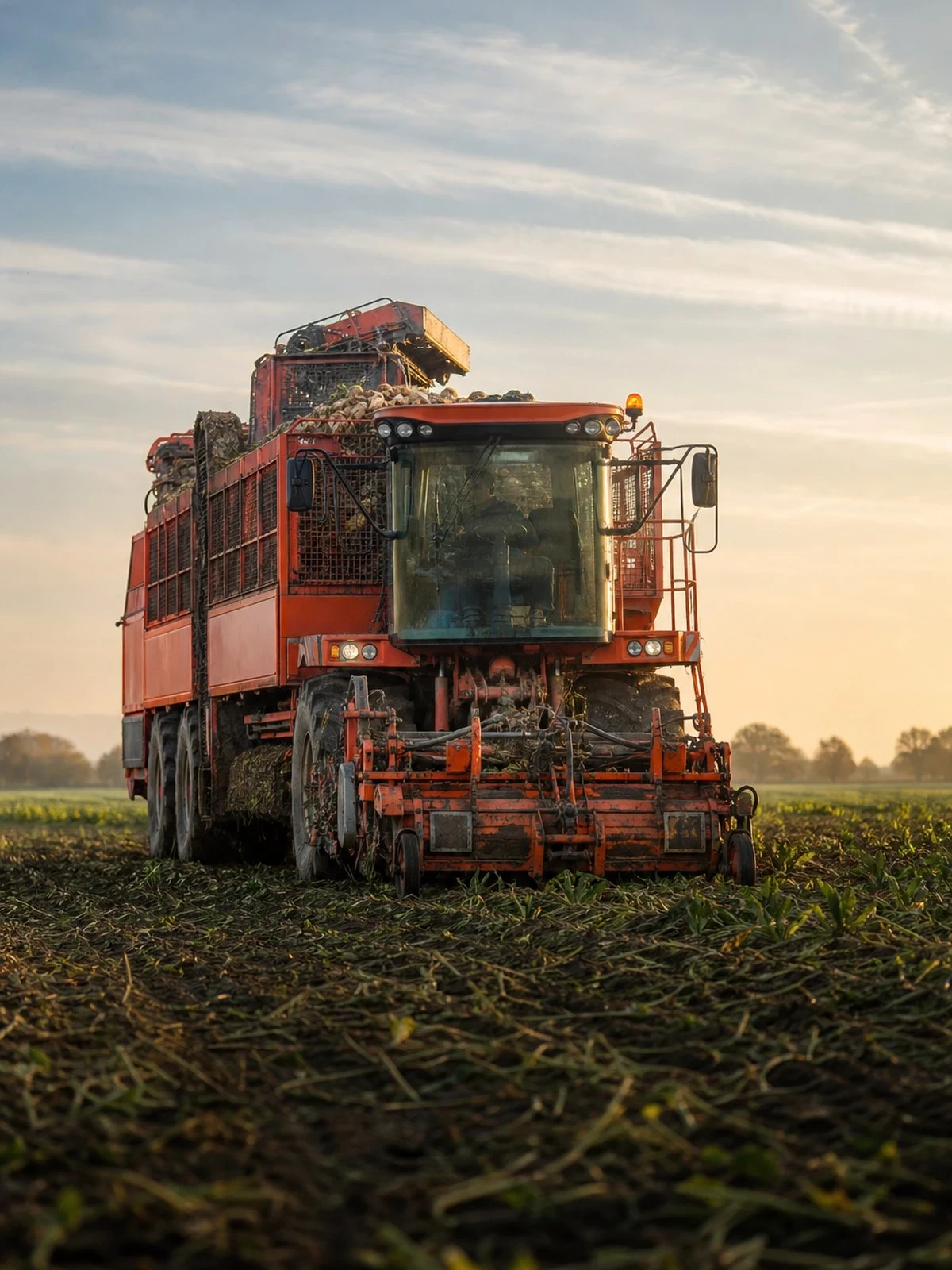
A harvesting machine runs for only a few weeks a year in dry crop, and that combination is exactly what makes fire and breakdown the core risk.
This page in another language: Nederlands
Work out for yourself what it would cost.
Enter your details; you will receive a proposal within one working day.
A premium indication, not personal advice. Prefer to talk it through? Call 072 - 509 24 56.
A harvester or forage harvester brings together everything that causes a fire: dry crop dust, oil-bearing components, a hot exhaust and an engine running at full load for days on end. If a fire starts in the field, it rarely stops at the machine. A stubble field, a hedgerow or the neighbour's crop goes with it, and then, alongside your own-damage loss, there is liability under Article 6:162 of the Dutch Civil Code.
The second feature is the harvesting window. An excavator that stands idle for two weeks can make up those weeks later. A harvesting machine cannot. If the machine breaks down at the wrong moment, the lost harvest is the real loss, and that is not covered by ordinary own-damage cover. Machinery breakdown or business interruption cover and an arrangement for hired equipment are the route for that.
Third, there is contracting work. If you lift or harvest for third parties, you are working on someone else's crop. Damage to that crop, loss through incorrect settings or contamination of a consignment is damage to the object being worked on and is not automatically covered. We go through that section when drawing up your plant and machinery insurance.
We compare your plant and machinery insurance across dozens of insurers, explain where the real differences lie, and arrange the switch from start to finish — without you having to chase it yourself.
 Plant and machinery insurance
 Compare
 Get covered
The structure of the cover in three parts, with an overview per situation below.
Damage you cause to others with the machine.
Damage to the machine, the body and the attachments.
What you add separately.
What is covered
| Situation | Third-party liability for plant and machinery | Own-damage cover |
|---|---|---|
| Damage to a building or a parked car next to the site | Yes | No |
| Theft of the machine from the building site | No | Provided that |
| Fire and storm damage | No | Yes |
| Inherent defect in the hydraulics or the engine | No | Provided that |
| Damage to the item you are working on with the machine | No | No |
| Wear and deferred maintenance | No | No |
Mobile plant is a motor vehicle within the meaning of the WAM and needs third-party liability insurance on public roads; non-mobile plant does not. Damage to cables and pipes is generally only covered if the excavation notification has been made and the trial trenches have been dug. The item you work on with the machine falls under the care, custody and control exclusion.
This overview is general in nature and is not personal advice. What is actually covered, including exclusions, limits and the excess, is set out in the policy conditions and the insurance card (verzekeringskaart) of the insurer; you receive both before you take out cover. Taking out cover without advice? Then read what execution only means for you.
Insurers weigh these details differently. That is where your saving is.
We look at the terms as well as the premium, and stay your point of contact when there is a claim.
We are not tied to one insurer and compare on the basis of an objective analysis of several companies.
You call or email someone who knows your file. No menu options, no changing call centres.
We cancel your old policy and align the start date, so you are never a day without cover.
We report the claim and monitor how it is handled. In urgent cases you can reach us on the emergency line.
Customers rate our service on four aspects: personal service, service delivery, availability and the outcome. The reviews are collected and published by NH1816 and come from customers who have actually taken out a policy with Finass Advies B.V. or reported a claim.
Four points that make the difference between a policy that pays out and one that does not.
Most total losses in this segment begin with dust and crop residue around hot parts, bearings and the exhaust. Clean the machine daily with compressed air, check the fire extinguishing equipment and record both. Insurers make that a condition at higher values. If the fire spreads to an adjoining plot or a hedgerow, then liability for someone else's crop comes on top of your own loss.
If the machine stands idle while the crop is ripe, it is not the repair that counts but the moment that was missed. A change in the weather, loss of quality and contractual penalties towards buyers follow. Own-damage cover pays for the repair and nothing more. Consider therefore machinery breakdown cover with business interruption or an arrangement for hired equipment, and agree in advance which supplier can provide replacement machinery within a day.
A stone, a piece of fencing or a broken pin passes through the lifting head into the web chain, the rotor or the chopping unit. That causes substantial damage, but the discussion is about whether it was sudden damage or foreseeable on that plot. Web chains, blades, lifting shares and rubbers are wear parts and fall outside all cover, whatever the cause of the failure.
A harvesting machine is wide and tall and travels on the public road daily during the season. There the compulsory cover under Article 2 of the Dutch Motor Insurance Liability Act (WAM)applies, as do the requirements for lighting and marking and sometimes an exemption. If you work as a contractor, damage to the plot, to the yield and to your client's consignment is added; that often falls under the working-on exclusion.
This is what people ask us most.
Fire falls under own-damage cover, but with these machines insurers set conditions for prevention. Prescribed extinguishing equipment that is missing, or deferred maintenance on bearings and the exhaust, can stand in the way of payment. So record the daily cleaning and the checks on the extinguishers; those records determine how the loss is assessed.
That is liability towards a third party and falls under the liability section, not under own-damage cover. The size of it can far exceed the value of your machine, certainly if a hedgerow or a barn also goes with it. So set your sum insured to match the surroundings in which you harvest and not solely the value of the equipment.
Not with ordinary own-damage cover. That pays for the repair. The loss lies in the missed window and in the quality of the consignment. Only machinery breakdown cover with business interruption or an arrangement for hired equipment brings that into play. Also arrange in advance where you can obtain a replacement machine within a day.
Often not as a matter of course. The crop you harvest is the thing you are working on, and damage to the object being worked on is excluded on many policies. Incorrect settings, damage to tubers or mixing with soil therefore soon falls outside the cover. Have that section assessed explicitly before you sign contracting agreements with quality guarantees.
Every situation is different. For these situations we have a separate page.
Request a quote without obligation. We will look at which insurer best matches your activities and your risk.
Prefer to call? 072 - 509 24 56, weekdays 09:00–17:00.
Claim on the road? Emergency line 06 - 55 20 40 72.
Finass Verzekert is a trading name of Finass Advies B.V. We advise on and arrange non-life insurance on the basis of an objective analysis of several insurers, and receive commission for this from the insurer, which is included in the premium. You pay no separate advice fee. Before you take out cover, we establish your wishes and needs.
You will find our licence, KvK and Kifid details and our complaints procedure at the foot of every page.
This page was compiled by Finass Verzekert (LinkedIn). Last updated on .
The information on this page is general in nature and is not personal advice.
Maandag- Vrijdag: 09:00- 17:00
We use cookies and similar technologies to improve your experience on our website.