

Third-party liability for plant and machinery
- Compulsory on public roads
- Also during work
- Cables and pipes separately
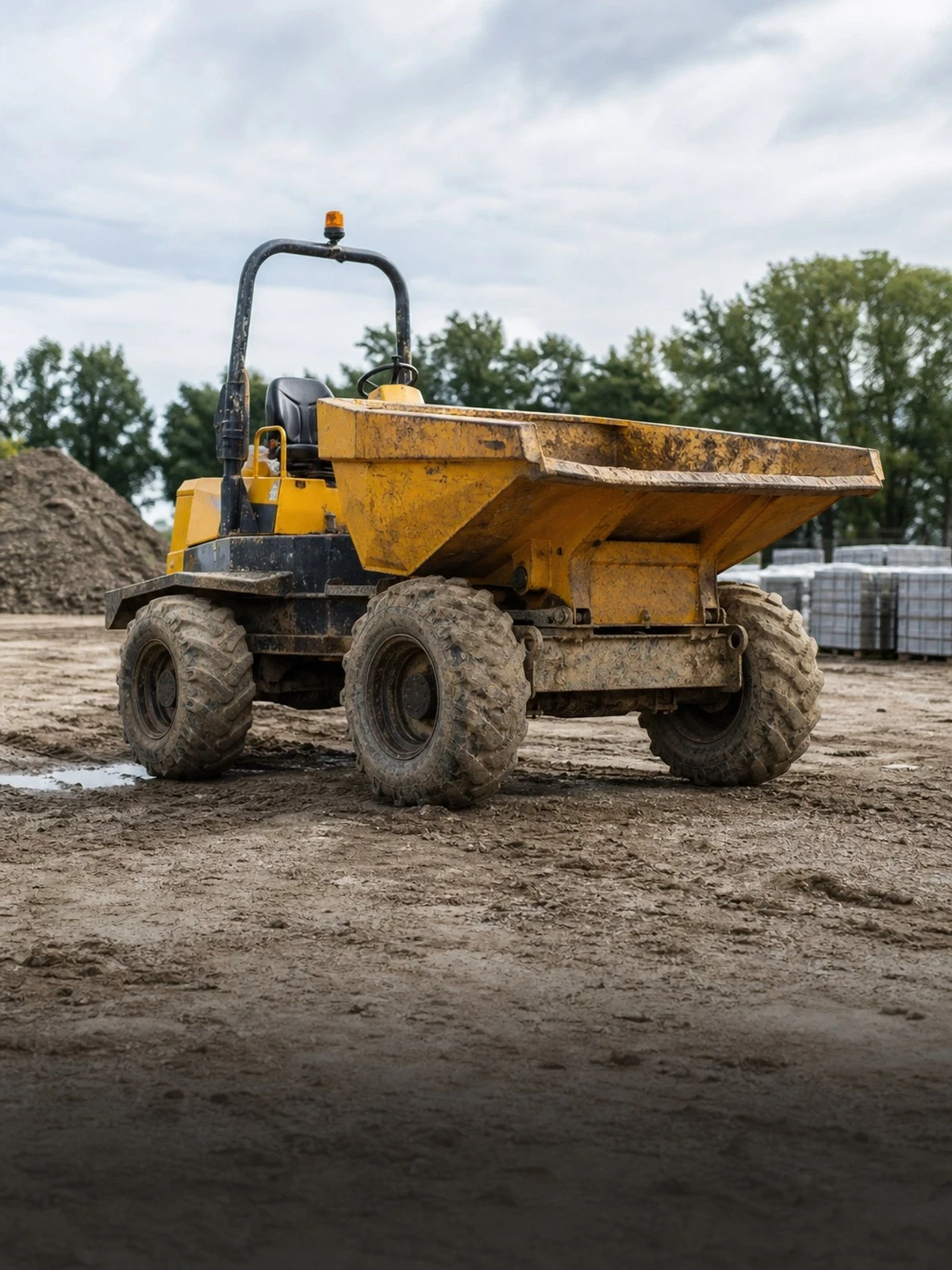
A dumper drives, carries and tips. It is precisely those three functions that determine which policy pays after a loss and where the cover stops.
This page in another language: Nederlands
Work out for yourself what it would cost.
Enter your details; you will receive a proposal within one working day.
A premium indication, not personal advice. Prefer to talk it through? Call 072 - 509 24 56.
A dumper with its own propulsion is a motor vehicle within the meaning of the WAM. If it travels on the public road, even only between two work sections or along a publicly accessible site road, third-party liability cover is compulsory under Article 2 of the Dutch Motor Insurance Liability Act (WAM). That applies with and without a registration number. If the machine stays within a closed building site, that obligation does fall away, but the liability under Article 6:162 of the Dutch Civil Code continues in full.
The own-damage cover relates to the dumper itself: overturning while tipping on an embankment, collision with other plant, sinking in, fire, storm and theft. The distinction from the liability layer is decisive. Damage on the dumper is own-damage. Damage through the dumper (a scaffold that is struck, damaged paving, injury to a colleague) is liability.
With a dumper there is also the cargo. Soil, rubble or asphalt in the skip is not part of the machine. Damage to or loss of it falls outside the own-damage cover. If the load belongs to a client, the public and employers' liability insurance comes into play, with the specific restrictions that apply there to property in your care.
We compare your plant and machinery insurance across dozens of insurers, explain where the real differences lie, and arrange the switch from start to finish — without you having to chase it yourself.
 Plant and machinery insurance
 Compare
 Get covered
The policy has a compulsory third-party liability layer, an own-damage layer and modules covering transport, load and driver.
Damage you cause to others with the machine.
Damage to the machine, the body and the attachments.
What you add separately.
What is covered
| Situation | Third-party liability for plant and machinery | Own-damage cover |
|---|---|---|
| Damage to a building or a parked car next to the site | Yes | No |
| Theft of the machine from the building site | No | Provided that |
| Fire and storm damage | No | Yes |
| Inherent defect in the hydraulics or the engine | No | Provided that |
| Damage to the item you are working on with the machine | No | No |
| Wear and deferred maintenance | No | No |
Mobile plant is a motor vehicle within the meaning of the WAM and needs third-party liability insurance on public roads; non-mobile plant does not. Damage to cables and pipes is generally only covered if the excavation notification has been made and the trial trenches have been dug. The item you work on with the machine falls under the care, custody and control exclusion.
What is actually covered, including exclusions, limits and the excess, is set out in the policy conditions and the insurance card (verzekeringskaart) that you receive before you take out cover.
Insurers weigh these details differently. That is where your saving is.
We look at the terms as well as the premium, and stay your point of contact when there is a claim.
We are not tied to one insurer and compare on the basis of an objective analysis of several companies.
You call or email someone who knows your file. No menu options, no changing call centres.
We cancel your old policy and align the start date, so you are never a day without cover.
We report the claim and monitor how it is handled. In urgent cases you can reach us on the emergency line.
Customers rate our service on four aspects: personal service, service delivery, availability and the outcome. The reviews are collected and published by NH1816 and come from customers who have actually taken out a policy with Finass Advies B.V. or reported a claim.
Four points that determine whether the dumper policy actually pays after a loss.
What lies in the skip is not part of the machine. If the load falls off, becomes contaminated or damages a parked car, own-damage cover does not resolve that. Damage to the load itself is excluded; damage the load causes to someone else is liability and runs through third-party liability cover or through the AVB. If the load belongs to the client, pay particular attention to the restriction for property you had in your in your care.
Most dumper claims arise during or just after tipping: overturning on uneven ground, sinking into fresh soil or hitting an overhead line. Insurers look closely at overloading and incorrect use. If the skip is loaded more heavily than the manufacturer allows, or tipping was done on a slope for which the machine is not intended, the own-damage claim can be rejected. Record work instructions and have the operator sign them off.
The following, among others, are outside the cover: wear and tear and ageing, a mechanical or electrical failure without an external cause such as a hydraulic ram that has given way; damage caused by overloading or incorrect use; damage to the the load or the workpiece; operation by someone without the required certification or without permission; and damage caused by intent or recklessness under Article 7:952 of the Dutch Civil Code. Soil contamination from leaking oil or fuel belongs on an environmental damage policy and not here.
What you declared on the application about work site, location and security falls under the duty of disclosure in Article 7:928 of the Dutch Civil Code. If practice departs from it — for instance regular use on the public road or lending to a subcontractor, report that during the policy year; otherwise the insurer can reduce or refuse the settlement under Article 7:930 of the Dutch Civil Code. You report a claim as soon as reasonably possible (Article 7:941 of the Dutch Civil Code).
This is what people ask us most.
The third-party liability cover is, as soon as the dumper uses the public road as a motor vehicle. Article 2 WAM imposes that requirement, including for a short move and including without a registration number. If the machine stays within a closed building site, the statutory obligation does not apply, but you remain liable for injury and damage to property you cause to others.
No. Own-damage cover relates to the machine, not to what is in it. Damage to or loss of soil, rubble or materials falls outside it. If the load causes damage to someone else, that is liability and the claim runs through the third-party liability cover or the public and employers' liability insurance, with the restrictions that apply there to property in your care.
Yes, provided they are authorised, hold the required certification and work with your permission. If someone works without the papers, an own-damage claim can be rejected. On a third-party liability claim the insurer usually does pay the injured party, because the WAM protects that third party, but it can then recover the amount paid from you. Keep certificates on file.
Then it is cargo and not a moving motor vehicle. Damage during loading, lashing, carriage and unloading often falls outside the ordinary own-damage cover and calls for a transport module or own-carriage cover. If you move between projects regularly, apply for that cover expressly before the first journey takes place.
Only where there was no overloading or incorrect use. A skip loaded too heavily, tipping on ground that is too steep or too soft, or use outside the manufacturer's specifications are common grounds for exclusion. So document the work instructions and the condition of the site. That helps in the assessment of the claim.
Every situation is different. For these situations we have a separate page.
Request a quote without obligation. We set the WAM obligation, the own-damage conditions and the cover for load and transport side by side.
Prefer to call? 072 - 509 24 56, weekdays 09:00–17:00.
Claim on the road? Emergency line 06 - 55 20 40 72.
Finass Verzekert is a trading name of Finass Advies B.V. We advise on and arrange non-life insurance on the basis of an objective analysis of several insurers, and receive commission for this from the insurer, which is included in the premium. You pay no separate advice fee. Before you take out cover, we establish your wishes and needs.
You will find our licence, KvK and Kifid details and our complaints procedure at the foot of every page.
This page was compiled by Finass Verzekert (LinkedIn). Last updated on .
The information on this page is general in nature and is not personal advice.
Maandag- Vrijdag: 09:00- 17:00
We use cookies and similar technologies to improve your experience on our website.