

Liability insurance for a delivery service
A delivery service has two risks that the AVB precisely does not cover: the consignment you carry and the vehicle you drive. What is left happens on the recipient's doorstep.
- Several insurers compared objectively
- 9.5 customer rating for a new policy
- AFM licence 12016589
- Personal 072 - 509 24 56, weekdays 9–17
This page in another language: Nederlands
Work out for yourself what it would cost.
Enter your details; you will receive a proposal within one working day.
- We compare the offerings of several insurers
- An adviser checks whether the cover suits your activities
- We arrange the switch, including cancellation
A premium indication, not personal advice. Prefer to talk it through? Call 072 - 509 24 56.
- Independent advice
- Several insurers
- Switching arranged
- Help with claims
In brief
The AVB pays for personal injury and damage to third parties' property. For a delivery service two core activities fall straight outside it. Damage caused with a motor vehicle is excluded and falls under the compulsory cover in Article 2 of the Dutch Motor Insurance Liability Act (WAM), and the consignment you have in your care is an item in your care, custody and control. A parcel that is broken, spoils or disappears is therefore not an AVB loss. That risk belongs on goods in transit insurance or on the carriers' liability, in which the AVC or CMR conditions of carriage apply.
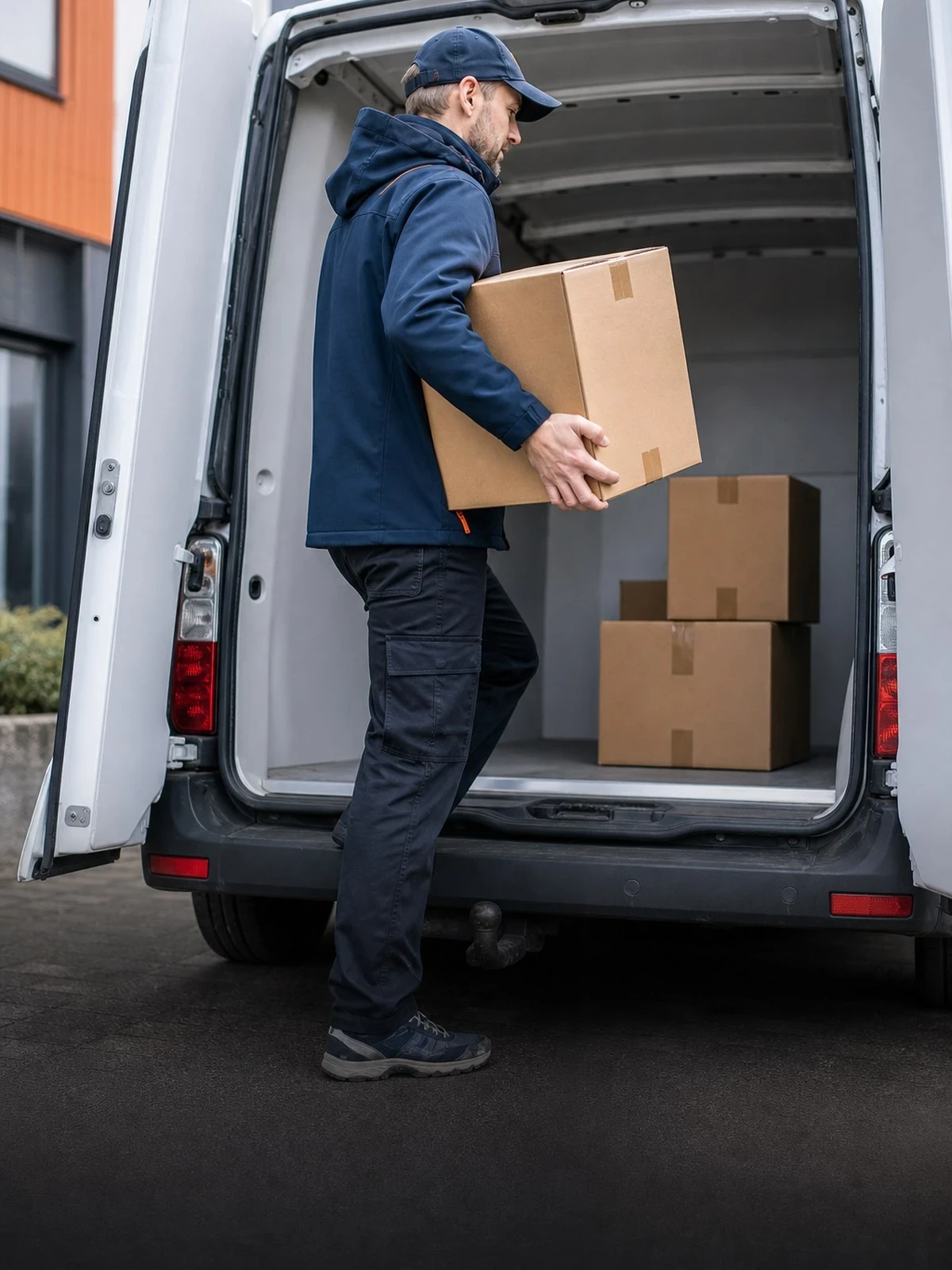
What the AVB does do relates to the moment of delivery. A sack truck that hits a shopfront, a heavy box that goes through a wooden staircase, a spilled order on a sofa or a parcel that falls on the recipient's foot: that is classic damage to property and personal injury under Article 6:162 of the Dutch Civil Code. Damage while loading and unloading at the consignor or damage to a roll cage at a distribution centre also falls under it, provided it was not caused with the vehicle itself.
The third strand is your staff. Delivery drivers lift, hurry and are on the road most of the day. Article 7:658 of the Dutch Civil Code requires you to provide a safe way of working, and in this trade that means work instructions on lifting weights, a realistic number of stops and maintenance of the vans and bicycles. The AVB is not intended for the driver's own loss. For that, look at WEGAS and WEGAM.
This page deals with one situation. The full overview is on Compare public and employers' liability insurance (AVB).
Independent, personal, sorted quickly
We compare your business liability insurance (AVB) across dozens of insurers, explain where the real differences lie, and arrange the switch from start to finish — without you having to chase it yourself.
 Business liability insurance (AVB)
 Compare
 Get covered
Why arrange it through Finass Verzekert?
We look at the terms as well as the premium, and stay your point of contact when there is a claim.
Independent
We are not tied to one insurer and compare on the basis of an objective analysis of several companies.
One fixed adviser
You call or email someone who knows your file. No menu options, no changing call centres.
Switching without hassle
We cancel your old policy and align the start date, so you are never a day without cover.
Help with claims
We report the claim and monitor how it is handled. In urgent cases you can reach us on the emergency line.
What to look out for
Four points that lead to discussion more often than the sum insured for delivery services.
The consignment falls outside the liability policy
As long as the goods are entrusted to you, they count as items in your care. Spoilage from a broken refrigeration unit, theft from the van or a broken consignment is then not an insured loss on the AVB. Your liability as a carrier is also limited by contract through AVC or CMR. That limit falls away in the case of deliberate recklessness.
Everything that drives is excluded
A van that hits a facade while reversing, a scooter that hits a cyclist and a cargo bike with electric assistance above the moped threshold fall under the motor vehicle risk. You arrange that with van insurance for courier services or a courier insurance, not with the AVB.
Being late is not a loss within the meaning of the policy
A client who says it lost turnover because a delivery was not on time is claiming pure financial loss. The AVB has no cover for that. The same applies to penalties under your contract of carriage and to administrative fines, for example for breaching driving and rest times or age checks when delivering alcohol.
Self-employed drivers and subcontractors
If you work with self-employed drivers or with regular subcontractors, check whether they are named as insured on your policy or have cover of their own. Under Article 7:658(4) of the Dutch Civil Code your duty of care can also apply to those who are not employed by you but drive under your direction. Ask for an up-to-date policy schedule every year.
What does your premium depend on?
- Payroll and number of delivery riders: the basis for the employers' liability section
- Type of consignments: meals, parcels, equipment or medicines weigh differently
- Fleet and means of transport: vans, scooters and bicycles each have their own regime
- Use of self-employed contractors: counts towards your duty of care and the group of insured persons
- Working area: delivering in the inner city is a different risk from driving regionally
- Sum insured and excess: per claim and per insurance year
Insurers weigh these details differently. That is where your saving is.
What is covered
| Situation | AVB | Carriers' cover |
|---|---|---|
| A sack truck hits a shop's frontage during a delivery | Yes | No |
| A heavy box goes through the wooden staircase in a customer's home | Yes | No |
| A parcel containing electronics disappears from the van en route | No | Yes |
| A load of frozen goods spoils because the refrigeration fails en route | No | Yes |
| A van hits the facade of a house while reversing | No | No |
| The client claims lost turnover because a delivery arrived a day late | No | Provided that |
The line runs at the parcel: damage around it is liability, damage to it is carriage.
Frequently asked questions
This is what people ask us most.
A driver damages a customer's front door. Is that covered?
Yes, that is the core of what this policy is intended for: damage to a third party's property, caused during the work and not with a motor vehicle. Think of a door frame hit by a sack truck or a damaged floor. The parcels being delivered at that moment do not fall under it. Those remain items in your care.
Who bears the cost of a consignment lost in a collision?
Damage to the other vehicle runs through the third-party cover on your van. The lost load falls outside that and is assessed on the basis of your contract of carriage and the conditions named in it. Without carriers' liability or goods in transit cover that remains your own risk, even where you are not at fault for the accident itself.
Is injury to a driver on the road insured?
Not on the ordinary AVB. The employers' liability section usually excludes loss suffered by employees as road users, while Article 7:658 of the Dutch Civil Code and the legal relationship with your staff can nonetheless give rise to an obligation to compensate. There is a separate road risk cover for employers for that. Report an accident in good time; Article 7:941 DCC requires you to do so as soon as you know about it.
A dog bites our driver. Who is liable?
The keeper of the animal. Article 6:179 of the Dutch Civil Code imposes strict liability on the keeper for damage the animal causes, even without fault. Your own policy does not come into play, but you can recover your employee's loss from the dog owner's personal liability insurance (AVP). Record the incident in writing straight away with address details and witnesses.
Every situation is different. For these situations we have a separate page.
- Compare public and employers' liability insurance (AVB)The main page
- Liability insurance for a self-employed carrierDeliveries, entering premises, parcels
- Liability insurance for a self-employed courierGoods outside cover, WAM, loading and unloading
- Liability insurance for a courier companyDelivery riders in traffic, the depot, subcontracting
- Liability insurance for a transport companyLoad, loading and unloading, drivers
- Liability insurance for a self-employed delivery riderBicycle or scooter, the consignment ·. Your own absence
- Liability insurance for a boarding kennelStrict liability for animals, care, custody and control, fencing
- Liability insurance for a self-employed animal carerDog walking, key holding, animals in your care
- Liability insurance for a car dealership or garageMotor vehicles, customers' cars, workshop