

Buildings
- Fire, explosion, lightning strike
- Storm, hail and rainfall
- Damage from forced entry and impact
- Fixed installations and canopies
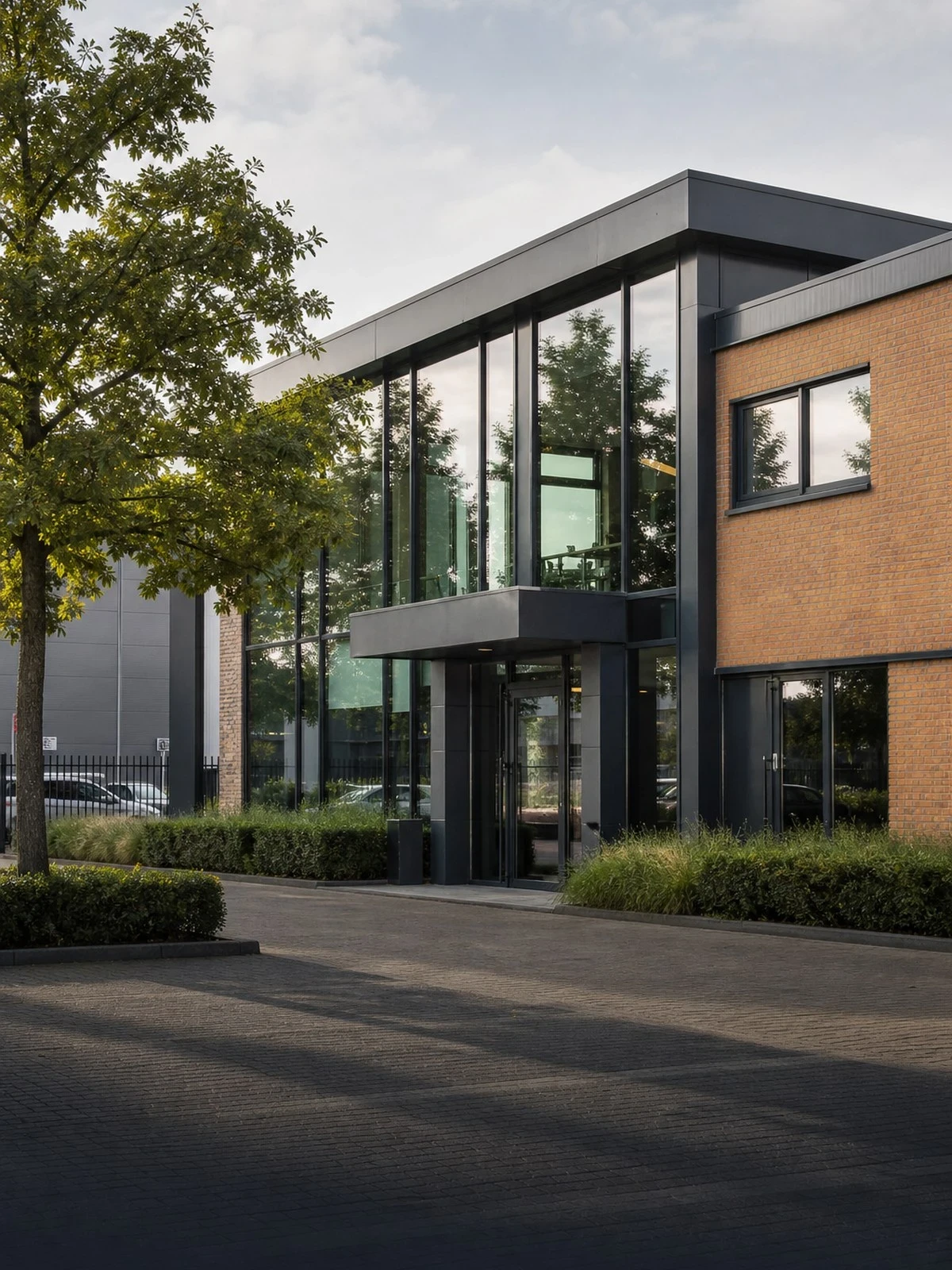
Commercial buildings insurance covers the property in which you run your business. The cover depends heavily on what you have had recorded on the policy about the use of that property.
This page in another language: Nederlands
Work out for yourself what it would cost.
Enter your details; you will receive a proposal within one working day.
A premium indication, not personal advice. Prefer to talk it through? Call 072 - 509 24 56.
Buildings insurance insures the building: foundations, walls, roof, floors, fixed installations, canopies, hard surfacing and outbuildings. Everything you would take with you if you moved (machinery, racking, computers, stock) is not included, but falls under the business contents and goods insurance. If you rent the property, you do not insure the buildings but tenant's improvements: the fixtures you have installed in the rented premises yourself.
The field that causes most claims disputes with commercial premises is the business activity: the description of your business activity. On the basis of that, the insurer decides whether to accept the risk, which prevention requirements apply and what rate to charge. A property insured as an office but actually used as a workshop is wrongly insured. That touches the duty of disclosure under Article 7:928 of the Dutch Civil Code and the consequences of this in Article 7:930 of the Dutch Civil Code.
Two covers sit alongside the buildings insurance and have to be taken out separately: business interruption for the loss of turnover for as long as you cannot produce, and loss of rent if you let the property in whole or in part. The buildings policy only pays for repairs to the bricks and mortar. See also business buildings insurance.
We compare your buildings insurance across dozens of insurers, explain where the real differences lie, and arrange the switch from start to finish — without you having to chase it yourself.
 Buildings insurance
 Compare
 Get covered
The buildings cover, the consequential loss cover and the glass section are three separate elements.
Damage to the building and to everything permanently attached to it.
The loss of turnover and the ongoing costs for as long as you cannot use the property.
Breakage of glass in the facade, frontage, doors and roof lights.
What is covered
| Situation | Basic | Extended |
|---|---|---|
| Fire damage to the business premises | Yes | Yes |
| Storm damage to the roof and facade cladding | Yes | Yes |
| Water damage from a burst pipe | Provided that | Yes |
| Loss of turnover during the rebuild | No | Provided that |
| Damage caused by a structural fault | No | No |
| Settlement of the foundations | No | No |
The precise perils, exclusions, limits and excesses are set out in the policy conditions and the insurance card (verzekeringskaart) you receive before taking out the policy.
Insurers weigh these details differently. That is where your saving is.
We look at the terms as well as the premium, and stay your point of contact when there is a claim.
We are not tied to one insurer and compare on the basis of an objective analysis of several companies.
You call or email someone who knows your file. No menu options, no changing call centres.
We cancel your old policy and align the start date, so you are never a day without cover.
We report the claim and monitor how it is handled. In urgent cases you can reach us on the emergency line.
Customers rate our service on four aspects: personal service, service delivery, availability and the outcome. The reviews are collected and published by NH1816 and come from customers who have actually taken out a policy with Finass Advies B.V. or reported a claim.
These subjects determine whether a large claim is actually paid.
Businesses change faster than their policy. An office that gains a workshop, a warehouse where forklift batteries are charged, a showroom where spraying is also done: all changes that alter the fire risk. The insurer is entitled to that information (Article 7:928 of the Dutch Civil Code) and can reduce or refuse the payout if it is withheld (Article 7:930 of the Dutch Civil Code). Report a change in writing and keep the confirmation. When you claim, that is your most important evidence.
The sum insured must rebuild value is: the cost of building the same property again in the same place, including demolition, clearing debris and current building regulations. The book value from your accounts and the WOZ value are unsuitable for this. Insurers index annually, but that index follows an average and does not correct for your own extension or installation. If the sum is too low, every claim is reduced proportionately for underinsurance.
Outside the cover are, among other things business downtime without separate business interruption cover, subsidence and foundation damage, damage caused by deferred maintenance and wear and tear, and construction and design faults. Damage caused deliberately or recklessly by the insured is excluded under Article 7:952 of the Dutch Civil Code. Gradual influences such as damp, corrosion and vermin also remain outside the cover, as does damage arising from use that differs from the declared trade description.
If part of your property stands empty, building work is being carried out or production has stopped, the risk changes. During a vacancy most policies limit the cover to fire, storm and explosion and glass and water damage often lapse entirely. During building work, requirements apply to working with naked flames and to securing the property. Report both situations in advance; reporting afterwards almost always leads to a dispute about cover when you claim.
This is what people ask us most.
No. The owner insures the buildings. You insure your business contents and goods and, in addition, your tenant's interest: the features you installed yourself, such as walls, floor finishes, a kitchenette or an adapted electrical installation. Do check what the tenancy agreement says about this, because it often records who insures which part.
No, that is a cover in its own right. The buildings policy pays for repairs to the building, but not for the turnover you lose during the months you cannot work. With business interruption cover you set the indemnity period yourself. Choose that period realistically: rebuilding an industrial unit including the permit procedure often takes longer than business owners expect.
Panels fixed to the roof are usually regarded as part of the building, but only if you have reported them and the sum insured has been adjusted for them. Some insurers set extra requirements for the mounting, the inverter or the roof covering beneath, or use a separate section. Always report the installation in advance.
Vacancy counts as a change of risk that you have to report. The insurer can limit the cover to fire, storm and explosion, set extra requirements for securing and inspecting the property, or adjust the premium. If you do not report it and damage arises that is connected with the vacancy, such as vandalism or an unnoticed leak, the payout is very likely to be reduced.
Usually not. Settlement, pile rot, subsidence and repairs to foundations are almost always excluded, because they involve gradual processes rather than a sudden event. Damage arising from them, such as cracks in walls and sticking doors, is also excluded. Only where there is a directly identifiable covered cause, such as an explosion, may the position be different.
Every situation is different. For these situations we have a separate page.
Request a quote without obligation. We will set the trade description, the rebuild value and business interruption side by side for each insurer.
Prefer to call? 072 - 509 24 56, weekdays 09:00–17:00.
Claim on the road? Emergency line 06 - 55 20 40 72.
Finass Verzekert is a trading name of Finass Advies B.V. We advise on and arrange non-life insurance on the basis of an objective analysis of several insurers, and receive commission for this from the insurer, which is included in the premium. You pay no separate advice fee. Before you take out cover, we establish your wishes and needs.
You will find our licence, KvK and Kifid details and our complaints procedure at the foot of every page.
This page was compiled by Finass Verzekert (LinkedIn). Last updated on .
The information on this page is general in nature and is not personal advice.
Maandag- Vrijdag: 09:00- 17:00
We use cookies and similar technologies to improve your experience on our website.