

Comprehensive
- Fire and water
- Falls and knocks
- Theft
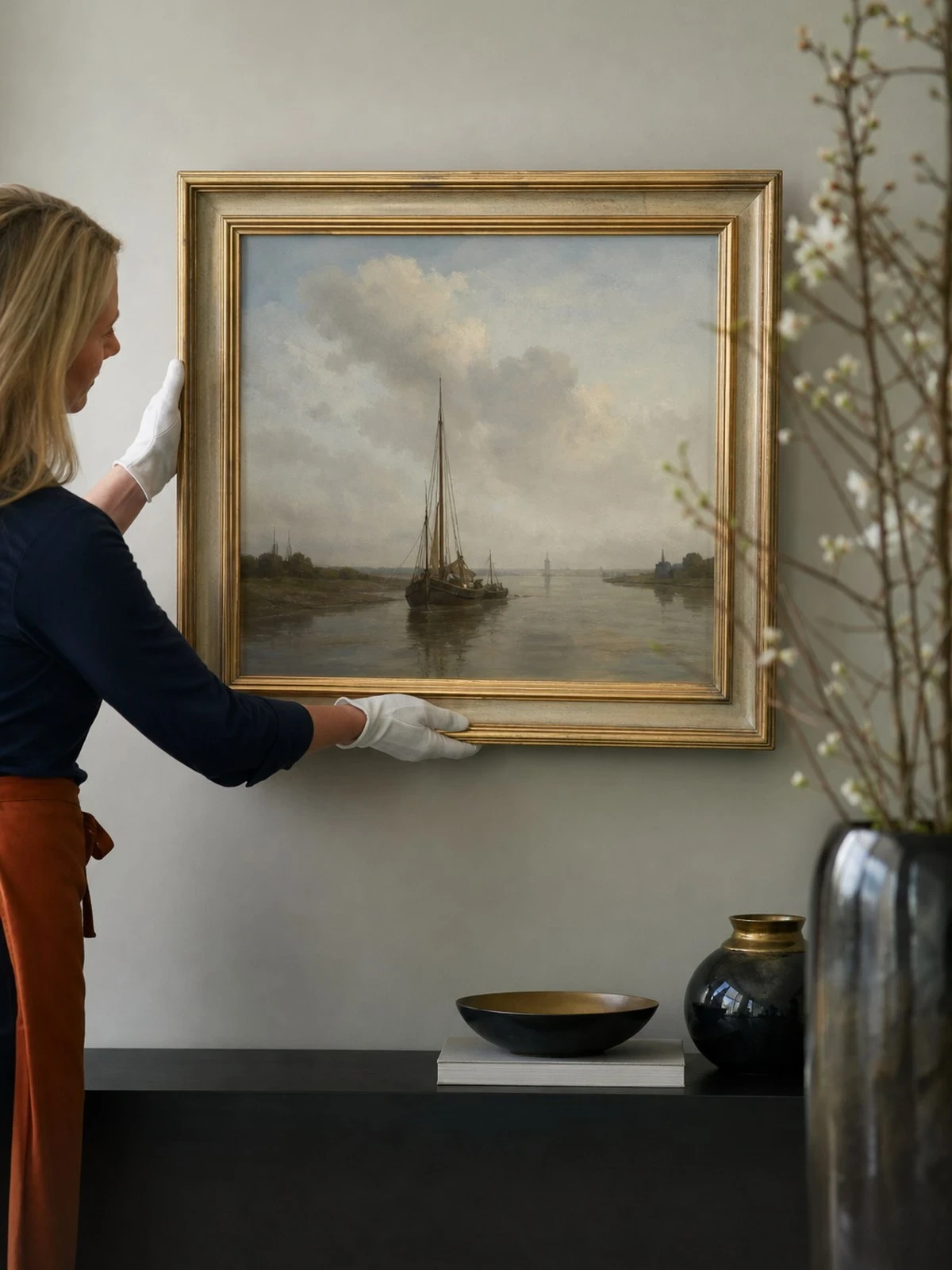
A painting hangs in the same place for years. What happens there with light, damp and the fixing determines whether anything is ever paid.
This page in another language: Nederlands · Deutsch
The calculator and the quote form below are in Dutch. Prefer to do this in English? Email info@finassverzekert.nl or call 072 - 509 24 56 and we will take it from there.
Work out for yourself what it would cost.
Enter your details; you will receive a proposal within one working day.
A premium indication, not personal advice. Prefer to talk it through? Call 072 - 509 24 56.
You insure a painting separately on agreed value. What is covered is the sudden event in and around the home: fire, soot, water from a burst pipe, theft during a burglary and a fall from the wall. That is narrower cover than the word comprehensive suggests, because with paintings most damage arises not suddenly but over years.
What is not paid for is exactly what most owners find: craquelure, discolouration from daylight, damp patches behind the canvas, mould and insect damage. These are gradual processes and they fall outside every policy. The insurer pays for an event with an identifiable moment, not for the passage of time in an unfortunate spot.
You also carry a duty of care for the hanging. If a work falls because a nail in plasterboard could not hold the weight, the insurer can argue that you failed to take sufficient care. In serious cases Article 7:952 of the Dutch Civil Code comes into play. If you own more works or something goes out on loan, see insuring art.
We compare your valuables insurance across dozens of insurers, explain where the real differences lie, and arrange the switch from start to finish — without you having to chase it yourself.
 Valuables insurance
 Compare
 Get covered
The structure of the cover in three parts, with an overview per situation below.
Damage to and theft of the work on your wall.
With antique frames the frame itself is valuable.
Most damage arises during transport.
What is covered
| Situation | Covered |
|---|---|
| Fire or water damage | Yes |
| A fall from the wall despite sound hanging | Yes |
| Theft during a burglary | Yes |
| Damage during a reported house move | Sometimes |
| Discolouration from sunlight | No |
| Craquelure and damp damage | No |
This overview is general in nature and is not personal advice. What is actually covered, including exclusions, limits and the excess, is set out in the policy conditions and the insurance card (verzekeringskaart) of the insurer; you receive both before you take out cover. Taking out cover without advice? Then read what execution only means for you.
Insurers weigh these details differently. That is where your saving is.
We look at the terms as well as the premium, and stay your point of contact when there is a claim.
We are not tied to one insurer and compare on the basis of an objective analysis of several companies.
You call or email someone who knows your file. No menu options, no changing call centres.
We cancel your old policy and align the start date, so you are never a day without cover.
We report the claim and monitor how it is handled. In urgent cases you can reach us on the emergency line.
Customers rate our service on four aspects: personal service, service delivery, availability and the outcome. The reviews are collected and published by NH1816 and come from customers who have actually taken out a policy with Finass Advies B.V. or reported a claim.
Four points that make the difference between a policy that pays out and one that does not.
After a fall, the loss adjuster’s first question is what the work was hanging on. A rail system with two supporting points in a load-bearing wall rarely leads to argument. A single nail in plasterboard or a rusted eye screw in an old frame does. Have heavier works fitted with new hanging fixtures by a framer and keep the invoice. Where the fixing was demonstrably inadequate, payment can be reduced or refused altogether.
Above an open fire a canvas takes soot and heat, on an outside wall damp works through the stretcher, in the bathroom paper cockles, and by a south-facing window pigment fades within a few years. None of those types of damage is insured. On acceptance an insurer sometimes looks at the position and may attach a clause to it. Hang valuable work out of direct sunlight and away from sources of heat.
With older works the original frame is sometimes an object to be valued in its own right. If only the frame breaks, the sum insured on the painting says little about that loss. Have an antique frame described separately. With works on paper the glazing is also functional: UV-filtering glass slows fading, but the shards of ordinary glass damage the sheet beneath in a fall, and that repair is expensive.
The moment a work comes off the wall is the moment it gets damaged. Report a house move in advance, because transport falls under a separate section and not under the ordinary cover at the address. Never let a handyman or decorator take works down. If they cause damage, you depend on their liability under Article 6:171 of the Dutch Civil Code and on their terms and conditions, which almost always limit it.
For protection against underinsurance, the report must be drawn up as referred to in Article 7:960 of the Dutch Civil Code, with the additional provision on value. A dealer's value statement does not always meet that requirement. The amount is then fixed for the term of the valuation. If the valuation has expired at the time of the loss, you fall back on market value.
In the event of loss or theft, the first question is whether the item existed and what it was worth. Keep the purchase invoice with the serial number, the valuation report, the box and the papers, and photograph everything from several angles. Store that digitally and not only at home; after a fire or burglary that is often the only evidence left.
This is what people ask us most.
In principle it is: a fall is a sudden event. The loss adjuster will then look at the fixing. If it was rated for the weight and properly installed, the repair is paid for. If the work hung from a single nail in a plasterboard wall or from weathered fixings, the insurer can argue insufficient care and reduce the payment.
You may, but the damage that arises there is not insured. Soot deposits, drying out of the canvas and movement of a panel through temperature changes count as gradual. Only where a fire breaks out and damages the work is there a covered event. With high values, insurers may also include a clause about where the work is placed in the home.
Discuss that with the insurer first. Conservation is irreversible and work carried out by someone unqualified reduces the value further, while the cost may then not be paid. In reality the insurer appoints a conservator or approves your proposal. Report the damage first, as Article 7:941 of the Dutch Civil Code requires, and only then start.
Yes. Watercolours, drawings and screenprints are sensitive to light and damp and lose value quickly as a result, without there being a covered event. Insurers therefore ask more often about the glazing and the position. UV-filtering glass and an acid-free mount are not conditions of cover, but they prevent precisely the damage you will never be paid for.
Every situation is different. For these situations we have a separate page.
Request a quote without obligation. We will look at which insurer best matches your activities and your risk.
Prefer to call? 072 - 509 24 56, weekdays 09:00–17:00.
Claim on the road? Emergency line 06 - 55 20 40 72.
Finass Verzekert is a trading name of Finass Advies B.V. We advise on and arrange non-life insurance on the basis of an objective analysis of several insurers, and receive commission for this from the insurer, which is included in the premium. You pay no separate advice fee. Before you take out cover, we establish your wishes and needs.
You will find our licence, KvK and Kifid details and our complaints procedure at the foot of every page.
This page was compiled by Finass Verzekert (LinkedIn). Last updated on .
The information on this page is general in nature and is not personal advice.
Maandag- Vrijdag: 09:00- 17:00
We use cookies and similar technologies to improve your experience on our website.