

Rebuild value
- Not the market value
- Not the WOZ value (the Dutch property valuation)
- Guarantee against underinsurance
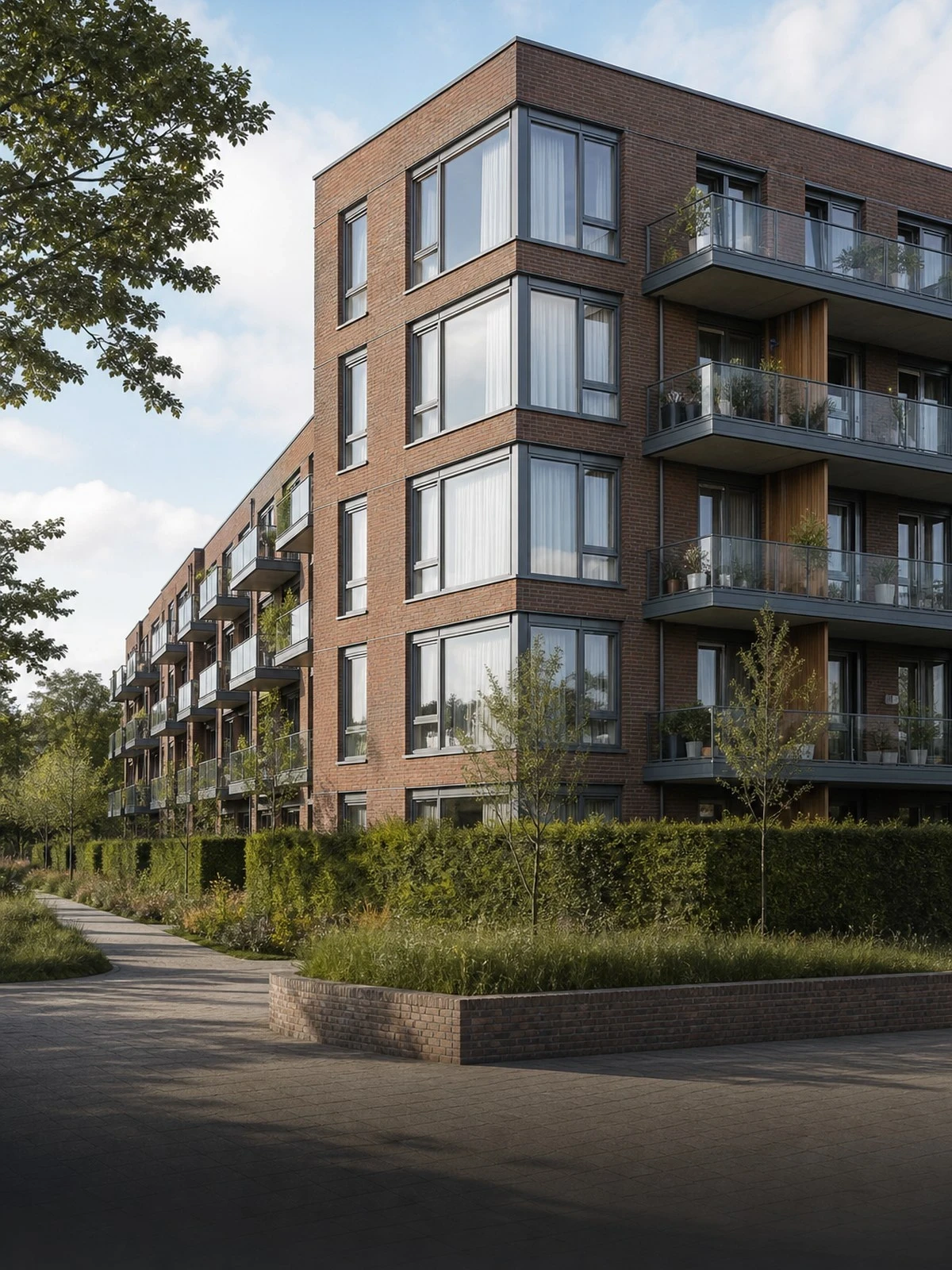
A housing association does not renovate a project but a portfolio, and does so in homes where the tenant simply stays put during the work.
This page in another language: Nederlands
Work out for yourself what it would cost.
Enter your details; you will receive a proposal within one working day.
A premium indication, not personal advice. Prefer to talk it through? Call 072 - 509 24 56.
With planned maintenance, sustainability works and major maintenance, tens to hundreds of homes go through the works each year. Separate project policies per complex then produce an administration nobody keeps up and gaps in cover between two assignments. A continuous arrangement with a notification procedure per works fits that flow better.
The second characteristic is that you remain owner and landlord while someone else works on your property. As the owner you are answerable under Article 6:174 of the Dutch Civil Code and as landlord you are bound by your tenancy agreement, even where the fault lies with the contractor. In practice the tenant will come to you first.
So the key question is not whether there is a CAR policy, but who bears which part: damage to the shell, damage to the occupants' contents, and the cost of alternative accommodation where a home is temporarily uninhabitable.
We compare your construction all risks (CAR) insurance across dozens of insurers, explain where the real differences lie, and arrange the switch from start to finish — without you having to chase it yourself.
 Construction all risks (CAR) insurance
 Compare
 Get covered
The structure of the cover in three parts, with an overview per situation below.
What it costs to rebuild the premises.
Everything permanently attached to the building.
What is excluded as standard.
What is covered
| Situation | Standard | With extension |
|---|---|---|
| Fire, smoke and lightning strike | Yes | Yes |
| Storm from force 7 upwards | Yes | Yes |
| Water damage from a burst pipe | Yes | Yes |
| Glass breakage | Sometimes | Yes |
| Groundwater coming through the floor | No | No |
| Wear and deferred maintenance | No | No |
This overview is general in nature and is not personal advice. What is actually covered, including exclusions, limits and the excess, is set out in the policy conditions and the insurance card (verzekeringskaart) of the insurer; you receive both before you take out cover. Taking out cover without advice? Then read what execution only means for you.
Insurers weigh these details differently. That is where your saving is.
We look at the terms as well as the premium, and stay your point of contact when there is a claim.
We are not tied to one insurer and compare on the basis of an objective analysis of several companies.
You call or email someone who knows your file. No menu options, no changing call centres.
We cancel your old policy and align the start date, so you are never a day without cover.
We report the claim and monitor how it is handled. In urgent cases you can reach us on the emergency line.
Customers rate our service on four aspects: personal service, service delivery, availability and the outcome. The reviews are collected and published by NH1816 and come from customers who have actually taken out a policy with Finass Advies B.V. or reported a claim.
Four points that make the difference between a policy that pays out and one that does not.
Record from what contract sum a works has to be notified separately and what falls automatically under the continuous cover. Also agree who notifies: your project manager or the contractor. The risk with this arrangement is not the premium but the administration: a works that exceeds the threshold and has not been notified is not insured, and that only comes to light on the day there is a fire in a complex covered in scaffolding.
Damage to tenants' furniture, floors and appliances is not exceptional when working in occupied condition. The existing property section usually relates to the building and not to their belongings, and your own buildings policy does not cover third-party contents either. Record for each project who handles contents claims, who bears the cost of temporary accommodation and which contact point the occupant calls. Without that agreement your service desk becomes the claims department.
On large-scale maintenance, the only defence against claims about existing defects is a standardised survey. Work digitally with a fixed checklist per room, dated photographs and sign-off by the occupant, and keep that centrally and not with the contractor. Arrange key management at the same time: theft from a home to which a third party had the key almost always leads to a dispute about who controlled access.
Deferred maintenance and existing defects that come to light during the work remain yours; they are not sudden damage. Loss of rent and compensation for nuisance fall outside the CAR policy. So do asbestos removal and the stoppage that follows it. And with sustainability works, performance that falls short, for example a heat pump that does not reach the level promised, is a contractual matter and not an insured event.
If you work in or on an existing building, that building is not your works but the property of the client. Damage to it does not fall under section 1 and, on your AVB, falls under the care, custody and control exclusion. The section existing property fills that gap, and with conversions, renovations and installation work that is not an edge case but the core of the risk.
After handover there is often a maintenance period during which you remain liable for defects that arose during construction. Agree that period explicitly and have it stated on the policy. Under the Wet kwaliteitsborging (the Dutch Building Quality Assurance Act) this carries more weight: Article 7:758(4) of the Dutch Civil Code places the burden of proof for hidden defects on the contractor.
This is what people ask us most.
With a steady annual flow of maintenance a continuous policy is more practical: no separate applications, no gaps between two assignments and one set of conditions. For a single, unusually large operation, for example demolition and replacement new build of a whole complex, a separate project policy is more suitable because the size and duration differ from your regular work.
That depends on what has been agreed. The existing property section covers your building, not the occupant's belongings. If the contractor is liable under Article 6:162 of the Dutch Civil Code, it runs through his liability cover. Record in advance that he handles this and that you pass the report on, so that the occupant is not left between two parties.
Yes. As owner of the building you remain answerable under Article 6:174 of the Dutch Civil Code if something falls off or gives way, even where the contractor loosened it. You can then recover your loss from him, but towards the occupant or a passer-by you are the party involved. So make sure your own liability cover is in order.
Both occur. If you take out the policy yourself, you determine the sections, the limits and the settlement, and you include the contractors as co-insured. If you leave it to the contractor, ask for the policy schedule, have yourself included as a co-insured and check that the existing property section is included with a limit that matches your complexes.
Every situation is different. For these situations we have a separate page.
Request a quote without obligation. We will look at which insurer best matches your activities and your risk.
Prefer to call? 072 - 509 24 56, weekdays 09:00–17:00.
Claim on the road? Emergency line 06 - 55 20 40 72.
Finass Verzekert is a trading name of Finass Advies B.V. We advise on and arrange non-life insurance on the basis of an objective analysis of several insurers, and receive commission for this from the insurer, which is included in the premium. You pay no separate advice fee. Before you take out cover, we establish your wishes and needs.
You will find our licence, KvK and Kifid details and our complaints procedure at the foot of every page.
This page was compiled by Finass Verzekert (LinkedIn). Last updated on .
The information on this page is general in nature and is not personal advice.
Maandag- Vrijdag: 09:00- 17:00
We use cookies and similar technologies to improve your experience on our website.