

Comprehensive worldwide
- Loss and disappearance
- Theft from the wrist
- Damage from falls and knocks
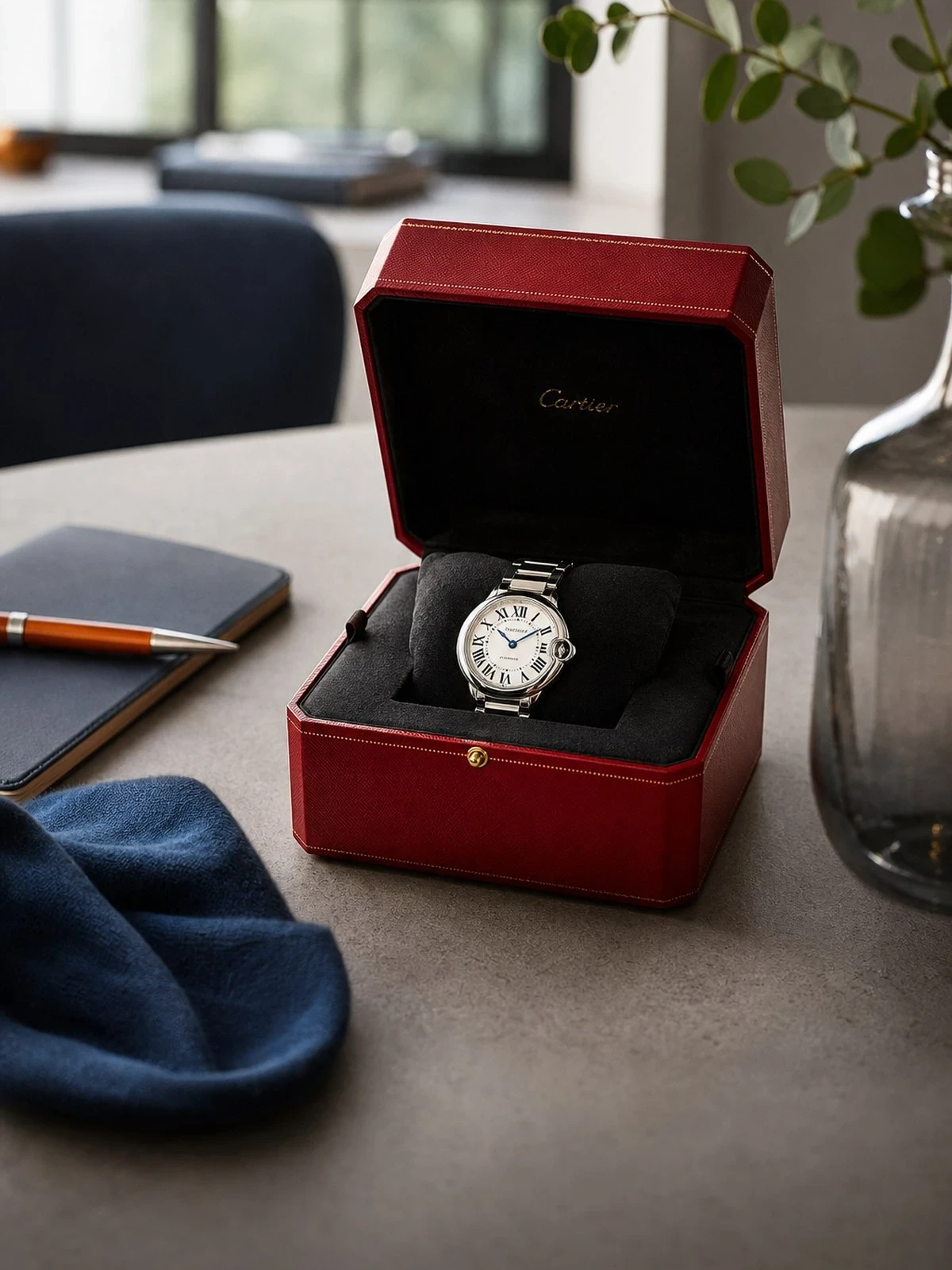
A Cartier is often valued not as a watch but as a piece of jewellery, and that changes who draws up the report, what can break and which clause affects you.
This page in another language: Nederlands
The calculator and the quote form below are in Dutch. Prefer to do this in English? Email info@finassverzekert.nl or call 072 - 509 24 56 and we will take it from there.
Work out for yourself what it would cost.
Enter your details; you will receive a proposal within one working day.
A premium indication, not personal advice. Prefer to talk it through? Call 072 - 509 24 56.
Cartier comes out of the jeweller's tradition and it shows in the pieces: precious metal cases, integrated bracelets, set stones and models that fall just as readily under jewellery as under watches. For insurance that means a different valuation. Not only the movement counts, but also the weight and fineness of the precious metal and the quality of the set stones. So have the report drawn up by a valuer who has command of both.
The second peculiarity is the pattern of claims. With a jewellery watch, the most common damage is not a faulty movement but the loss of a stone from its setting or a link breaking in the bracelet. Many policies only cover that where there is an identifiable cause, such as a knock or a fall. If a stone is lost because the setting has loosened or the link wore through from years of wear, that is maintenance and not an insured event.
The third point is when it is worn. A jewellery watch goes out to occasions, in a clutch bag, to the hotel and sometimes abroad. That is exactly where practice collides with the wearing and safe clause. Establish in advance what the policy allows when you are not wearing the watch, because a hotel safe is not always the safe the conditions have in mind.
We compare your valuables insurance across dozens of insurers, explain where the real differences lie, and arrange the switch from start to finish — without you having to chase it yourself.
 Valuables insurance
 Compare
 Get covered
The structure of the cover in three parts, with an overview per situation below.
Loss, theft and damage, wherever you are.
A recognised valuer records the value, usually for three to five years.
Provisions that determine when you are covered.
What is covered
| Situation | Valuables | Home contents |
|---|---|---|
| A Cartier lost on holiday | Yes | No |
| Stolen from the wrist in the street | Yes | No |
| Theft at home during a burglary | Yes | Sometimes |
| Damage through your own doing | Yes | No |
| Not in the safe when it should have been | No | No |
| Wear and loss of value | No | No |
This overview is general in nature and is not personal advice. What is actually covered, including exclusions, limits and the excess, is set out in the policy conditions and the insurance card (verzekeringskaart) of the insurer; you receive both before you take out cover. Taking out cover without advice? Then read what execution only means for you.
Insurers weigh these details differently. That is where your saving is.
We look at the terms as well as the premium, and stay your point of contact when there is a claim.
We are not tied to one insurer and compare on the basis of an objective analysis of several companies.
You call or email someone who knows your file. No menu options, no changing call centres.
We cancel your old policy and align the start date, so you are never a day without cover.
We report the claim and monitor how it is handled. In urgent cases you can reach us on the emergency line.
Customers rate our service on four aspects: personal service, service delivery, availability and the outcome. The reviews are collected and published by NH1816 and come from customers who have actually taken out a policy with Finass Advies B.V. or reported a claim.
Four points that make the difference between a policy that pays out and one that does not.
A valuation that looks only at the make and model falls short with Cartier. On some versions the precious metal weight, its fineness and the set stones account for most of the value, and assessing that calls for a gemmologist. Ask for a report with a description of each stone and each component. That makes partial damage traceable later and prevents argument about exactly what was lost.
A set stone that disappears from the case or the bracelet is often only noticed hours later. Without an identifiable sequence of events, many insurers treat that as gradual effect or wear and tear and therefore outside the cover. Have the settings checked at the periodic service and keep the service record. When you claim, that record is the difference between a mishap and deferred maintenance.
A watch you wear to occasions sits idle the rest of the time. Above a certain amount the policy then requires it to be kept in a safe, sometimes with an alarm and a monitoring centre connection. While travelling that is awkward: a hotel safe usually does not meet the safe requirement described. Ask in advance how the cover away from home is arranged and what is expected of you on overnight stays.
Wear of settings, links and the clasp is maintenance and is not insured. Nor are scratches on a gold case from normal wear. Loss of a stone with no identifiable cause is usually refused. And if you have the watch altered, engraved or fitted with a non-original strap, it departs from the valuation report; the difference in value that this creates is at your expense.
Stricter safe conditions apply to gem-set pieces than to a steel watch. Above a certain amount it almost always applies that the watch is in the safe when you are not wearing it, sometimes with a requirement for an alarm connected to a monitoring centre. After a theft that is the first thing you will be asked about, and it is the most common reason for refusal.
Repair calls for a valuer and watchmaker with command of both the horological and the jewellery side. Also keep the invoice, the box, the papers and the serial number, and photograph everything. After a loss the first question is whether the watch existed and what it was worth; keep that file digitally and not only at home.
This is what people ask us most.
That depends on the piece. On a version with a lot of precious metal and set stones the value lies largely in the material and a jewellery valuation is appropriate. On a plain steel version the emphasis is on the movement. In both cases the policy is valuables insurance. The difference lies in who values it and what is looked at.
Only with an identifiable cause, such as a fall or a knock. If the stone disappears because the setting has loosened, insurers regard that as gradual effect or deferred maintenance and it is excluded. Have the settings checked periodically and keep the service records; they make it plausible that it was not a defect that crept up.
Yes, if the territory is worldwide. Do watch the clause about storage: a hotel safe often does not meet the safe requirement in the policy, which can leave theft from the hotel room uninsured. If you are wearing the watch, the ordinary cover applies. Have this looked into in advance rather than after you get back.
A report drawn up as a valuation within the meaning of Article 7:960 of the Dutch Civil Code fixes the value for the term of the policy, so that no discussion about underinsurance arises when a loss occurs. A jeweller's statement of value does not always meet that standard. With gem-set pieces that matters all the more, because otherwise the value of the material and the stones is open to question each time.
Every situation is different. For these situations we have a separate page.
Request a quote without obligation. We will look at which insurer best matches your activities and your risk.
Prefer to call? 072 - 509 24 56, weekdays 09:00–17:00.
Claim on the road? Emergency line 06 - 55 20 40 72.
Finass Verzekert is a trading name of Finass Advies B.V. We advise on and arrange non-life insurance on the basis of an objective analysis of several insurers, and receive commission for this from the insurer, which is included in the premium. You pay no separate advice fee. Before you take out cover, we establish your wishes and needs.
You will find our licence, KvK and Kifid details and our complaints procedure at the foot of every page.
This page was compiled by Finass Verzekert. Last updated on .
The information on this page is general in nature and is not personal advice.
Maandag- Vrijdag: 09:00- 17:00
We use cookies and similar technologies to improve your experience on our website.