

The works
- Fire, storm and water
- Theft of materials
- Inherent defect and design fault
- Vandalism on the building site
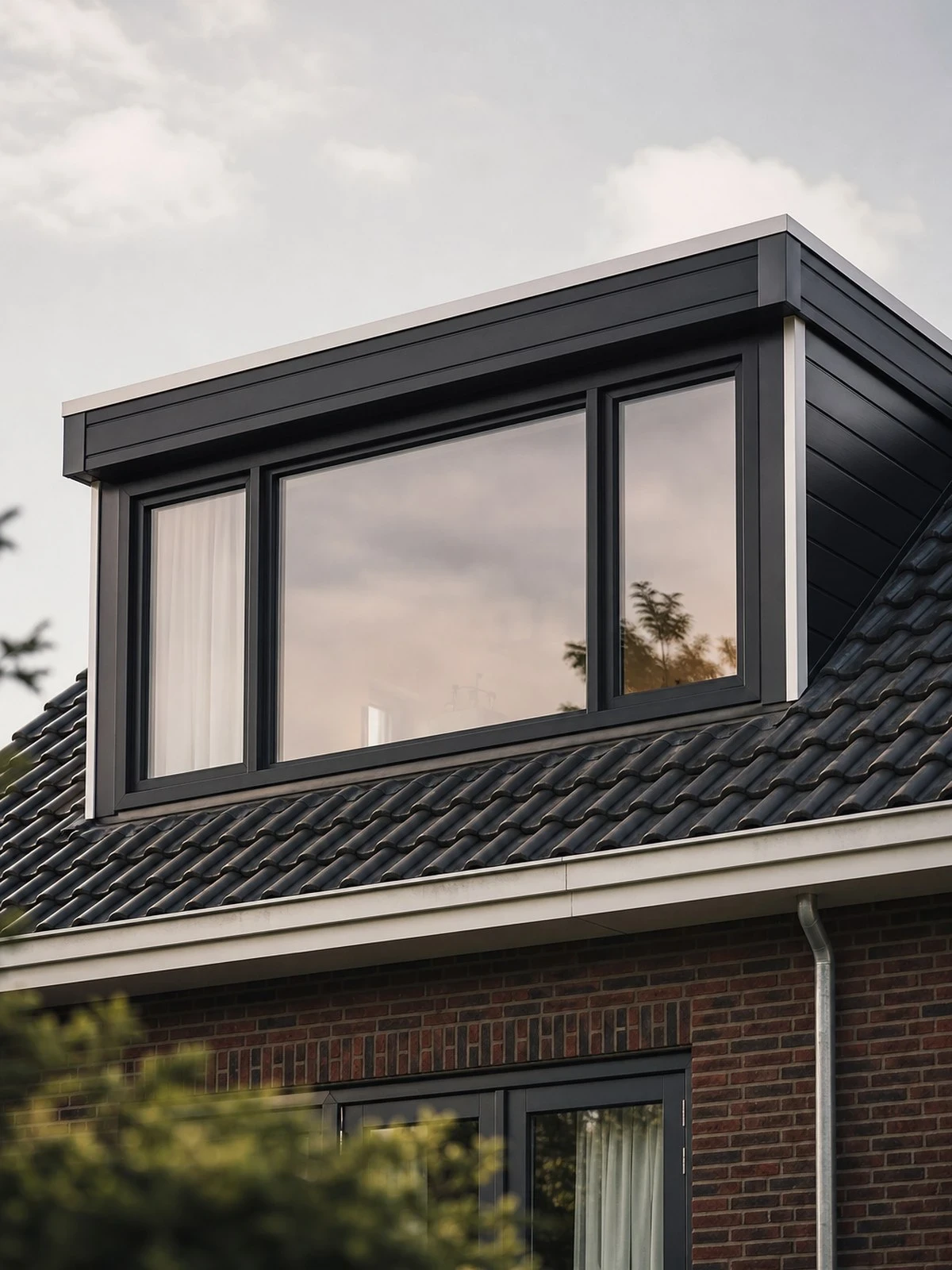
A dormer window is often in place within a day, but during that part of the day a complete unit hangs above an occupied house and the roof lies open to the loft.
This page in another language: Nederlands
Work out for yourself what it would cost.
Enter your details; you will receive a proposal within one working day.
A premium indication, not personal advice. Prefer to talk it through? Call 072 - 509 24 56.
The contract sum for a dormer window is modest. The possible damage is not. Soaked insulation, a ceiling that has to come out and the occupant's belongings together quickly run up to a multiple of the job. The sum insured for your works follows the contract sum, but the existing property section has to follow the house. Those are two very different amounts.
The second point is the lifting. A prefabricated unit goes over the facade on a crane or telehandler, often above a garden, a drive or the public road. Damage caused by a motor vehicle is excluded on liability covers, and a lorry-mounted crane or telehandler is one. For driving, Article 2 of the Dutch Motor Insurance Liability Act (WAM)applies; for the lifting itself, working risk cover on the policy of the machine is needed.
And then the client: with a dormer window that is almost always a private individual who simply goes on living there during the work. That brings with it the duty to inform in Article 7:765a of the Dutch Civil Code and a conversation about contents that you are better off having in advance. The page about private clients goes into that further.
We compare your construction all risks (CAR) insurance across dozens of insurers, explain where the real differences lie, and arrange the switch from start to finish — without you having to chase it yourself.
 Construction all risks (CAR) insurance
 Compare
 Get covered
The structure of the cover in three parts, with an overview per situation below.
Damage to the works themselves during construction or installation.
Damage to property and persons of third parties on and around the works.
What comes into play alongside the works themselves.
What is covered
| Situation | Works section | Liability section |
|---|---|---|
| Storm or water damage to the works in progress | Yes | No |
| Theft of materials from the building site | Sometimes | No |
| Damage to an adjoining building | No | Yes |
| Injury to a bystander | No | Yes |
| The client's existing property | Sometimes | Sometimes |
| Repair of your own defective work | No | No |
This overview is general in nature and is not personal advice. What is actually covered, including exclusions, limits and the excess, is set out in the policy conditions and the insurance card (verzekeringskaart) of the insurer; you receive both before you take out cover. Taking out cover without advice? Then read what execution only means for you.
Insurers weigh these details differently. That is where your saving is.
We look at the terms as well as the premium, and stay your point of contact when there is a claim.
We are not tied to one insurer and compare on the basis of an objective analysis of several companies.
You call or email someone who knows your file. No menu options, no changing call centres.
We cancel your old policy and align the start date, so you are never a day without cover.
We report the claim and monitor how it is handled. In urgent cases you can reach us on the emergency line.
Customers rate our service on four aspects: personal service, service delivery, availability and the outcome. The reviews are collected and published by NH1816 and come from customers who have actually taken out a policy with Finass Advies B.V. or reported a claim.
Four points that make the difference between a policy that pays out and one that does not.
When a prefabricated dormer is lifted, the load passes over the facade, the garden or the street. If something is damaged in the process, the motor vehicle exclusion is the first obstacle: damage with or by the crane does not fall on your construction policy. If you hire in a crane with an operator, ask about the working risk cover and record who gives the instructions. Without that agreement two insurers point at each other.
For the opening, roof rafters have to be cut and supported by a trimmer structure. If something goes wrong there and the roof sags, that is a workmanship error: repairing your own work is at your expense. The damage to the roof, the ceiling and the rest of the house is consequential damage and falls under the existing property section. Keep the structural assumptions you worked to.
Between cutting the opening and making it watertight, the loft is open. Plan around the weather forecast, have covering material ready before the first tile comes off, and do not carry on if thunderstorms are forecast. In the event of water damage, insurers assess whether you made that judgement. Leaving a roof open because the unit is only being delivered the next morning is not an unforeseen event but a planning choice.
Floors, furniture and items stored in the loft are within reach of your work, and contents do not automatically fall under existing property. Agree that the loft will be cleared and record with photographs how the ceiling and roof boarding looked; arguments afterwards are almost always about damp patches that were already there. Also state in writing whether and how your liability is insured, as Article 7:765a of the Dutch Civil Code requires.
If you work in or on an existing building, that building is not your works but the property of the client. Damage to it does not fall under section 1 and, on your AVB, falls under the care, custody and control exclusion. The section existing property fills that gap, and with conversions, renovations and installation work that is not an edge case but the core of the risk.
After handover there is often a maintenance period during which you remain liable for defects that arose during construction. Agree that period explicitly and have it stated on the policy. Under the Wet kwaliteitsborging (the Dutch Building Quality Assurance Act) this carries more weight: Article 7:758(4) of the Dutch Civil Code places the burden of proof for hidden defects on the contractor.
This is what people ask us most.
You can, but for a job of one or two days it is rarely practical. Continuous cover includes every job automatically up to an agreed maximum per works, so that you do not have to make an application for each assignment. A separate project policy is mainly worthwhile for an unusually large or unusual works for which the client requires a policy schedule of its own.
Not on your construction policy. Liability covers exclude damage caused by a motor vehicle, and a lorry-mounted crane or telehandler counts as one. For the traffic element the compulsory cover under Article 2 WAM applies. For damage during lifting, working risk cover on the policy of the machine is needed. Check that in advance for hired plant.
In reality you do, and that is only possible with photographs taken in advance. An occupant reports after the job what they notice and links it to your work. Without a survey beforehand it is your word against theirs. So before starting, walk through the loft and the room below together and record the condition, preferably with the date in the file.
Not automatically. The existing property section relates first of all to the building, not to the contents. If you want those covered as well, have it included expressly. It is wiser to have the loft cleared completely before you start. That removes the argument and, in the event of a leak, saves the largest part of the loss.
Every situation is different. For these situations we have a separate page.
Request a quote without obligation. We will look at which insurer best matches your activities and your risk.
Prefer to call? 072 - 509 24 56, weekdays 09:00–17:00.
Claim on the road? Emergency line 06 - 55 20 40 72.
Finass Verzekert is a trading name of Finass Advies B.V. We advise on and arrange non-life insurance on the basis of an objective analysis of several insurers, and receive commission for this from the insurer, which is included in the premium. You pay no separate advice fee. Before you take out cover, we establish your wishes and needs.
You will find our licence, KvK and Kifid details and our complaints procedure at the foot of every page.
This page was compiled by Finass Verzekert (LinkedIn). Last updated on .
The information on this page is general in nature and is not personal advice.
Maandag- Vrijdag: 09:00- 17:00
We use cookies and similar technologies to improve your experience on our website.