

Liability
- Collision and jetty damage
- No legal obligation
- Often required by the marina
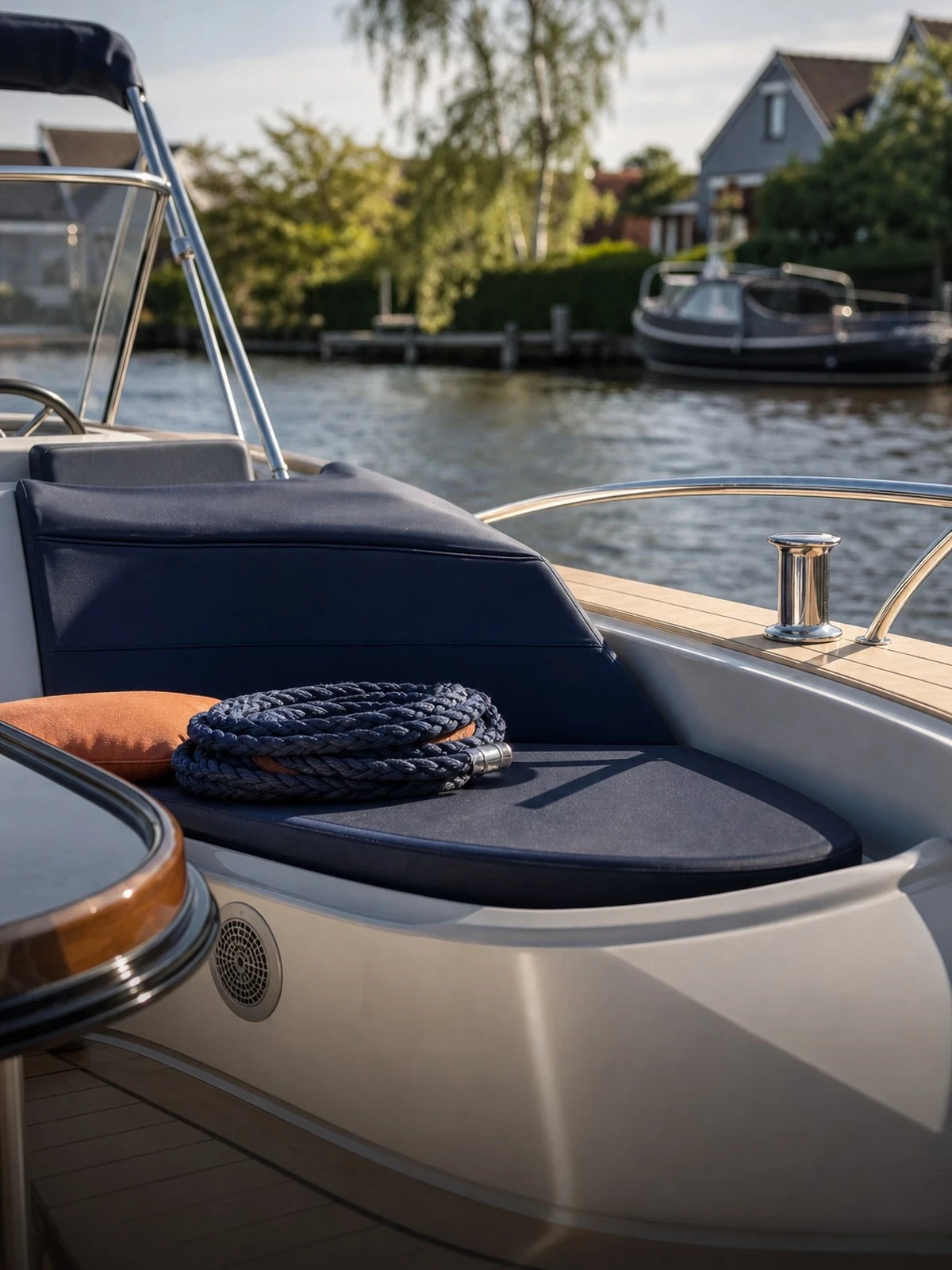
A predator fishing boat is usually an open boat with a lot of electronics on board: sonar, a plotter, an electric trolling motor and batteries. It is precisely that equipment and the loose fishing gear that are not automatically covered by the own-damage section.
This page in another language: Nederlands
The calculator and the quote form below are in Dutch. Prefer to do this in English? Email info@finassverzekert.nl or call 072 - 509 24 56 and we will take it from there.
Work out for yourself what it would cost.
Enter your details; you will receive a proposal within one working day.
A premium indication, not personal advice. Prefer to talk it through? Call 072 - 509 24 56.
The liability cover pays for damage you cause to others with the boat: a collision, damage to a jetty or a quay wall and injury to someone on another craft. That cover is not compulsory by law, but many fishing waters, harbours and slipways make it a condition, and abroad it is asked for regularly.
The own-damage cover pays for damage to the boat itself: the hull, the console, the seats, the outboard motor and the permanently fitted instruments. That last word is decisive. A plotter or sonar unit fitted in the console belongs to the boat. A portable fishfinder, loose batteries, rods, reels and a keepnet do not. Those fall under equipment or personal belongings, with a separate limit or no cover at all.
You set the sum insured on the basis of the purchase value or a valuation report. A valuation under Article 7:960 of the Dutch Civil Code makes the amount binding for an agreed period. Have the outboard motor, the trolling motor and the electronics listed separately with their values. See also the general pleasure craft insurance.
We compare your pleasure craft insurance across dozens of insurers, explain where the real differences lie, and arrange the switch from start to finish — without you having to chase it yourself.
 Pleasure craft insurance
 Compare
 Get covered
Three components that you choose separately, with an overview per situation below.
Damage you cause to others with the vessel.
Damage to the boat, the engine and the fixed equipment.
What you add separately.
What is covered
| Situation | Liability | Own-damage cover |
|---|---|---|
| Damage to another vessel or a jetty | Yes | No |
| Theft of the boat or the outboard motor | No | Provided that |
| Fire and storm damage in the berth or ashore | No | Yes |
| Sinking through a leak or through rainwater | No | Provided that |
| Salvage and removal of the wreck | Provided that | Provided that |
| Osmosis, wear and deferred maintenance | No | No |
There is no statutory insurance requirement for pleasure craft. The WAM applies only to motor vehicles. Marinas, harbours and hire companies do generally require liability cover. Pay attention to the sailing area described and to the lay-up or winter storage period: outside the sailing area or during undeclared storage, cover may lapse.
What is actually covered, including exclusions, limits and the excess, is set out in the policy conditions and the insurance card (verzekeringskaart) that you receive before you take out cover.
Insurers weigh these details differently. That is where your saving is.
We look at the terms as well as the premium, and stay your point of contact when there is a claim.
We are not tied to one insurer and compare on the basis of an objective analysis of several companies.
You call or email someone who knows your file. No menu options, no changing call centres.
We cancel your old policy and align the start date, so you are never a day without cover.
We report the claim and monitor how it is handled. In urgent cases you can reach us on the emergency line.
Customers rate our service on four aspects: personal service, service delivery, availability and the outcome. The reviews are collected and published by NH1816 and come from customers who have actually taken out a policy with Finass Advies B.V. or reported a claim.
Four points that determine whether the policy actually pays out in the event of a claim.
The own-damage cover is about the boat and what is permanently fitted in or on it. A plotter mounted in the console, a through-hull transducer and a permanently mounted trolling motor belong to it. Loose rods, reels, portable fishfinders, power banks, batteries and tackle fall outside it, or under a low limit for equipment. On predator fishing boats the value of that equipment regularly exceeds the value of the hull. So have the equipment listed on the policy schedule with a description and a value, or insure it separately.
A detachable outboard motor and a trolling motor on the bow plate are popular targets. Insurers cover theft subject to conditions: a certified motor lock, mounting with security bolts and storage on a locked site or in a shed. If those requirements are not met, no payment follows, even though the motor appears on the policy. The same often applies to the trailer: a hitch lock or a wheel clamp can be a condition. Keep serial numbers and purchase invoices with your policy documents.
The policy schedule states where you may sail: for example the Dutch inland waters, or a wider area including the IJsselmeer, the Waddenzee or coastal waters. If you sail outside it, there is no cover, not even for liability. Anyone going abroad on a fishing trip has to have the cover extended in advance. The use counts too: guided fishing trips for payment, guiding work and hiring out the boat are commercial use and are almost always excluded on a private policy.
Predator fishing boats are often kept on a trailer. Damage during transport by road is not automatically covered, and the the trailer itself is never covered by the boat policy. In the winter storage a lay-up period with limited cover applies; frost damage because the engine or the cooling system has not been drained is not covered. Wear and tear, osmosis, corrosion and deferred maintenance are covered nowhere. Damage caused deliberately or recklessly is excluded under Article 7:952 of the Dutch Civil Code. State the use, the equipment and the storage address correctly (Article 7:928 of the Dutch Civil Code) and report a claim as soon as reasonably possible (Article 7:941 of the Dutch Civil Code).
This is what people ask us most.
Usually not. Permanently fitted instruments belong to the boat, but loose rods, reels, portable fishfinders, batteries and tackle fall under equipment with a low limit or outside the cover altogether. Have valuable equipment listed on the policy schedule with a description and a value, or insure it separately; otherwise you are empty-handed if it is stolen from the boat.
Only if it appears on the policy with its make, type and serial number and the security requirements have been met. Insurers generally ask for mounting with security bolts or a lock, and for storage on a locked site. If the motor is taken off the bow plate and stored separately, check whether the cover also applies away from the boat.
Not on a private policy. Guided trips for payment, guiding work and hiring out the boat count as commercial use and are almost always excluded. That calls for commercial cover. If you fail to disclose that use, the insurer can reduce or refuse payment under Article 7:930 of the Dutch Civil Code and terminate the policy.
For pleasure craft capable of more than 20 kilometres per hour, or longer than 15 metres, the small craft boating licence is compulsory. Many predator fishing boats with a more powerful outboard motor fall under this. If you sail without the required licence, that is an exclusion on almost every policy and the insurer does not have to pay the own-damage claim.
Damage during transport on the trailer is not automatically covered. That varies from policy to policy and sometimes calls for a separate module. You insure the trailer itself separately or through the trailer cover on your motor insurance. During the lay-up period, cover remains limited to fire, storm and theft, and frost damage from a system that has not been drained is excluded.
Every situation is different. For these situations we have a separate page.
Request a quote without obligation. We check the sailing area, the value of your equipment and the security requirements.
Prefer to call? 072 - 509 24 56, weekdays 09:00–17:00.
Claim on the road? Emergency line 06 - 55 20 40 72.
Finass Verzekert is a trading name of Finass Advies B.V. We advise on and arrange non-life insurance on the basis of an objective analysis of several insurers, and receive commission for this from the insurer, which is included in the premium. You pay no separate advice fee. Before you take out cover, we establish your wishes and needs.
You will find our licence, KvK and Kifid details and our complaints procedure at the foot of every page.
This page was compiled by Finass Verzekert (LinkedIn). Last updated on .
The information on this page is general in nature and is not personal advice.
Maandag- Vrijdag: 09:00- 17:00
We use cookies and similar technologies to improve your experience on our website.