

Motorcycle insurance through Klaverblad
Motorcycle policies resemble each other in the names of their covers and differ in the provisions underneath. Choosing an insurer is about those provisions, not about the name on the policy schedule.
- Several insurers compared objectively
- 9.5 customer rating for a new policy
- AFM licence 12016589
- Personal 072 - 509 24 56, weekdays 9–17
This page in another language: Nederlands
Work out for yourself what it would cost.
Enter your details; you will receive a proposal within one working day.
- We compare the offerings of several insurers
- An adviser checks whether the cover suits your situation
- We arrange the switch, including cancellation
A premium indication, not personal advice. Prefer to talk it through? Call 072 - 509 24 56.
- Independent advice
- Several insurers
- Switching arranged
- Help with claims
In brief
Finass Advies acts as an intermediary and compares the market objectively across several insurers. Klaverblad is one of the companies we approach for motorcyclists. Which policy it becomes follows from your situation: the type of machine, your claims history and whether you ride all year round. The forms of cover themselves are set out under motorcycle insurance cover.
Where policies really differ is in four provisions: the length of the purchase price basis, the structure of the no-claims table and how far you fall back after a claim, the scope of the accessories section, and whether assistance also applies within the Netherlands. Two quotations with the same premium can be far apart on those points. So ask not only for a price, but for the conditions alongside it.
One point motorcyclists underestimate: in a collision with a car you have no special statutory protection. Article 185 of the Dutch Road Traffic Act protects pedestrians and cyclists against motorised traffic, but that provision does not apply between two motor vehicles. You have to prove the other party's fault under Article 6:162 of the Dutch Civil Code. That makes the quality of the recovery assistance on your policy a real criterion of choice.
This page deals with one situation. The full overview is on Compare motorcycle insurance.
Independent, personal, sorted quickly
We compare your motorcycle insurance across dozens of insurers, explain where the real differences lie, and arrange the switch from start to finish — without you having to chase it yourself.
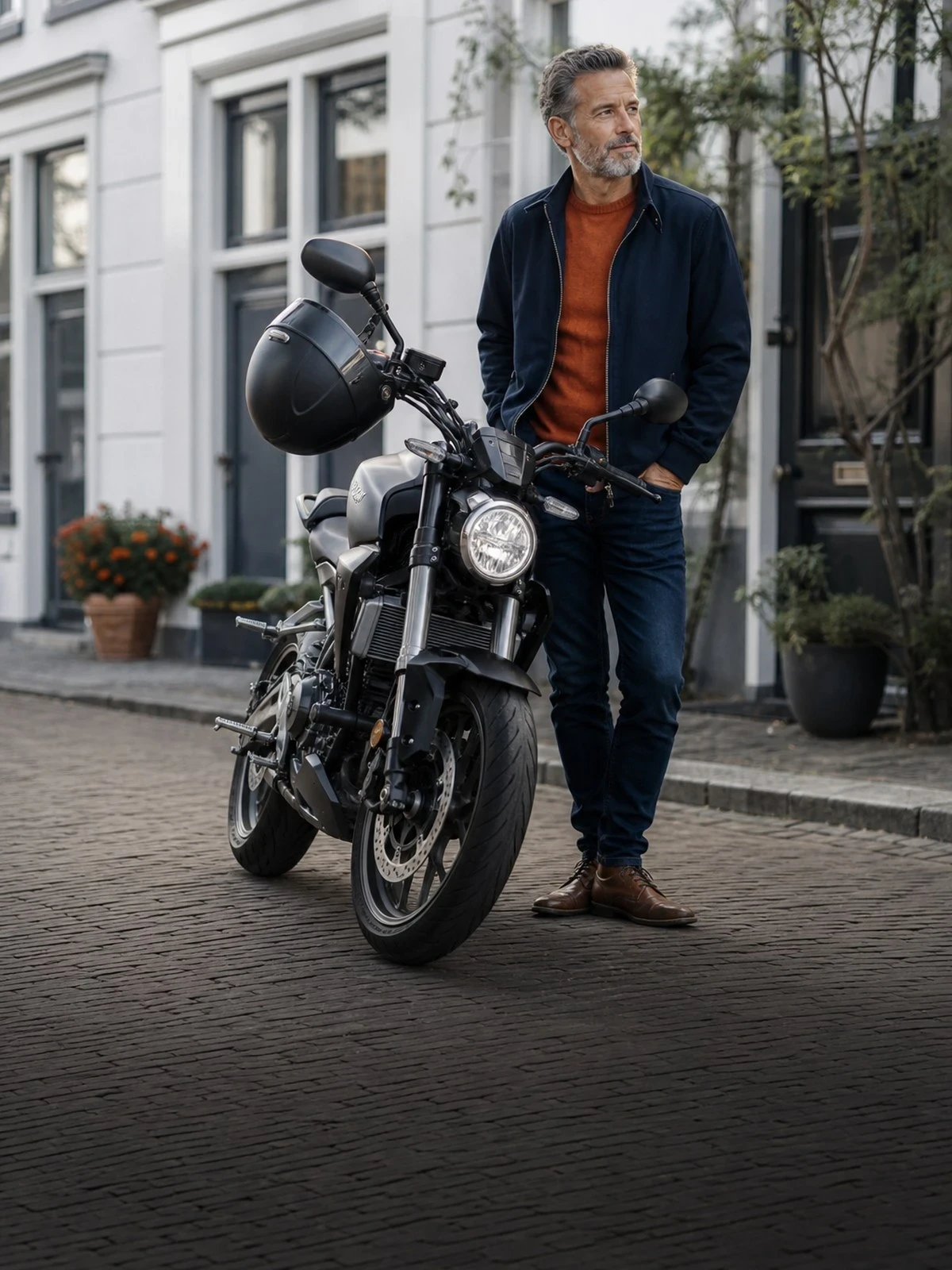 Motorcycle insurance
 Compare
 Get covered
Why arrange it through Finass Verzekert?
We look at the terms as well as the premium, and stay your point of contact when there is a claim.
Independent
We are not tied to one insurer and compare on the basis of an objective analysis of several companies.
One fixed adviser
You call or email someone who knows your file. No menu options, no changing call centres.
Switching without hassle
We cancel your old policy and align the start date, so you are never a day without cover.
Help with claims
We report the claim and monitor how it is handled. In urgent cases you can reach us on the emergency line.
What to look out for
Four points on which motorcycle policies differ from each other and which you should have confirmed in advance.
Recovering your own loss
If a car driver hits you, you have to prove his liability. Without witnesses or camera footage that often ends in an argument about the apportionment of blame. A recovery assistance cover on the motorcycle policy or a separate legal expenses insurance deals with the legal side and the costs of an expert. Without that cover you pay for that process yourself, even where you are ultimately proved right.
Valuation basis and no-claims table
Ask how long the purchase price basis runs and what the drop in the no-claims scale is after one claim. Some policies offer no-claims protection under which one claim per period does not affect the step on the scale. That claim is often still counted when your no-claims years are reported to a subsequent insurer. So also ask what is registered.
Excess and the choice on an older machine
On a machine with a low market value, comprehensive cover rarely justifies the premium plus the excess. Third-party, fire and theft, however, covers no fall of your own: only named perils such as fire, theft, storm and glass breakage. Work out what would be left on a total loss. For enthusiasts' machines the structure of a classic motorcycle is often more suitable.
What virtually every policy excludes
Damage during competitions, speed events and gymkhanas falls outside, including track days. Riding under the influence or refusing a breath test leads to a claim being declined and to recovery of the amount paid to the other party. Letting and carriage for hire or reward are excluded, and intent in any event under Article 7:952 of the Dutch Civil Code. A breakdown on the road is not damage and calls for assistance cover.
What does your premium depend on?
- Type, weight and power output: the classification into rating groups runs along these lines
- Age and experience: the number of years holding a licence counts
- No-claims years: and whether protection is included
- Type of cover and excess: third-party liability, third-party, fire and theft, or comprehensive, with or without add-ons
- Storage location: a locked garage is weighed differently from the street
- Annual mileage: seasonal riders cover fewer kilometres
Insurers weigh these details differently. That is where your saving is.
What is covered
| Situation | Third-party liability | Comprehensive |
|---|---|---|
| You brake too late and damage the tailgate of the car in front of you | Yes | Yes |
| You slide out on a patch of oil and the machine lands on its side | No | Yes |
| Your motorcycle is stolen from a locked garage | No | Yes |
| Your motorcycle jacket and helmet are unusable after the fall | No | Provided that |
| You come off on a bend during a track day on a closed circuit | No | No |
| After winter storage the machine will not start because of corrosion and a flat battery | No | No |
Your own injury falls outside these columns; occupant or accident cover alongside the motorcycle policy is needed for that.
Frequently asked questions
This is what people ask us most.
Why does the premium differ so much between companies?
Because every insurer uses its own rating groups and applies its own underwriting rules to age, length of licence, postcode and type of machine. A company with many touring riders on its books prices a sports model differently from one that actively targets them. So always compare premium and conditions together. The cheapest policy may have a shorter valuation basis.
Am I better protected against a car as a motorcyclist?
No. Article 185 of the Dutch Road Traffic Act protects non-motorised road users such as pedestrians and cyclists. A motorcycle is a motor vehicle, so between you and the car the ordinary rules of Article 6:162 of the Dutch Civil Code apply: you have to show that the other party acted unlawfully. After a collision, make sure you get witness details and photographs of the final positions.
What happens in the case of drink-riding?
The own damage is not paid for and the insurer recovers from you the amount paid to the other party. Third-party liability cover remains in place towards the victim, because the WAM requires that, but the insurer may then turn to you. Refusing a breath or blood test is usually treated in the conditions as equivalent to riding under the influence.
What exactly is no-claims protection?
An additional condition under which one claim per period does not lead to a drop in the no-claims scale, so that your discount stays the same. Note the distinction with the registration of no-claims years: the claim is usually still reported, so that on switching insurer you can still end up lower. Ask in advance how the company records this.
Every situation is different. For these situations we have a separate page.
- Compare motorcycle insuranceThe main page
- Choosing motorcycle insurance that suits your motorcycleForm of cover, licence category, modifications
- Insuring your Honda motorcycleDriving licence category, accessories, imports
- Insuring an MP3: motorcycle, scooter or something in betweenVehicle category, driving licence, rate
- Insuring your KTMRegistration or off-road, modifications, transport
- Insuring your MP3 against theft and damageTipping over, lock certificate, accessories
- The cover provided by motorcycle insuranceThird-party, third-party, fire and theft, comprehensive