

The works
- Fire, storm and water
- Theft of materials
- Inherent defect and design fault
- Vandalism on the building site
In steel construction the largest single loss hangs on a cable: the erection phase is short and determines virtually the whole risk profile.
This page in another language: Nederlands
Work out for yourself what it would cost.
Enter your details; you will receive a proposal within one working day.
A premium indication, not personal advice. Prefer to talk it through? Call 072 - 509 24 56.
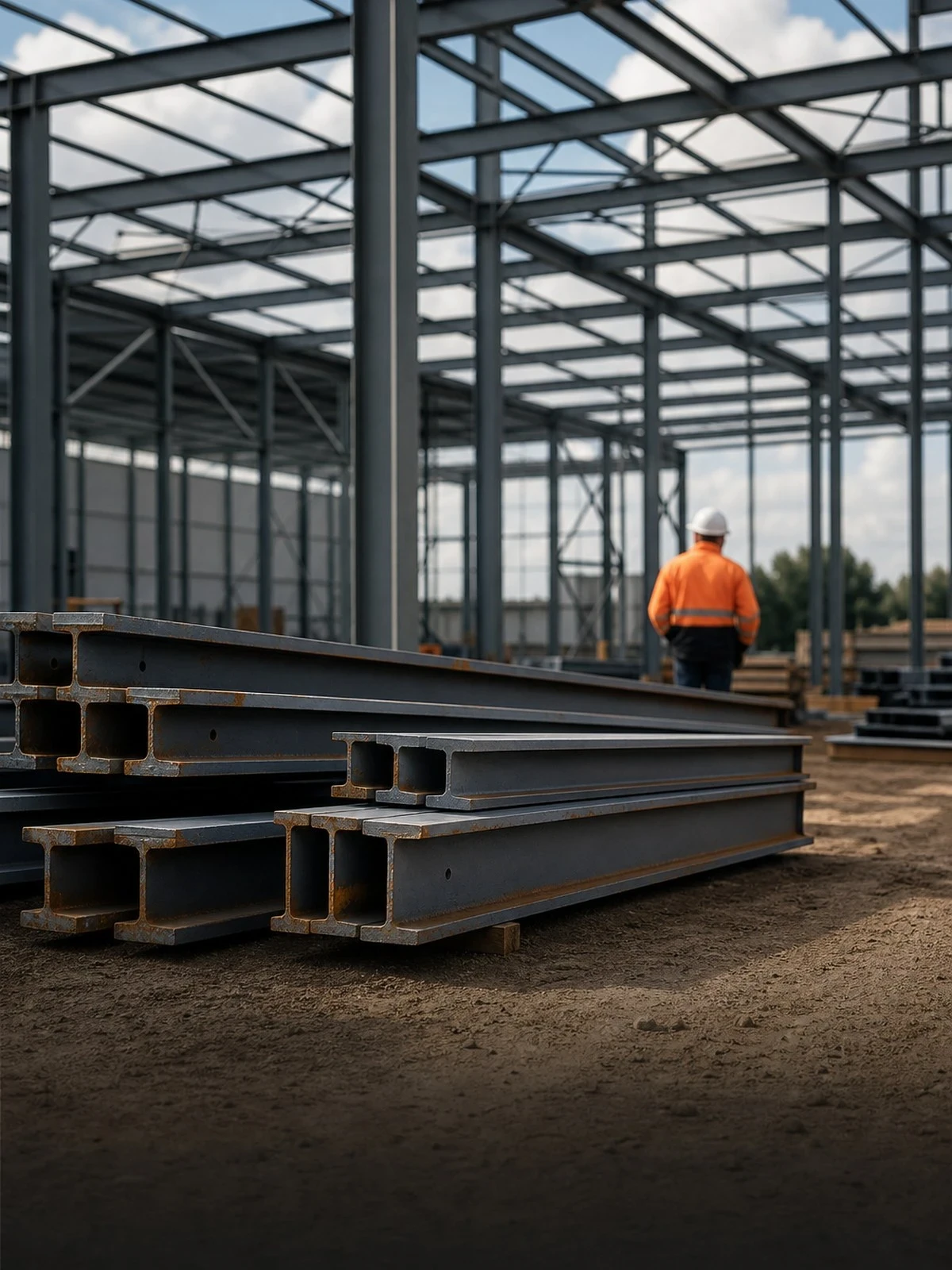
Steel structures are made in a workshop and assembled on site. That means the value of the works arrives in a short time, in parts fabricated with weeks of lead time, and that the critical moments are concentrated: unloading, slinging, lifting and temporary setting until the structure is stable.
A load that falls or swings affects three kinds of interest in one movement: your own works, the plant and the people below. That brings the works section, the liability section and the employers' liability in Article 7:658 of the Dutch Civil Code into play at the same time, while the mobile crane itself is a motor vehicle and needs its own insurance under Article 2 WAM.
Finally, on erection work the type of policy shifts. Where the bulk of the work consists of installing and assembling rather than building, an erection all risks insurance often fits better than a classic construction policy.
We compare your construction all risks (CAR) insurance across dozens of insurers, explain where the real differences lie, and arrange the switch from start to finish — without you having to chase it yourself.
 Construction all risks (CAR) insurance
 Compare
 Get covered
The structure of the cover in three parts, with an overview per situation below.
Damage to the works themselves during construction or installation.
Damage to property and persons of third parties on and around the works.
What comes into play alongside the works themselves.
What is covered
| Situation | Works section | Liability section |
|---|---|---|
| Storm or water damage to the works in progress | Yes | No |
| Theft of materials from the building site | Sometimes | No |
| Damage to an adjoining building | No | Yes |
| Injury to a bystander | No | Yes |
| The client's existing property | Sometimes | Sometimes |
| Repair of your own defective work | No | No |
This overview is general in nature and is not personal advice. What is actually covered, including exclusions, limits and the excess, is set out in the policy conditions and the insurance card (verzekeringskaart) of the insurer; you receive both before you take out cover. Taking out cover without advice? Then read what execution only means for you.
Insurers weigh these details differently. That is where your saving is.
We look at the terms as well as the premium, and stay your point of contact when there is a claim.
We are not tied to one insurer and compare on the basis of an objective analysis of several companies.
You call or email someone who knows your file. No menu options, no changing call centres.
We cancel your old policy and align the start date, so you are never a day without cover.
We report the claim and monitor how it is handled. In urgent cases you can reach us on the emergency line.
Customers rate our service on four aspects: personal service, service delivery, availability and the outcome. The reviews are collected and published by NH1816 and come from customers who have actually taken out a policy with Finass Advies B.V. or reported a claim.
Four points that make the difference between a policy that pays out and one that does not.
After a lifting incident the expert asks about the lifting plan, the declared weights, the calculation of outrigger pressure, the bearing capacity of the ground and the certificates of the slinger and the crane operator. If those are missing, the conclusion is quickly that insufficient care was taken. Record for each critical lift what you calculated and who stood where, including the wind reading, because the wind limit is the most frequently exceeded threshold in this trade.
Between setting the first column and fitting the wind bracing, the steel is geometrically unstable. Collapse in that phase is physical damage to your own works, and the insurer will assess whether the temporary stability provisions complied with the erection drawing. Do not run ahead of the bracing to gain time on the programme: that is precisely the deviation on which cover fails, and it is visible afterwards in the erection sequence.
Trusses and beams travel as abnormal loads and then lie on site for days. Damage or distortion during the journey, or theft of steel from the site, falls outside the works section as long as transport and storage on site have not been insured separately. On an element with an eight-week lead time the problem is not the replacement value but the standstill of the rest of the build waiting for it.
Fire arising from welding or cutting work is assessed against the fire safety requirements: combustible material removed, sparks screened off, an extinguisher within reach and a check afterwards. Beyond that, putting right your own welding faults or dimensional deviations is excluded, as are corrosion and reapplying damaged protective coatings. For the mobile crane, damage to the vehicle itself falls under plant and machinery insurance and not under the construction policy.
If you work in or on an existing building, that building is not your works but the property of the client. Damage to it does not fall under section 1 and, on your AVB, falls under the care, custody and control exclusion. The section existing property fills that gap, and with conversions, renovations and installation work that is not an edge case but the core of the risk.
After handover there is often a maintenance period during which you remain liable for defects that arose during construction. Agree that period explicitly and have it stated on the policy. Under the Wet kwaliteitsborging (the Dutch Building Quality Assurance Act) this carries more weight: Article 7:758(4) of the Dutch Civil Code places the burden of proof for hidden defects on the contractor.
This is what people ask us most.
No. A mobile crane is a motor vehicle and needs its own liability cover under Article 2 WAM; damage to the crane itself belongs on plant and machinery insurance or is at your expense under the hire contract. What the construction policy can cover is the damage the crane causes to your works or to third parties.
Injury to your own staff does not run through the liability section for third parties but through your employers' liability. Article 7:658 of the Dutch Civil Code places the duty of care on you, and after an accident you have to show that you met it: fall protection, anchor points, instruction and supervision. Separate employers' liability cover is not a luxury for erection work at height.
When the emphasis lies on assembly and commissioning rather than on building work. An erection policy is tailored to the assembly and testing of structures and installations, with attention to the test phase. Where steel construction is part of a wider building project, you are often included on the main contractor's project policy. In that case check that you are named on it as a co-insured.
That the lifting zone is fenced off, that nobody comes under the load and that there is supervision with a designated responsible person. On a claim about injury to someone from another party, the insurer checks those measures. Record the barriers and the coordination with the other contractors in writing in the site meeting, including the times during which lifting takes place.
Every situation is different. For these situations we have a separate page.
Request a quote without obligation. We will look at which insurer best matches your activities and your risk.
Prefer to call? 072 - 509 24 56, weekdays 09:00–17:00.
Claim on the road? Emergency line 06 - 55 20 40 72.
Finass Verzekert is a trading name of Finass Advies B.V. We advise on and arrange non-life insurance on the basis of an objective analysis of several insurers, and receive commission for this from the insurer, which is included in the premium. You pay no separate advice fee. Before you take out cover, we establish your wishes and needs.
You will find our licence, KvK and Kifid details and our complaints procedure at the foot of every page.
This page was compiled by Finass Verzekert (LinkedIn). Last updated on .
The information on this page is general in nature and is not personal advice.
Maandag- Vrijdag: 09:00- 17:00
We use cookies and similar technologies to improve your experience on our website.