

Liability insurance for an independent garage business
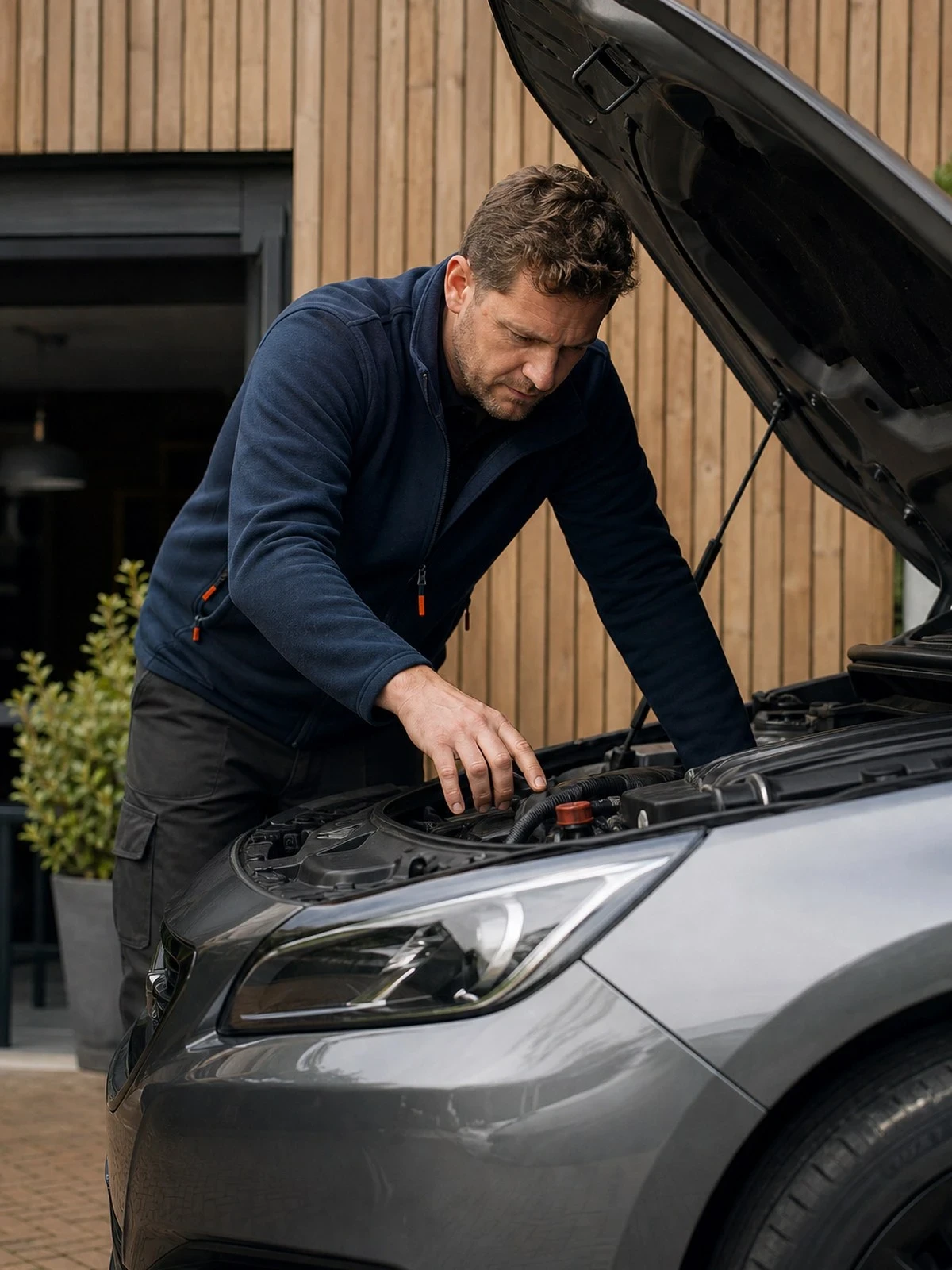
If you work on cars as a self-employed person, on the customer's drive or in a small workshop of your own, the risk shifts from staff to the vehicle you have in your care.
- Several insurers compared objectively
- 9.5 customer rating for a new policy
- AFM licence 12016589
- Personal 072 - 509 24 56, weekdays 9–17
This page in another language: Nederlands
Work out for yourself what it would cost.
Enter your details; you will receive a proposal within one working day.
- We compare the offerings of several insurers
- An adviser checks whether the cover suits your activities
- We arrange the switch, including cancellation
A premium indication, not personal advice. Prefer to talk it through? Call 072 - 509 24 56.
- Independent advice
- Several insurers
- Switching arranged
- Help with claims
In brief
As a self-employed motor engineer you have no staff, so employers' liability stays out of the picture and two other provisions weigh all the more heavily. The first is the motor vehicle exclusion: anything you cause with a car while driving it falls outside the AVB and under the insurance requirement of Article 2 of the Dutch Motor Insurance Liability Act (WAM). A test drive after a repair, moving a car a short distance and collecting it from the customer all fall under that. Discuss in advance who bears the driving risk and whether that has to be placed on a garage insurance.
The second provision is the care, custody and control exclusion. As long as you are working on a car, you have it in your care. A scratch in the bodywork from a spanner that slips, a burnt-out wiring loom or a vehicle that slides off the jack is then not an insured loss. What can be covered is the damage arising beyond that: the customer's garage door, the car next to it on the drive, the tiled floor you spill oil on.
That leaves the consequences of your work after you have left. If a brake line comes loose or a wheel bolt turns out not to have been tightened, the damage to other vehicles and the injury flowing from it are liability under Article 6:162 of the Dutch Civil Code. Carrying out the repair again, with new parts and your own hours, remains your your own work and is not insured anywhere.
This page deals with one situation. The full overview is on Compare public and employers' liability insurance (AVB).
Independent, personal, sorted quickly
We compare your business liability insurance (AVB) across dozens of insurers, explain where the real differences lie, and arrange the switch from start to finish — without you having to chase it yourself.
 Business liability insurance (AVB)
 Compare
 Get covered
Why arrange it through Finass Verzekert?
We look at the terms as well as the premium, and stay your point of contact when there is a claim.
Independent
We are not tied to one insurer and compare on the basis of an objective analysis of several companies.
One fixed adviser
You call or email someone who knows your file. No menu options, no changing call centres.
Switching without hassle
We cancel your old policy and align the start date, so you are never a day without cover.
Help with claims
We report the claim and monitor how it is handled. In urgent cases you can reach us on the emergency line.
What to look out for
Four points that make the difference between being paid and not being paid for a sole trader business in motor engineering.
Working on someone else's premises
If you carry out repairs at people's homes or in a company car park, declare that in the application. A policy that assumes work in your own workshop does not automatically cover an oil stain on a private drive or damage to a vehicle parked next to it. Undisclosed circumstances can lead to a partial payout under Articles 7:928 and 7:930 of the Dutch Civil Code.
Electric cars and high voltage
Work on a traction battery calls for demonstrable competence and the right tools. Insurers impose requirements on this, and after a fire following battery work compliance is checked. If the fire spreads to the house or to an adjoining building, it quickly becomes a substantial claim in which the question of your certification is central.
What you continue to bear yourself
Excluded are: the vehicle you are working on, any damage you cause while driving a motor vehicle, putting your own repair right, and administrative fines. Your own tools are not a liability matter but property; there is tools insurance for self-employed professionals.
Your own inability to work is not covered
If you are injured under a car or by an angle grinder, the AVB pays nothing: that policy is there for other people's losses. You arrange income during long-term absence with disability insurance. For a sole trader with no colleagues to take over the work, that is often the weightier risk.
What does your premium depend on?
- Annual turnover: the usual measure for a self-employed person with no wage bill
- Nature of the work: maintenance, diagnostics, accident repair or battery work
- Working on site or in your own premises: mobile work touches more third-party property
- Sale or fitting of parts: supplying goods brings liability for the goods supplied
- Care, custody and control cover required: for the vehicle you have in your care
- Sum insured and excess: per claim and per insurance year
Insurers weigh these details differently. That is where your saving is.
What is covered
| Situation | Basic | With care, custody and control cover |
|---|---|---|
| A spanner slips and puts a scratch in the wing of the car you are working on | No | Yes |
| You spill oil on the decorative paving of your customer's drive | Yes | Yes |
| A brake line you fitted comes loose and the customer causes a collision | Yes | Yes |
| You drive the customer's car to the car wash and hit a bollard on the way | No | No |
| A charging cable you borrowed from the customer burns through while you are working | No | Yes |
| You are injured yourself under a car and cannot take on work for weeks | No | No |
Care, custody and control cover is exclusively about the vehicle you have in your hands, not about your own absence or the driving risk.
Frequently asked questions
This is what people ask us most.
Am I insured during a test drive in the customer's car?
Not on public and employers' liability insurance. Driving a motor vehicle falls under the motor vehicle exclusion and under the compulsory insurance in Article 2 WAM. In reality you then drive on the customer's third-party cover, with all the consequences for their no-claims years, or on separate motor trade cover. Make a written arrangement about that in advance.
What if a customer says my repair wrecked the engine?
The care, custody and control exclusion then comes into play: you had the car you were working on in your care, and damage to it is excluded as standard. Some insurers offer limited care, custody and control cover for an additional premium, usually with a lower sum insured and an excess. Ask about it expressly if you regularly carry out major repairs.
As a self-employed professional, do I come under the client's duty of care?
That is possible. Article 7:658(4) of the Dutch Civil Code also extends to people carrying out work outside employment in the course of someone else's business, provided they depend on that party for their safety. If you regularly work in a garage's workshop, that question is relevant. It does not deal with your own income risk.
Do clients ask for this insurance as a matter of course?
Larger motor businesses and leasing companies often include an obligation in their purchasing conditions to hold liability insurance and to produce a policy schedule. Look not only at the sum insured but also at the description of the insured capacity: it has to cover your activities as you actually carry them out.
Every situation is different. For these situations we have a separate page.
- Compare public and employers' liability insurance (AVB)The main page
- Liability insurance for a self-employed bicycle repairerRepairs in your care, brakes, batteries
- Liability insurance for a car dealership or garageMotor vehicles, customers' cars, workshop
- Liability insurance for a self-employed glazierBreakage, care, custody and control, safety glass
- Liability insurance for a self-employed electricianSubcontracting, your own injury, care, custody and control
- Liability insurance for a self-employed delivery riderBicycle or scooter, the consignment ·. Your own absence
- Liability insurance for a self-employed welderWorking alone, follow-up checks, the workpiece
- Liability insurance for a self-employed call centre agentLoaned equipment, engagement terms, home workplace
- Liability insurance for a self-employed DJWorking solo on site, borrowed backline, your own injury