

Motorhome insurance in your company's name
If the camper van belongs to the business, more changes than the registered keeper. Who drives it, what the vehicle is used for and whether a hire charge is involved determine whether the policy holds up.
- Several insurers compared objectively
- 9.5 customer rating for a new policy
- AFM licence 12016589
- Personal 072 - 509 24 56, weekdays 9–17
This page in another language: Nederlands
Work out for yourself what it would cost.
Enter your details; you will receive a proposal within one working day.
- We compare the offerings of several insurers
- An adviser checks whether the cover suits your activities
- We arrange the switch, including cancellation
A premium indication, not personal advice. Prefer to talk it through? Call 072 - 509 24 56.
- Independent advice
- Several insurers
- Switching arranged
- Help with claims
In brief
In reality a camper van on the balance sheet comes in three variants. The first is the camper van of the business owner, bought through the business and used mainly privately. You can read more about that under camper van owned by the business and private use. The second is the camper van as a business asset: a mobile workplace, a demonstration vehicle or accommodation for staff on a project. The third is the camper van as stock in trade or a hire vehicle. Each variant calls for a different policy, and the difference lies in who is behind the wheel and for what.
The compulsory liability cover under Article 2 of the Dutch Motor Insurance Liability Act (WAM) applies in all three cases, but acceptance varies. A commercial policy often carries a named driver clause: only named individuals, or anyone above a certain age with a minimum number of years' driving experience. If you let a young employee drive while the clause excludes that, third-party liability towards the victim is still arranged, but the insurer can recover the loss from your business. If several vehicles are registered to the business, a fleet insurance can be more practical.
Hire is the pivotal point. As soon as payment is made for the use, an ordinary policy is not sufficient and hire cover is needed, with its own requirements for the hire contract, deposit, identification and claims handling. If you trade in camper vans commercially or have them in for servicing, that belongs on a motor trade insurance for camper van businesses, which also covers test drives and customers' vehicles. Background on the business variant is set out under insuring a business camper van.
This page deals with one situation. The full overview is on Compare motorhome insurance.
Independent, personal, sorted quickly
We compare your motorhome insurance across dozens of insurers, explain where the real differences lie, and arrange the switch from start to finish — without you having to chase it yourself.
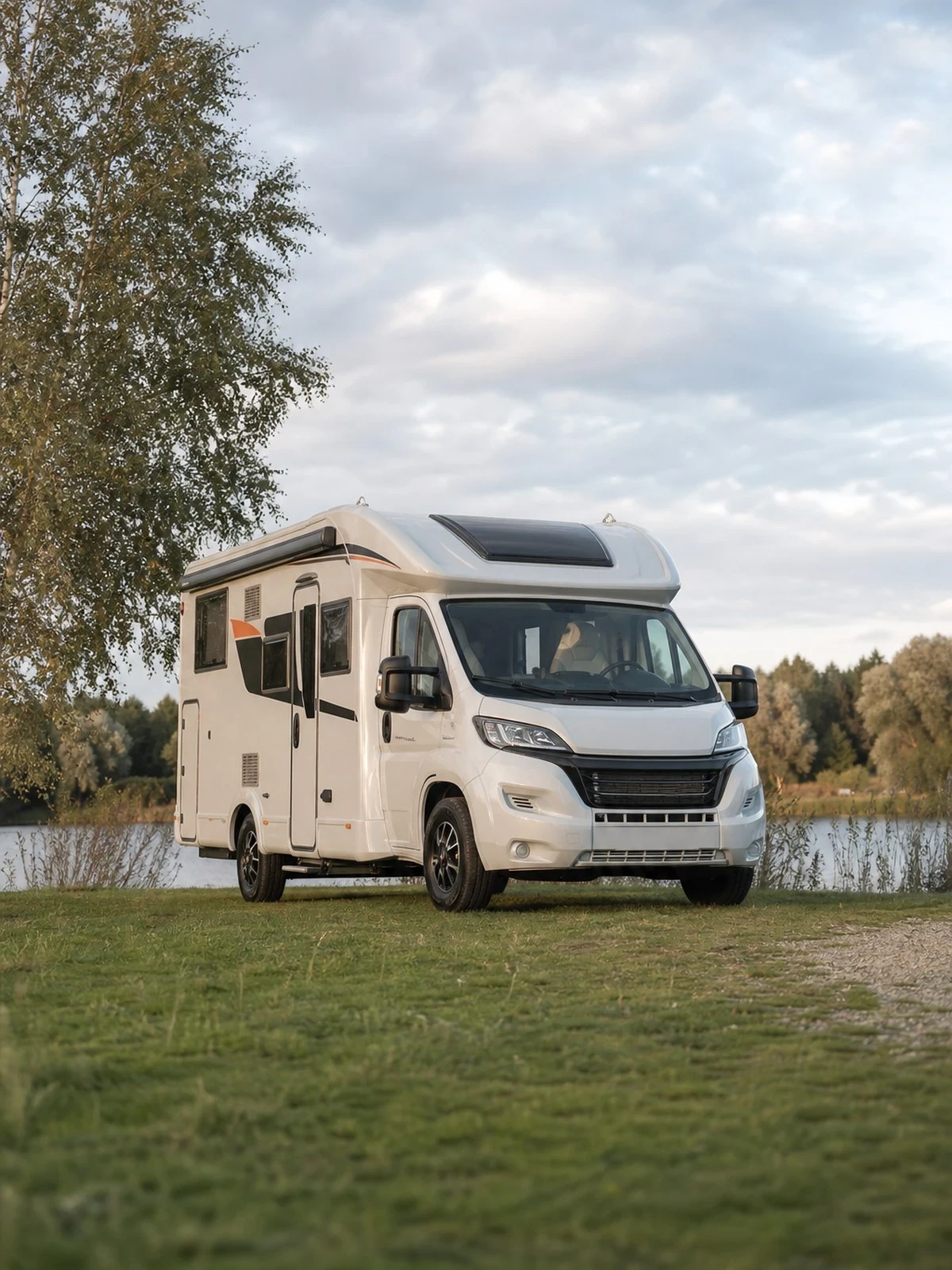 Motorhome insurance
 Compare
 Get covered
Why arrange it through Finass Verzekert?
We look at the terms as well as the premium, and stay your point of contact when there is a claim.
Independent
We are not tied to one insurer and compare on the basis of an objective analysis of several companies.
One fixed adviser
You call or email someone who knows your file. No menu options, no changing call centres.
Switching without hassle
We cancel your old policy and align the start date, so you are never a day without cover.
Help with claims
We report the claim and monitor how it is handled. In urgent cases you can reach us on the emergency line.
What to look out for
Four points that go wrong more often with a camper van used for business than with a private one.
Weight and driving licence
A category B licence allows you to drive a vehicle up to a maximum permitted weight of 3,500 kilograms. Many roomier camper vans come close to that, or exceed it, once luggage, water and passengers are on board; a category C1 licence is then needed. If an employee drives a camper van that is too heavy, the required entitlement to drive is missing and own-damage cover lapses. See also insuring heavy camper vans.
Staff behind the wheel
If you have employees drive for work, an accident engages your duty of care under Article 7:658 of the Dutch Civil Code. Damage suffered by the employee themselves as driver does not fall under ordinary public and employers' liability insurance (AVB). There is separate motor-related cover for that, explained under WEGAS and WEGAM. Agency staff also fall under that duty of care by virtue of subsection 4.
What is excluded as standard
Excluded are hire without a hire clause, carriage of goods or passengers for payment, permanent occupation, damage to the load and to tools in the camper van, and damage caused by wear, rust and deferred maintenance. Intent and wilful recklessness fall away under Article 7:952 of the Dutch Civil Code. Fines for overloading or for driving and rest times are never insured.
Value, VAT and depreciation
The book value in your accounts is not the insured value. Insurers work with the list price or the market value, and whether the payout is made with or without VAT depends on your deduction position. Record that in advance, otherwise a shortfall arises on a total loss that you bear yourself. Fitting-out and vehicle graphics belong on the policy schedule separately as accessories.
What does your premium depend on?
- Purpose of use: own business use, hire or trading stock
- Circle of drivers: fixed drivers or changing staff
- Maximum permitted mass: determines the driving licence category and the rate
- Annual mileage: business use is often higher than holiday use
- Storage outside periods of use: business premises, the public road or a locked hall
- Number of vehicles: from a certain number of vehicles a fleet contract is more favourable
Insurers weigh these details differently. That is where your saving is.
What is covered
| Situation | Third-party, fire and theft | Comprehensive |
|---|---|---|
| A storm brings a branch down on the roof of the camper van while it stands on your business premises | Yes | Yes |
| Your employee reverses the camper van into a loading dock | No | Yes |
| The camper van is stolen from the locked site at night | Yes | Yes |
| The water system splits because the camper van was not drained before winter | No | No |
| You hit a deer crossing the road on the way to a client | Yes | Yes |
| A visitor damages the side wall while the camper van is set up as a promotional vehicle in a square | No | Provided that |
These answers apply to your own business use; as soon as hire charges are involved, the hire clause decides.
Frequently asked questions
This is what people ask us most.
Can I also use a camper van owned by the business privately?
Yes, but report the mixed use. The insurer wants to know who drives, how many kilometres are covered and where the vehicle stands when it is not in use. Separate tax rules apply to the private use of a business asset; they are independent of the policy. If you fail to report the use, that engages Articles 7:928 and 7:930 of the Dutch Civil Code.
We hire out our camper van in the low season. Can that go on the same policy?
Not without hire cover. Hire brings with it changing drivers who do not know the vehicle, and the claims frequency is therefore higher. Insurers set requirements for the hire contract, the deposit, the checking of driving licences and the condition of the vehicle on handover and return. If you hire it out without this being stated on the policy, own-damage claims during that hire period are in principle not covered.
Are the fittings of a mobile workplace insured as well?
Fixed fitting-out such as a workbench, cupboards or a power supply can be insured as an accessory, provided it is named and valued. Loose equipment, tools and stock do not fall under that and belong on business contents or goods cover. Also ask whether theft from the vehicle is limited to situations with signs of forced entry; that is almost always the case.
What happens if an employee damages the camper van?
The own-damage claim is paid if the policy allows it and the driver meets the clause. Recovery from the employee is limited: under Article 7:661 of the Dutch Civil Code an employee is only liable in cases of intent or wilful recklessness. So do not count on being able to pass the excess on to the driver, unless that exception demonstrably applies.
Every situation is different. For these situations we have a separate page.
- Motorhome insuranceThe main page
- Using a company motorhome privately as wellRegistered to the business, private use, must be declared
- Insuring a business motorhomeCamper van owned by the business, declare hire, contents insured separately
- Insuring a business motorhome: what you need to knowWeight and driving licence, green card, suspension
- Insuring a heavy motorhomeWeight, driving licence, storage
- Insuring a hobby motorhomeOwn registration number, contents insured separately, damp damage excluded
- Camper van insurance through Unigarant
- Camper van insurance through NH1816