

The works
- Fire, storm and water
- Theft of materials
- Inherent defect and design fault
- Vandalism on the building site
In commercial construction, dozens of firms work for years on one object. The policy then has to protect not one contractor but the whole site.
This page in another language: Nederlands
Work out for yourself what it would cost.
Enter your details; you will receive a proposal within one working day.
A premium indication, not personal advice. Prefer to talk it through? Call 072 - 509 24 56.
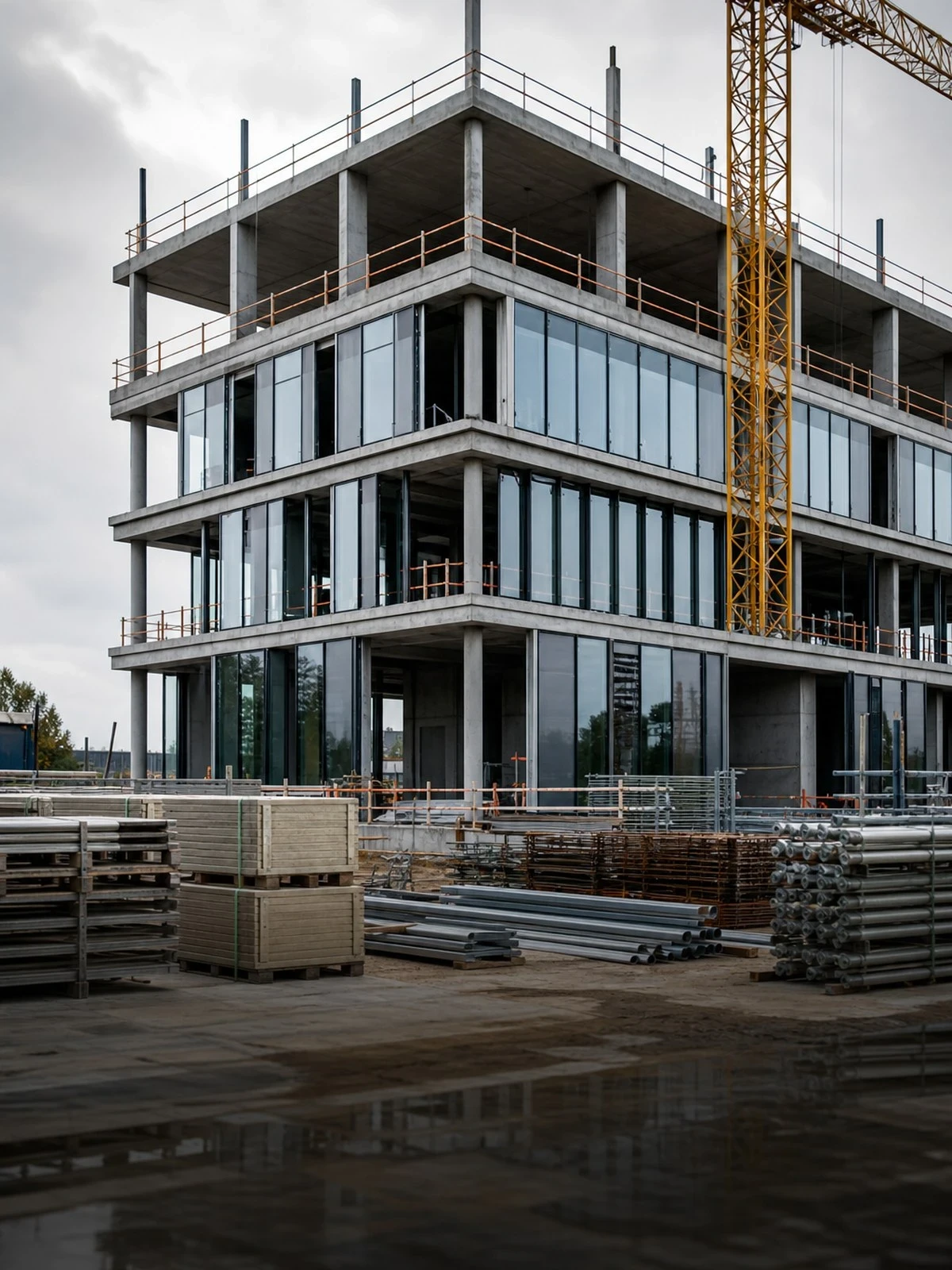
An office, school, distribution centre or healthcare building is built by a main contractor with a long line of separate and subcontractors, installation firms and specialist parties. What they mainly damage is each other's work: the core driller hits a pipe, the installation company damages the poured floor, the facade contractor drops something on the air handling unit that has just been fitted.
That is why one project-specific policy is usually taken out here, on which all the building parties are named as insured. That prevents every instance of damage from turning into recovery proceedings between parties who have to keep working alongside each other, and it makes clear who reports the claim and who receives the expert.
Two features need extra attention: the building services, which only show whether they work during testing, and the duration. A three-year project is a different project at the end from at the start, and both the sum insured and the end date have to follow that.
We compare your construction all risks (CAR) insurance across dozens of insurers, explain where the real differences lie, and arrange the switch from start to finish — without you having to chase it yourself.
 Construction all risks (CAR) insurance
 Compare
 Get covered
The structure of the cover in three parts, with an overview per situation below.
Damage to the works themselves during construction or installation.
Damage to property and persons of third parties on and around the works.
What comes into play alongside the works themselves.
What is covered
| Situation | Works section | Liability section |
|---|---|---|
| Storm or water damage to the works in progress | Yes | No |
| Theft of materials from the building site | Sometimes | No |
| Damage to an adjoining building | No | Yes |
| Injury to a bystander | No | Yes |
| The client's existing property | Sometimes | Sometimes |
| Repair of your own defective work | No | No |
This overview is general in nature and is not personal advice. What is actually covered, including exclusions, limits and the excess, is set out in the policy conditions and the insurance card (verzekeringskaart) of the insurer; you receive both before you take out cover. Taking out cover without advice? Then read what execution only means for you.
Insurers weigh these details differently. That is where your saving is.
We look at the terms as well as the premium, and stay your point of contact when there is a claim.
We are not tied to one insurer and compare on the basis of an objective analysis of several companies.
You call or email someone who knows your file. No menu options, no changing call centres.
We cancel your old policy and align the start date, so you are never a day without cover.
We report the claim and monitor how it is handled. In urgent cases you can reach us on the emergency line.
Customers rate our service on four aspects: personal service, service delivery, availability and the outcome. The reviews are collected and published by NH1816 and come from customers who have actually taken out a policy with Finass Advies B.V. or reported a claim.
Four points that make the difference between a policy that pays out and one that does not.
If the main contractor, separate contractors, subcontractors and installation firms are all on the policy, the follow-up question is whether they may claim against each other through that policy. Without a cross-liability provision, the insurer can argue that damage by one insured to another does not count as damage to a third party. Have it recorded that each insured is treated as if a separate policy had been taken out for them.
Climate installations, sprinklers, lifts and electrical systems are put under pressure or under voltage at the end of the build. It is precisely then that water damage arises in a finished building or a fire in a distribution board. Insurers provide a separate testing cover for that, limited in duration, with its own conditions and often a higher excess. Report when testing begins and check that the period is long enough for the full commissioning process.
A policy taken out on the original contract sum no longer covers, three years later, the value standing on the site. Every variation increases the amount that would have to be rebuilt after a total loss, and underinsurance is settled proportionately. Report additional work periodically and apply for an extension before the end date: a policy that expires on its renewal date while building is still going on leaves the building uninsured.
Reductions and penalties imposed by your client for late completion fall outside it, even where the delay results from an insured loss. Design faults by the architect and structural engineer belong to those consultants' professional indemnity. Business interruption loss of a user who has already moved into part of the building is not physical damage and often falls outside the liability section. And damage to tower cranes, access platforms and site huts is plant, not works.
If you work in or on an existing building, that building is not your works but the property of the client. Damage to it does not fall under section 1 and, on your AVB, falls under the care, custody and control exclusion. The section existing property fills that gap, and with conversions, renovations and installation work that is not an edge case but the core of the risk.
After handover there is often a maintenance period during which you remain liable for defects that arose during construction. Agree that period explicitly and have it stated on the policy. Under the Wet kwaliteitsborging (the Dutch Building Quality Assurance Act) this carries more weight: Article 7:758(4) of the Dutch Civil Code places the burden of proof for hidden defects on the contractor.
This is what people ask us most.
If both parties are named as insured on the project policy, the damage is put right out of that policy without either having to claim against the other. That only works if a cross-liability provision has been included. Without it, the insurer can reject the claim and recovery proceedings start between two parties who still have months of working together ahead of them.
The part handed over is no longer works but the client's property. From that moment damage to it no longer falls under section 1 but at most under the existing property section or under the owner's buildings insurance. Record for each phase on what date which part transfers, and have both insurers confirm those dates in writing.
Yes, and in good time. A project policy expires on the agreed end date and covers nothing after that, even if the building is still full of scaffolding. Apply for an extension before that date passes and at the same time report the additional work instructed in the meantime, so that the sum insured matches what is actually there again.
Because installations only show over the seasons whether they have been properly commissioned, maintenance periods of several years are agreed on commercial projects. The policy has to follow that period, and the extended variant also covers damage arising during the maintenance work itself. Check that the period on the policy runs in step with what has been agreed contractually.
Every situation is different. For these situations we have a separate page.
Request a quote without obligation. We will look at which insurer best matches your activities and your risk.
Prefer to call? 072 - 509 24 56, weekdays 09:00–17:00.
Claim on the road? Emergency line 06 - 55 20 40 72.
Finass Verzekert is a trading name of Finass Advies B.V. We advise on and arrange non-life insurance on the basis of an objective analysis of several insurers, and receive commission for this from the insurer, which is included in the premium. You pay no separate advice fee. Before you take out cover, we establish your wishes and needs.
You will find our licence, KvK and Kifid details and our complaints procedure at the foot of every page.
This page was compiled by Finass Verzekert (LinkedIn). Last updated on .
The information on this page is general in nature and is not personal advice.
Maandag- Vrijdag: 09:00- 17:00
We use cookies and similar technologies to improve your experience on our website.