

Buildings insurance for businesses
Most disappointments in a buildings claim come not from the cover but from the amount, and from the question of whether the damaged item was part of the building at all.
- Several insurers compared objectively
- 9.5 customer rating for a new policy
- AFM licence 12016589
- Personal 072 - 509 24 56, weekdays 9–17
This page in another language: Nederlands
Work out for yourself what it would cost.
Enter your details; you will receive a proposal within one working day.
- We compare the offerings of several insurers
- An adviser checks whether the cover suits your activities
- We arrange the switch, including cancellation
A premium indication, not personal advice. Prefer to talk it through? Call 072 - 509 24 56.
- Independent advice
- Several insurers
- Switching arranged
- Help with claims
In brief
Buildings insurance pays for damage to the premises themselves. Insurance is on rebuild value: the amount needed to build the same building again in the same place and for the same use. That is something other than the purchase price, the WOZ value or the book value. If the amount is too low, a proportionate reduction follows, even on a claim well below the sum insured. A valuation that meets the requirements gives certainty about the basis under Article 7:960 of the Dutch Civil Code for as long as the report remains valid.
Equally decisive is the question of what counts as part of the building. Items permanently attached to the building count: foundations, roof, installations, lifts and fixed partition walls. Outside the description of the building often fall paved areas, fencing, boundary walls, flagpoles, advertising columns and free-standing canopies. Solar panels are not everywhere automatically regarded as part of the building. Name these items expressly in your application, because the loss adjuster reads only what is written.
Alongside the rebuilding costs there are additional items. Clearance and demolition costs are almost always insured separately and are not included in the rebuild value. If rebuilding requires you to meet stricter requirements than the original construction, those additional costs are only covered where the policy says so. For the shutdown in your business you look to business interruption insurance, for the items inside to business contents insurance and during conversion work to Construction all risks (CAR) insurance.
This page deals with one situation. The full overview is on Compare commercial buildings insurance.
Independent, personal, sorted quickly
We compare your commercial buildings insurance across dozens of insurers, explain where the real differences lie, and arrange the switch from start to finish — without you having to chase it yourself.
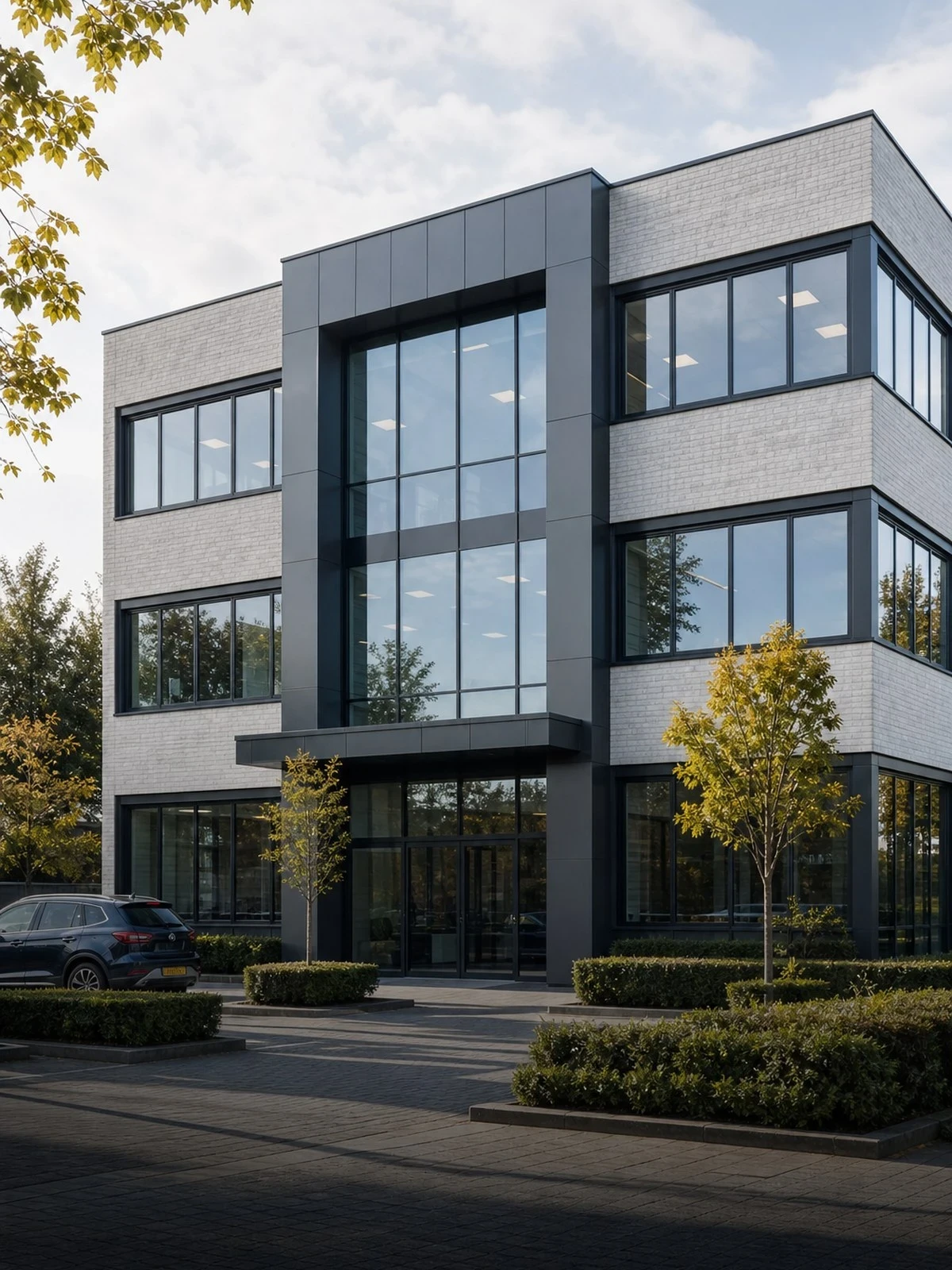 Commercial buildings insurance
 Compare
 Get covered
Why arrange it through Finass Verzekert?
We look at the terms as well as the premium, and stay your point of contact when there is a claim.
Independent
We are not tied to one insurer and compare on the basis of an objective analysis of several companies.
One fixed adviser
You call or email someone who knows your file. No menu options, no changing call centres.
Switching without hassle
We cancel your old policy and align the start date, so you are never a day without cover.
Help with claims
We report the claim and monitor how it is handled. In urgent cases you can reach us on the emergency line.
What to look out for
Four subjects that determine what actually appears on the settlement after a fire or storm.
The rebuild value does not stay correct by itself
Building costs move, and an extension or a new installation raises the rebuild value. An index clause absorbs general price movements, but not your own building work. Have the sum reassessed after every alteration. With underinsurance the insurer reduces payment in the same proportion as the sum insured differs from the actual value.
Report conversion work or a change of use
An extension, a different use for part of the premises or housing a second business changes the risk. Insurers accept on the basis of what you declare. If reality turns out to differ, Articles 7:928 and 7:930 of the Dutch Civil Code come into play. During the building period itself the buildings cover is often restricted as well, so that separate construction cover is needed.
Storm, water and the small print
Storm damage is usually only covered from a wind force stated in the conditions and with a separate excess. Water damage is covered where water escapes unforeseen from pipes or appliances, but not where it involves groundwater, sewers, penetrating damp or rain through open windows. Flooding from a primary flood defence and earthquake are excluded on virtually every policy.
What a buildings policy never solves
Outside the cover are wear, inherent defect, construction faults and subsidence, deferred maintenance, vermin and gradual action of damp. Soil contamination after a covered event is not property damage but belongs on environmental damage insurance. Damage to machinery without an external cause belongs on machinery breakdown insurance. Anyone who caused the damage deliberately can rely on no section at all under Article 7:952 of the Dutch Civil Code.
What does your premium depend on?
- Rebuild value: the basis for the premium and the payout
- Construction type and roof covering: masonry, steel, timber or sandwich panels
- Business process in the building: office, storage, workshop or production
- Compartmentation and prevention: fire walls, detection and extinguishers
- Ancillary items covered as well: site, solar panels, installations and clearing up
- Claims history and excess: possibly with a separate excess for storm
Insurers weigh these details differently. That is where your saving is.
What is covered on the building
| Situation | Extended | Comprehensive |
|---|---|---|
| Your own forklift knocks the sectional door out of its runners | Provided that | Yes |
| A decorator drops a bucket of thinners on the new resin floor | No | Yes |
| Unknown persons spray graffiti across the whole front elevation overnight | No | Yes |
| Smoke from a fire next door settles in your ceilings and walls | Yes | Yes |
| A visitor drives their car through the shop window | Provided that | Provided that |
| After a cold spell a pipe bursts in the unheated storage area | Provided that | Provided that |
Glass and frost damage are often in a section or clause of their own; check whether that has been switched on for your policy.
Frequently asked questions
This is what people ask us most.
Are my solar panels included on the buildings policy?
That differs by insurer. Some policies treat roof-mounted panels as part of the building, others require a separate mention and sometimes separate cover. State in your application how many panels there are, how they are fixed and where the inverter is. Unreported panels can also change the fire risk of the roof.
What happens if I do not rebuild after a total loss?
Settlement is then often not on rebuild value but on a lower basis, for example market value. Conditions tie payment on rebuild value to actual rebuilding within a stated period. If you want to dispose of the premises after a loss, discuss in advance which basis then applies, so that you are not left with a shortfall afterwards.
Are the clearing-up costs included in the sum insured?
No, they usually appear as a separate item on the policy schedule. After a major fire, demolition, disposal and cleaning the site are a substantial part of the bill, certainly where asbestos is released. Check whether the amount for clearing up is realistic for your premises and whether asbestos removal falls within it or is excluded.
I rent my business premises. What do I insure myself?
The shell is then a matter for the owner. You insure what you have installed yourself, such as a kitchenette, partition walls, floor finishes or an air conditioning system. That is called tenant's improvements and belongs on your own policy. You also remain liable for damage to the premises you rent; check whether tenant's liability is included on your liability insurance.
Every situation is different. For these situations we have a separate page.
- Buildings insurance (opstalverzekering) and commercial buildings insurance (gebouwenverzekering): the same or not?The main page
- Buildings insurance (opstalverzekering) for let propertyVacancy, loss of rent, owner's liability
- Compare commercial buildings insuranceRebuild value, construction, fire prevention
- Buildings and premises insurance for propertyRebuild value, loss of rent, glass
- a.s.r.'s buildings insurancePrevention, warranty clauses, fire safety