

Plant and machinery insurance through Allianz
In law, plant and machinery is two things at once: a motor vehicle on the road and a tool on site. That dual role decides which section of the policy pays a claim.
- Several insurers compared objectively
- 9.5 customer rating for a new policy
- AFM licence 12016589
- Personal 072 - 509 24 56, weekdays 9–17
This page in another language: Nederlands
Work out for yourself what it would cost.
Enter your details; you will receive a proposal within one working day.
- We compare the offerings of several insurers
- An adviser checks whether the cover suits your activities
- We arrange the switch, including cancellation
A premium indication, not personal advice. Prefer to talk it through? Call 072 - 509 24 56.
- Independent advice
- Several insurers
- Switching arranged
- Help with claims
In brief
Finass acts as an intermediary and compares more than thirty insurers objectively. Allianz is used among other things for businesses with a mixed machine fleet, where both self-propelled plant and attached implements are on one policy. The choice of insurer follows from the cover you need, not the other way round: which machines go onto the public road, what stays on your own site, and who operates it.
The pivotal point is the division between traffic risk and working risk. As soon as an excavator, telehandler or aerial work platform goes onto the public road, the insurance obligation under Article 2 of the Dutch Motor Insurance Liability Act (WAM) applies and the liability must be insured as a motor vehicle. When that same machine is standing still while digging or lifting, that is working risk. Some policies cover only the first, and the damage you cause more often in practice sits precisely in the second.
The own-damage cover on the plant itself is a separate consideration. Third-party, fire and theft mainly addresses fire, storm and theft; comprehensive cover adds your own fault and external events. Machinery breakdown caused by an internal defect generally falls outside that and belongs on a machinery breakdown insurance. Which sections suit which type of machine is set out under the covers of a plant and machinery policy.
This page deals with one situation. The full overview is on Compare plant and machinery insurance.
Independent, personal, sorted quickly
We compare your plant and machinery insurance across dozens of insurers, explain where the real differences lie, and arrange the switch from start to finish — without you having to chase it yourself.
 Plant and machinery insurance
 Compare
 Get covered
Why arrange it through Finass Verzekert?
We look at the terms as well as the premium, and stay your point of contact when there is a claim.
Independent
We are not tied to one insurer and compare on the basis of an objective analysis of several companies.
One fixed adviser
You call or email someone who knows your file. No menu options, no changing call centres.
Switching without hassle
We cancel your old policy and align the start date, so you are never a day without cover.
Help with claims
We report the claim and monitor how it is handled. In urgent cases you can reach us on the emergency line.
What to look out for
Four provisions that are more often decisive for plant and machinery than the sum insured.
What the machine is working on is not insured
The care, custody and control exclusion applies in full to plant and machinery: damage to the item you have in your care falls outside the liability cover. If a demolition crane damages the building it is meant to demolish, or a telehandler pushes through the floor it is driving on, that is not covered but is a risk for your own account. Only damage to other people's property outside the job in hand is insured.
Cables, pipes and the excavation notification
Excavation damage is the most expensive common loss in this industry. Policies almost always contain a clause that links cover to a timely excavation notification and trial trenches. If you dig without up-to-date location data, the insurer may reject the claim, even where liability under Article 6:162 of the Dutch Civil Code is established. Record the notification and the sign-off on site.
Operation, certificates and key management
An operator without the required certificate of competence, or an agency worker who steps onto a forklift truck without instruction, is a classic ground for rejection. The same applies to theft where keys were left in the machine or the agreed security was not switched on. This is no formality: it is written into the policy as a prevention condition in the policy.
Attached implements and hired plant
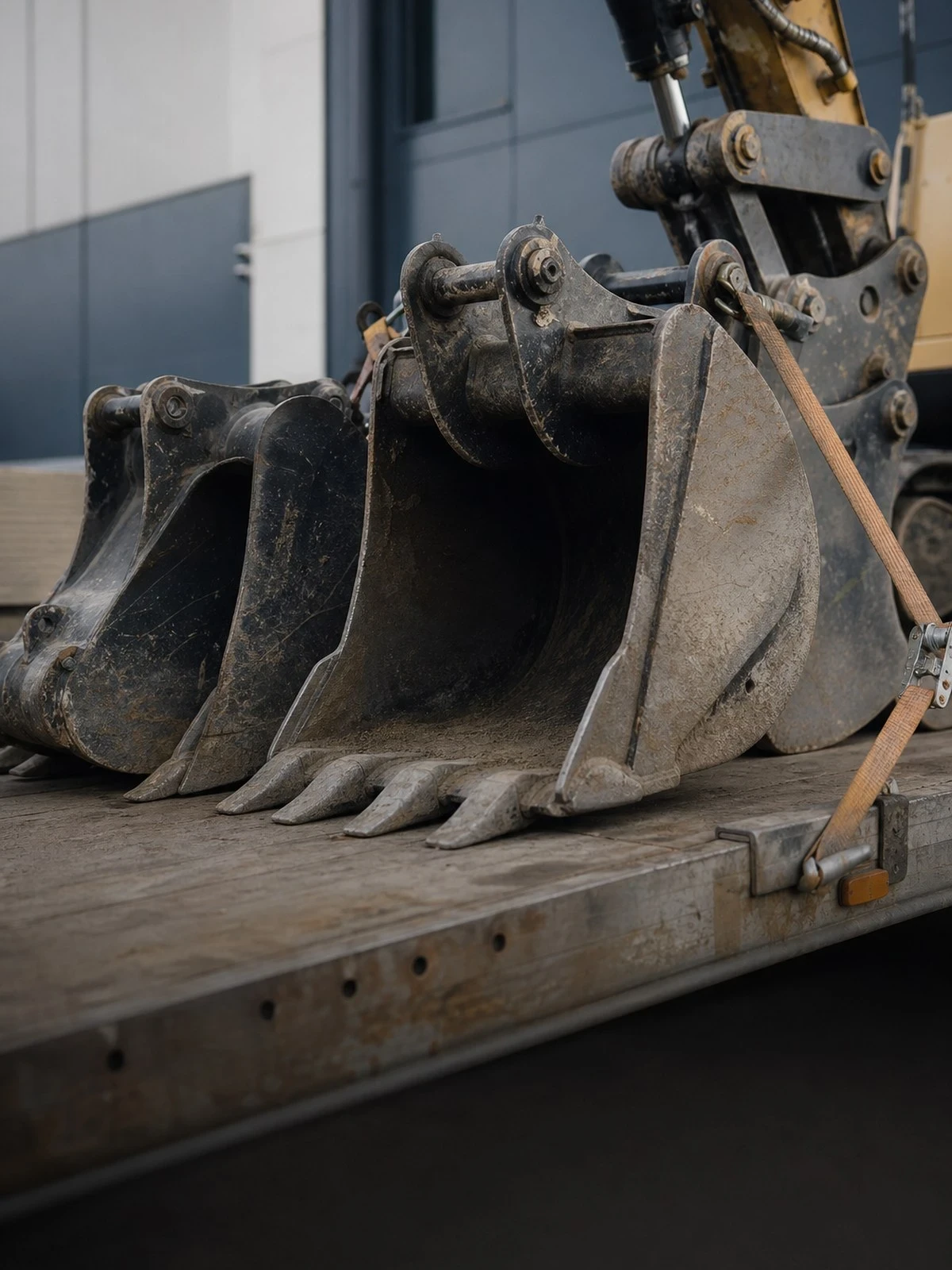
Quick couplers, sorting grabs, drill heads and lifting beams are only insured if they are named in the specification. Plant you hire temporarily is not automatically covered under your own policy. A separate hired plant clause is needed for that. Report additions to the fleet immediately, because Article 7:928 of the Dutch Civil Code requires you to inform the insurer fully.
What does your premium depend on?
- Type and weight of the machine: a mini excavator weighs differently from a tracked excavator
- List price or purchase price: the basis for the own-damage premium
- Year of manufacture and depreciation arrangement: determines whether replacement value as new or market value applies
- Nature of the work: earthmoving, demolition and lifting weigh more heavily than internal transport
- On the public road or not: decisive for the section that is required by law
- Storage and security outside working hours: fencing, track and trace and overnight storage reduce the theft risk
Insurers weigh these details differently. That is where your saving is.
What is covered
| Situation | Third-party liability | Comprehensive |
|---|---|---|
| Your telehandler hits a parked car on the public road | Yes | Yes |
| Your loading shovel knocks over a fence on the client's site | Provided that | Yes |
| A loose beam falls from the crane onto a passer-by's car | Yes | Yes |
| Fire in your tracked excavator standing on a closed building site | No | Yes |
| Your operator overturns the aerial work platform and the boom is bent | No | Yes |
| Theft of a mini excavator from an unguarded building site | No | Provided that |
The working risk and the own-damage cover appear as separate sections on the policy; check for each machine which of the two is actually insured.
Frequently asked questions
This is what people ask us most.
Is plant and machinery insurance required by law?
For plant that takes part in traffic on the public road, yes. Article 2 of the Dutch Motor Insurance Liability Act (WAM) requires the keeper of a motor vehicle to hold liability insurance, and self-propelled plant falls under that. If a machine stays exclusively on closed private ground, that obligation does not apply, but you then carry the full liability risk for injury and damage to property yourself.
What is the difference with public and employers' liability insurance?
The AVB usually excludes damage caused with or by a motor vehicle, precisely because the motor vehicle regime exists for that. Plant and machinery therefore falls into a gap if you only have an AVB. For your other business risks the public and employers' liability insurance remains necessary; the two policies complement each other and barely overlap.
Does the own-damage section cover a defective engine or hydraulics?
No. Wear, mechanical or electronic failure and the consequences of deferred maintenance are an inherent defect and remain excluded under own-damage cover. If you do want to insure internal damage, machinery breakdown cover is the route to take. Damage that is the direct result of overloading or of lifting above the permitted capacity also falls outside the cover.
What about damage to the machine caused by an employee?
Own-damage caused by your own operator is insured under comprehensive cover; recovery from the employee is severely restricted by law. If the driver is injured, your duty of care under Article 7:658 of the Dutch Civil Code comes into play, and that is a different section. Report every claim as soon as you become aware of it, as Article 7:941 DCC requires.
Every situation is different. For these situations we have a separate page.
- Compare plant and machinery insuranceThe main page
- The cover provided by plant and machinery insuranceThird-party liability, own-damage, working risk
- Non-self-propelled plant and machinery insurance through Avéro Achmea
- Which plant and machinery policies are there?Third-party liability under the WAM, own-damage, the boundary with the AVB
- Insuring an excavatorExcavation damage, KLIC notification, theft
- Insuring a bulldozerWAM obligation, own-damage, transport and theft