

Liability insurance for an air conditioning firm
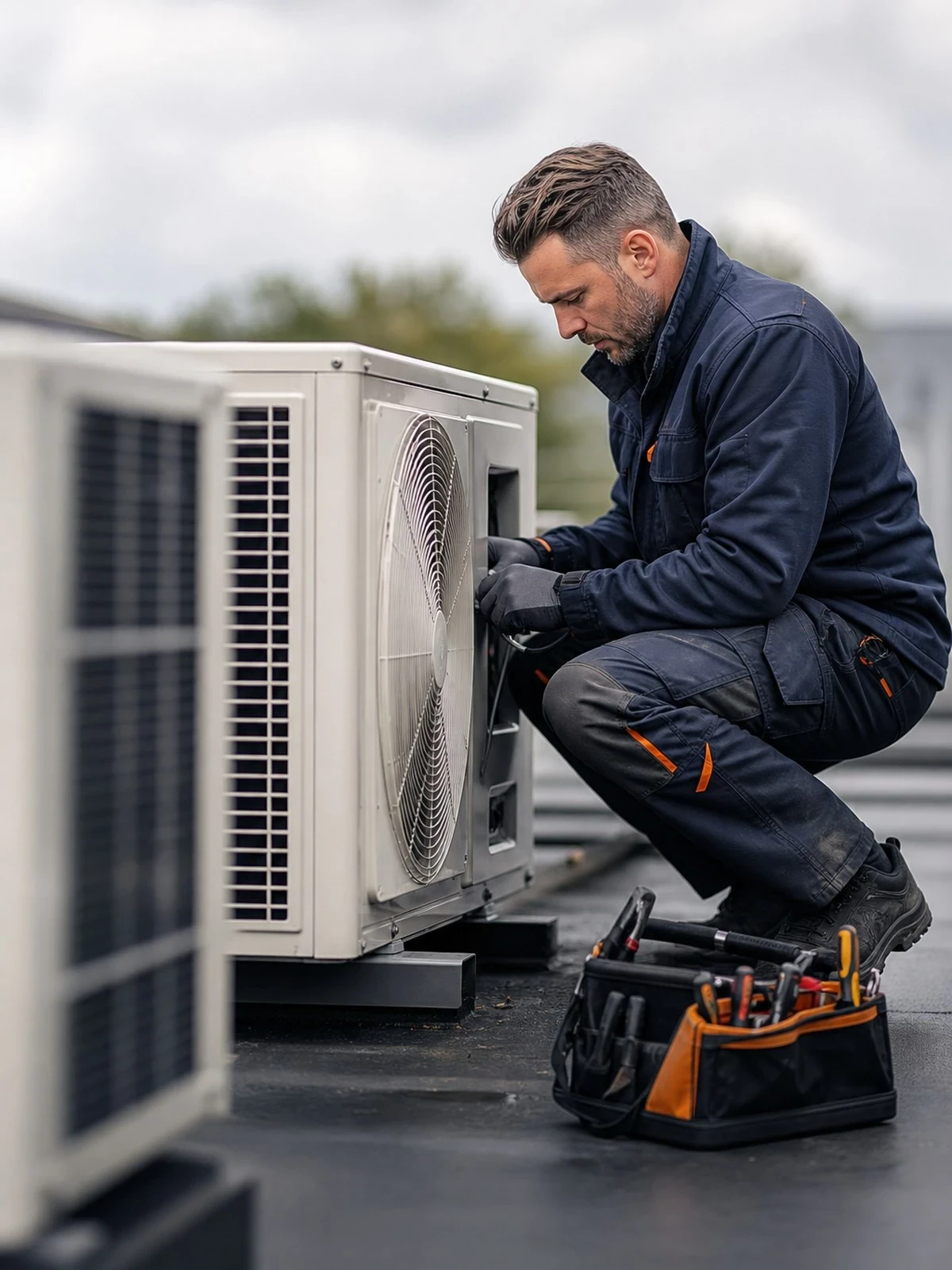
An air conditioning business works with pressurised refrigerant, drills through facades and roofs and leaves behind installations that drain water for years. The losses that arise from that are almost always water damage or consequential loss at the customer's premises.
- Several insurers compared objectively
- 9.5 customer rating for a new policy
- AFM licence 12016589
- Personal 072 - 509 24 56, weekdays 9–17
This page in another language: Nederlands
Work out for yourself what it would cost.
Enter your details; you will receive a proposal within one working day.
- We compare the offerings of several insurers
- An adviser checks whether the cover suits your activities
- We arrange the switch, including cancellation
A premium indication, not personal advice. Prefer to talk it through? Call 072 - 509 24 56.
- Independent advice
- Several insurers
- Switching arranged
- Help with claims
In brief
Most claims in refrigeration engineering start small. A condensate drain that becomes blocked or is laid at the wrong fall brings a ceiling down months later. A duct that is not finished airtight causes damp problems in the cavity. An outdoor unit fixed to a facade without regard to the substrate comes loose. That is damage to someone else's property and that is what the AVB is for. The structure of that cover is set out on the hub page public and employers' liability insurance.
The second risk is the refrigerant itself. A leak means not only that the installation fails, but also that fluorinated greenhouse gases escape. Working on such systems is subject to statutory certification, for the business as well as for the engineer. Insurers often take that requirement over in a clause: if the certification is not in order, cover for that loss can lapse. Environmental damage on your own or someone else's land belongs on an environmental damage insurance and not here.
Third, there is the care, custody and control exclusion. The part of the building you are working on and the installation you have in your hands are items in your care. If you damage the system you are maintaining or the facade you are drilling into, that usually falls outside it. For larger installation projects a erection all risks insurance closes that gap; it insures the works themselves during construction and the testing phase.
This page deals with one situation. The full overview is on Compare public and employers' liability insurance (AVB).
Independent, personal, sorted quickly
We compare your business liability insurance (AVB) across dozens of insurers, explain where the real differences lie, and arrange the switch from start to finish — without you having to chase it yourself.
 Business liability insurance (AVB)
 Compare
 Get covered
Why arrange it through Finass Verzekert?
We look at the terms as well as the premium, and stay your point of contact when there is a claim.
Independent
We are not tied to one insurer and compare on the basis of an objective analysis of several companies.
One fixed adviser
You call or email someone who knows your file. No menu options, no changing call centres.
Switching without hassle
We cancel your old policy and align the start date, so you are never a day without cover.
Help with claims
We report the claim and monitor how it is handled. In urgent cases you can reach us on the emergency line.
What to look out for
Four points that determine whether a loss is paid in refrigeration engineering.
Drilling and cutting through what cannot be seen
A duct to the outside goes through a structure containing pipes, wiring and sometimes underfloor heating. If you hit those, consequential loss follows on top of the repair. Insurers then ask whether you checked the location beforehand; document what you know about the structure and put anything unusual to the customer in writing.
Certification as a condition in the policy
Work on systems containing fluorinated greenhouse gases may only be carried out by certified businesses and individuals. If that appears as a warranty clause on your policy, compliance is not a formality but a condition of cover. Keep employees' certificates up to date and keep the evidence with the file.
What is not included
Outside the cover are the costs of replacing or putting right your own installation work, damage to the installation you in your care has, fines from a regulator, and liability under a guarantee or maintenance contract that goes further than the law. Pure financial loss caused by incorrect advice on capacity falls outside it as well.
Legionella and air handling
With larger systems involving humidification or wet cooling towers there is a health risk. Insurers then impose requirements on the management plan, the flushing regime and record-keeping. If you carry out that work, declare it expressly. A policy that assumes only split units in homes does not automatically cover a commercial job involving air handling.
What does your premium depend on?
- Annual turnover: the basis, with an adjustment at the end of the year
- Payroll: for the employers' liability section
- Type of installations: split units, VRF systems or industrial refrigeration
- Share of maintenance contracts: ongoing management raises the exposure
- Certification. F-gas certificate for the business and the engineers
- Sum insured and excess: per claim and per insurance year
Insurers weigh these details differently. That is where your saving is.
What is covered
| Situation | AVB | BAV |
|---|---|---|
| An outdoor unit comes away from the facade and falls on a parked car | Yes | No |
| An engineer puts a ladder through the shop window below | Yes | No |
| An employee is crushed while hoisting an outdoor unit onto the roof | Yes | No |
| The customer claims three months of emergency cooling because the system is undersized | No | Yes |
| A regulator fines you because an engineer worked without a valid certificate | No | No |
| The customer withholds the final instalment because completion ran four weeks late | No | No |
If something is broken or someone is injured, look at the left-hand column. If it only cost money, look at the right-hand one.
Frequently asked questions
This is what people ask us most.
Is water damage from a blocked condensate drain covered?
The damage to the customer's ceiling, floor and contents is damage to property and can fall under the policy if you are liable. Cleaning or replacing the drain itself is putting your own work right and stays at your expense. Under a maintenance contract, the insurer looks at whether the check was actually carried out and recorded.
What if a customer complains that the unit does not cool enough?
That is a dispute about performance and not damage to property. Replacement with a heavier unit or a refund is pure financial loss and falls outside this policy. That belongs with professional indemnity insurance where you also advise on capacity and the choice of installation.
Does the policy pay for refrigerant that has escaped?
Not the value of the refrigerant itself, and not the environmental costs either. Those belong on an environmental damage insurance. Loss suffered by third parties can fall under the liability cover, for example spoiled stock in a cold room after a failure. Where commercial refrigeration fails, a claim about lost turnover often follows as well, and that has to be assessed separately.
Do I have to declare subcontractors separately?
Yes. If you have installation or service work carried out by self-employed people, declare that in the application. If they work under your direction, your duty of care applies under Article 7:658(4) of the Dutch Civil Code. Ask for evidence of their own liability insurance as well, so that a claim does not land entirely on your policy.
Every situation is different. For these situations we have a separate page.
- Compare public and employers' liability insurance (AVB)The main page
- Liability insurance for a self-employed central heating engineerAuthority in your name, water damage, subcontracting
- Liability insurance for a self-employed air conditioning fitterWorking in people's homes, facade fixings, care, custody and control
- Liability insurance for a central heating firmCombustion gases, certification, hot work
- Liability insurance for a self-employed solar panel fitterRoof penetrations, the DC side, yield
- Liability insurance for a self-employed rooferOpen roof, torch, care, custody and control
- Liability insurance for a self-employed plumberWater damage, your own work, naked flames
- Liability insurance for a concrete firmFormwork, strength class, pump truck
- Liability insurance for an installation companyProjects, guarantees, subcontracting