

Liability insurance for a flange assembly company
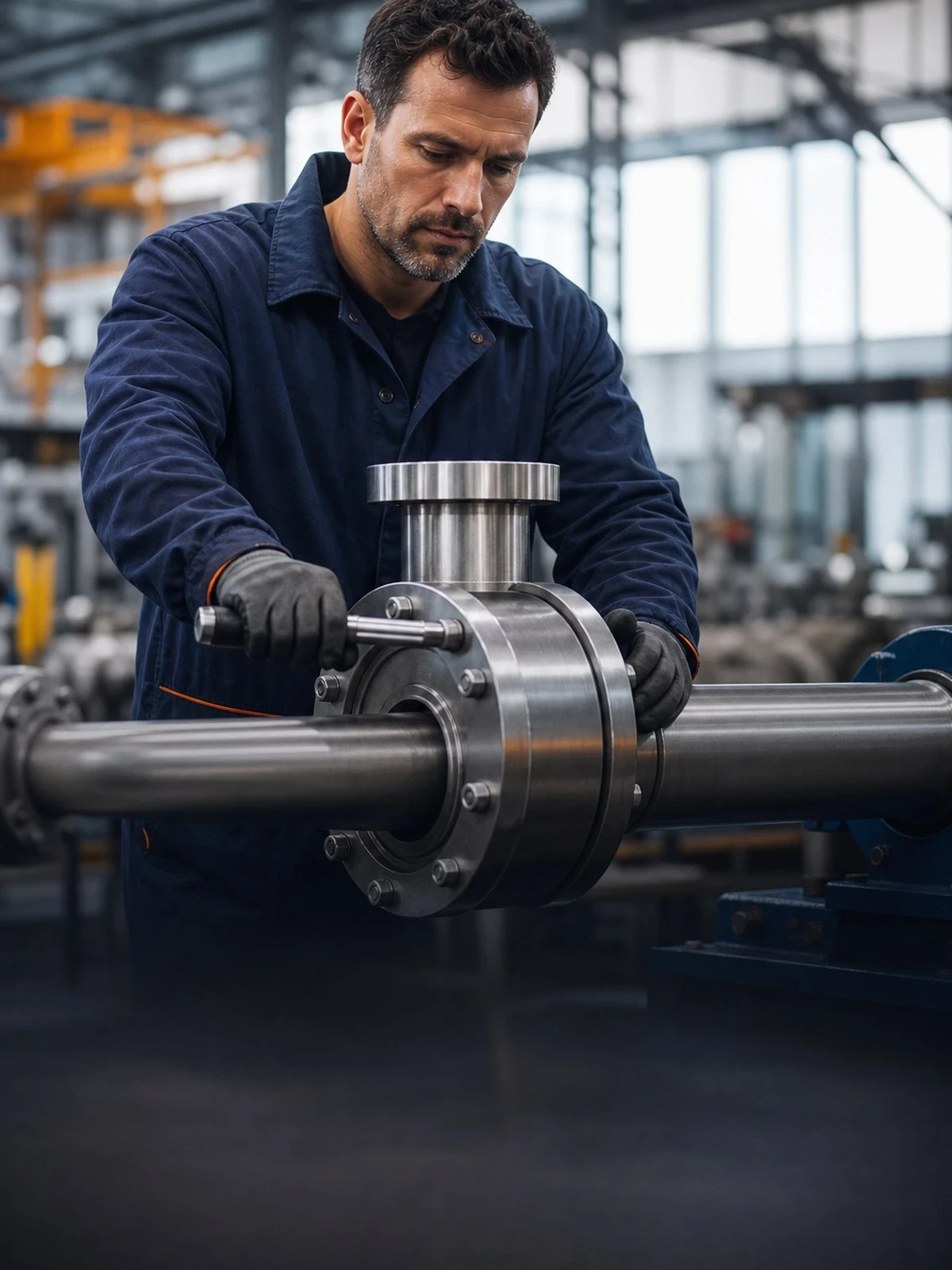
A flange assembly company supplies gangs to plants where a leaking joint immediately affects production, safety and the environment. The client places that risk with you by contract.
- Several insurers compared objectively
- 9.5 customer rating for a new policy
- AFM licence 12016589
- Personal 072 - 509 24 56, weekdays 9–17
This page in another language: Nederlands
Work out for yourself what it would cost.
Enter your details; you will receive a proposal within one working day.
- We compare the offerings of several insurers
- An adviser checks whether the cover suits your activities
- We arrange the switch, including cancellation
A premium indication, not personal advice. Prefer to talk it through? Call 072 - 509 24 56.
- Independent advice
- Several insurers
- Switching arranged
- Help with claims
In brief
What goes wrong in this trade is closely defined: a joint not torqued to specification, a tightening sequence not followed, a gasket of the wrong material or a gasket left out on reassembly. The result is product escaping during start-up, injury to people standing beside the line and a plant that may not run until the cause is established. Injury and damaged property arising from that fall within the scope of public and employers' liability insurance.
For a company there is an extra layer that a self-employed person does not have: the contractual. Clients in the process industry work with their own purchasing conditions, minimum sums insured, penalty clauses for late completion and indemnities. Liability that you accept voluntarily over and above your liability in lawis excluded on the AVB, as are fines and reductions. Have this checked before a framework contract is signed, not after the first shutdown has been worked.
The second layer is your organisation. You work with shifts, with hired-in fitters and with subcontractors. Article 7:658 of the Dutch Civil Code requires you to provide a safe workplace, and subsection 4 extends that to everyone working under your direction, whatever the contract. During a turnaround that means demonstrable supervision of confined spaces, work permits, breathing air and calibrated tools. For injury in traffic on the way to the site there is separate cover under WEGAS and WEGAM.
This page deals with one situation. The full overview is on Compare public and employers' liability insurance (AVB).
Independent, personal, sorted quickly
We compare your business liability insurance (AVB) across dozens of insurers, explain where the real differences lie, and arrange the switch from start to finish — without you having to chase it yourself.
 Business liability insurance (AVB)
 Compare
 Get covered
Why arrange it through Finass Verzekert?
We look at the terms as well as the premium, and stay your point of contact when there is a claim.
Independent
We are not tied to one insurer and compare on the basis of an objective analysis of several companies.
One fixed adviser
You call or email someone who knows your file. No menu options, no changing call centres.
Switching without hassle
We cancel your old policy and align the start date, so you are never a day without cover.
Help with claims
We report the claim and monitor how it is handled. In urgent cases you can reach us on the emergency line.
What to look out for
Four points that weigh most heavily at an assembly company in the process industry.
Records are your defence
After a leak, the first question is who made up which joint, with which spanner, to what torque and who signed it off. A watertight joint registration system and calibration certificates for torque wrenches and hydraulic tools determine whether a claim stays with you or goes to someone else. Without a file, the client's insurer wins.
Environmental damage has a limit of its own
If product escapes, soil or water investigation follows. The AVB covers at most sudden and unforeseen pollution; gradually occurring pollution and clean-up of your own site are excluded. There is environmental damage insurancefor that, which sits alongside the liability cover.
Subcontractors in the chain
If you bring in another company at peak times, you remain liable towards your client. Check whether that party has a current AVB of its own with an adequate limit and whether your own policy includeswork carried out by third parties. If it does not, the loss falls between two policies.
The plant is in your care
Pipework, valves and vessels you work on are in your care. Damaged sealing faces, stripped tapped holes or a cracked flange neck therefore run into the care, custody and control exclusion. Carrying out your own assembly work again is also your own performance: gaskets, bolts and hours are not insured losses.
What does your premium depend on?
- Payroll and number of engineers: the main yardstick for employers' liability
- Type of installations: refining and chemicals weigh more heavily than food production
- Share of turnaround work: peak work in shifts increases exposure
- Hired-in labour and subcontracting: decisive for your duty of care and for supply chain risk
- Contractual requirements from clients: these drive the sum insured you need
- Area of cover: work on sites abroad calls for an extension
Insurers weigh these details differently. That is where your saving is.
What is covered
| Situation | AVB | BAV |
|---|---|---|
| A bolt shears while being retightened and hits one of the client's operators | Yes | No |
| Your gang drops a set of gaskets on an instrument cabinet, which is put out of use | Yes | No |
| While stripping insulation you damage the tracing on an adjacent line | Yes | No |
| A fitter at your company suffers hearing damage after years of work near blow-off lines | Yes | No |
| The client passes on a second week of crane hire because your gang finished late | No | Yes |
| Your own hydraulic torque wrench falls off the scaffold and is beyond repair | No | No |
As long as something is broken or someone is injured, you look to the AVB. If it is purely about costs passed on, you look to professional indemnity.
Frequently asked questions
This is what people ask us most.
A leak on start-up shuts the plant down for days. Is that loss covered?
Only if property damage came first. If parts of the plant were damaged or product was lost, the shutdown is consequential loss and fits within the AVB. If the line is down only because the joint has to be made up again with nothing broken, it is pure financial loss and the AVB gives no cover.
Our client requires an indemnity in the contract. Does the insurance follow that?
Not automatically. The AVB covers in principle the liability that follows from the law. If you take on more by contract, an indemnity for all loss regardless of fault or a penalty per hour of downtime for instance, that additional part falls outside cover. Have provisions of this kind assessed before you sign.
Who is liable if a hired-in fitter is injured?
Under Article 7:658(4) of the Dutch Civil Code your duty of care also applies to people who are not employed by you but do work under your direction. The insurer checks whether the work permit, instruction, supervision and protective equipment were demonstrably in place. Employers' liability must be included as a separate section on the policy for this.
When must a claim be reported?
As soon as you are reasonably aware of it; Article 7:941 of the Dutch Civil Code requires this and late notification can affect your right to payment. Report an incident that is not yet a claim but could lead to one as well, such as a leak found whose cause is still being investigated. Do not admit liability before the facts are established.
Every situation is different. For these situations we have a separate page.
- Compare public and employers' liability insurance (AVB)The main page
- Liability insurance for a self-employed flange fitterTorque, calibration, sign-off
- Liability insurance for a self-employed pipefitterPressure testing, torque, handover
- Liability insurance for a self-employed flange fitter or pipefitterSetting out, prefabrication, hiring in
- Liability insurance for a self-employed process operatorOperating, batch, alarm response
- Liability insurance for a welding company in the petrochemical industryTurnarounds, qualification, project policies
- Liability insurance for self-employed people in petrochemicalsAccess requirement, ATEX, recovery along the chain
- Liability insurance for an installation companyProjects, guarantees, subcontracting
- Liability insurance for a window cleaning firmFacade installations, teams, maintenance contracts