

Liability
- Collision and jetty damage
- No legal obligation
- Often required by the marina
Aluminium does not rust, but it does corrode galvanically: as soon as the hull, the propeller shaft and the shore power connection form a current path, the metal slowly dissolves, and that is precisely the type of damage No policy pays for.
This page in another language: Dutch
Work out for yourself what it would cost.
Enter your details; you will receive a proposal within one working day.
A Premium indication, not personal advice. Prefer to talk it through? Call 072 - 509 24 56.
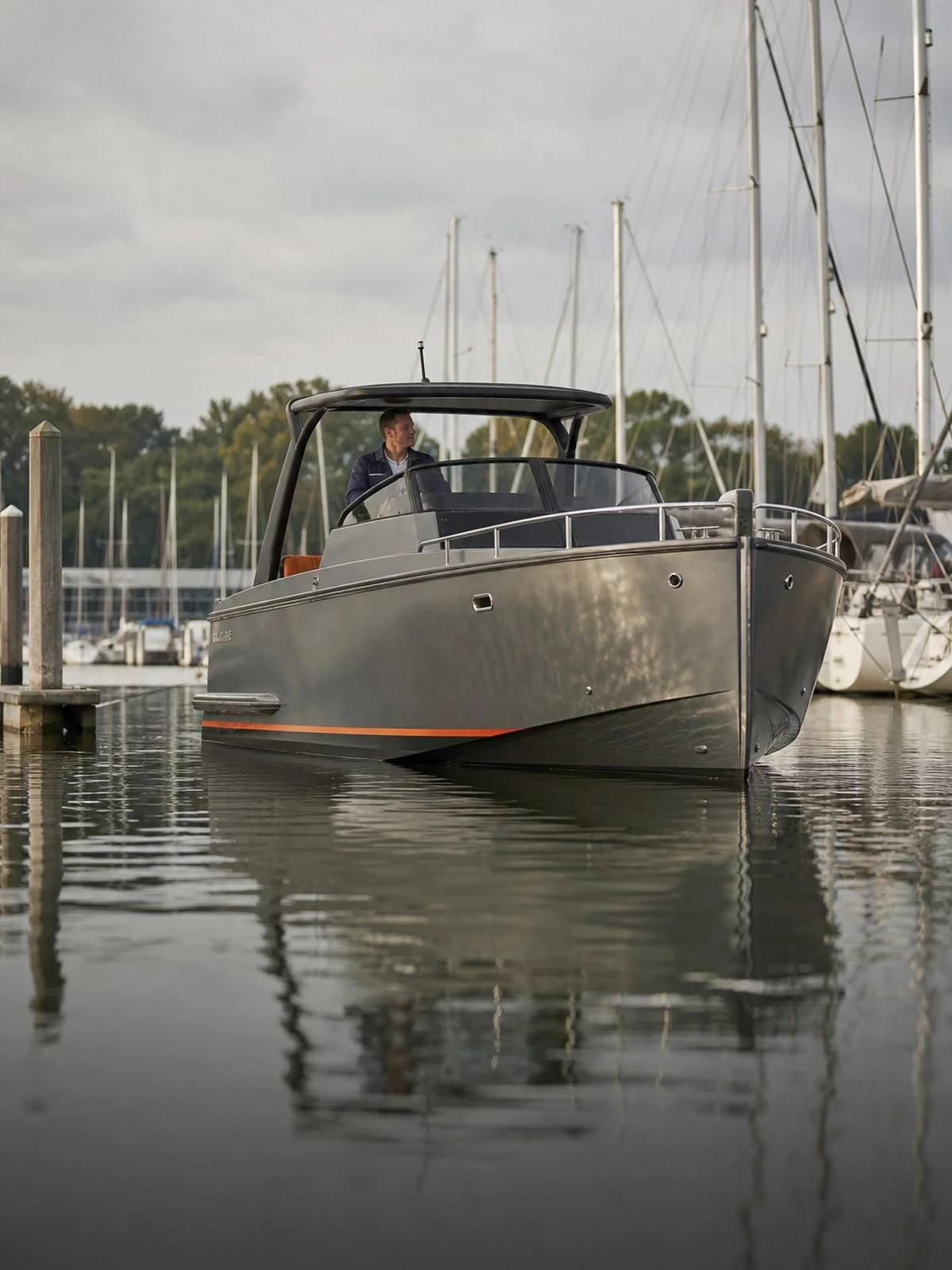
An aluminum hull behaves differently from polyester or wood when it is damaged. A collision usually leaves a dent rather than a fracture, so the vessel stays afloat but the plating is deformed. Repair therefore means welding and letting in new plate, not filling and respraying. That makes the cost of small collisions relatively high, while the chance of a total loss is low.
The risk that is typical of aluminum appears as an exclusion in almost every policy: electrolytic and galvanic corrosion. Worn or missing sacrificial anodes, a poor bonding connection or a current leak through the shore power connection attack the metal gradually. Gradual means: no sudden and unforeseen event, and therefore no Cover. Consequential damage from that process, such as a plate corroded through, also falls outside the Cover.
When you apply, we therefore record where the vessel lies, whether shore power is used and whether a galvanic isolator or an isolating transformer is fitted. That information falls under your duty of disclosure Article 7:928 of the Dutch Civil Code. If you would first like to see the difference in materials, read insuring a fiberglass boatas well, where osmosis rather than corrosion is the gradual risk.
We compare your Pleasure craft insurance across dozens of insurers, explain where the real differences lie, and arrange the switch from start to finish — without you having to chase it yourself.
 Pleasure craft Insurance
 Compare
 Get covered
The structure of the cover in three parts, with an overview per Situation below.
Damage you cause to others with the vessel.
Damage to the boat, the engine and the fixed equipment.
What you add separately.
What is covered
| Situation | Liability | Own-damage Cover |
|---|---|---|
| Damage to another vessel or a jetty | Yes | No |
| Theft of the boat or the outboard Motorcycle | No | Provided that |
| Fire and storm damage in the berth or ashore | No | Yes |
| Sinking through a leak or through rainwater | No | Provided that |
| Salvage and removal of the wreck | Provided that | Provided that |
| Osmosis, wear and deferred maintenance | No | No |
There is no statutory insurance requirement for pleasure craft. The WAM applies only to motor vehicles. Marinas, harbors and hire companies do generally require liability cover. Pay attention to the sailing area described and to the lay-up or winter storage period: outside the sailing area or during undeclared storage, cover may lapse.
This overview is general in nature and is not personal advice. What is actually covered, including exclusions, limits and the excess, is set out in the policy conditions and the Insurance card (insurance card) of the insurer; you receive both before you take out Cover. Taking out Cover without advice? Then read what Execution only means for you.
Insurers weigh these details differently. That's where your saving is.
We look at the terms as well as the premium, and stay your point of Contact when there is a claim.
We are not tied to one insurer and Compare on the basis of an objective analysis of several companies.
You call or email someone who knows your file. No menu options, no changing call centers.
We cancel your old policy and align the start date, so you are never a day without Cover.
We report the claim and monitor how it is handled. In urgent cases you can reach us on the emergency line.
Customers rate our service on four aspects: personal service, service delivery, availability and the outcome. The reviews are collected and published by NH1816 and come from customers who have actually taken out a policy with Finass Advies BV or reported a claim.
Four points that make the difference between a policy that pays out and one that does not.
Sacrificial anodes are meant to dissolve. That's what they are for. If they are gone and the hull itself starts to corrode, the loss adjuster will treat that as deferred maintenance. Have the anodes checked at every winter service and keep the job sheet showing the date and the number of anodes replaced. In a claim for pitting in the hull plating, that is the first document you will be asked for.
An aluminum vessel at a jetty with shore power is electrically connected to every other vessel on that same jetty. An earth fault on a neighboring boat can use your hull as an anode. A galvanic isolator or an insulating transformer breaks that path. Insurers do not always require such a device, but without one any resulting damage stays uninsured, because the process is gradual.
Aluminum cannot simply be pushed back into shape: the material work-hardens as it deforms and cracks if it is worked a second time. A proper repair calls for the damaged plate to be cut out and new plate welded in by a certified welder, in the correct alloy. Have the repair yard agree the approach with the loss adjuster in advance. A cheaper local repair that cracks later is rarely paid for a second time.
Many policies pay for damage that affects the structure or the waterproofness, but take a cautious view of purely cosmetic deformation. On a bare aluminum hull every repaired patch shows, even after expert welding. Agree in advance whether a cosmetic exclusion or a separate excess applies to damage that causes no loss of function. On aluminum that difference between insurers is greater than on painted vessels.
This is what people ask us most.
No. Galvanic and electrolytic corrosion develop over a longer period and are therefore not a sudden, unexpected event. Almost every pleasure craft policy excludes this, together with consequential damage such as a plate corroded through or a damaged propeller shaft. Damage from an identifiable incident does remain covered, for example a collision or a grounding, even if the hull is deformed as a result.
That depends on the sailing area in your policy, not on the material. It does matter that you use the right type of anode: zinc anodes belong in salt water, aluminum anodes in brackish water. If you use the wrong type, the protection is inadequate and the loss adjuster will treat the resulting damage as a maintenance defect.
In theory Yes, through the tort provisions of Article 6:162 of the Dutch Civil Code, if you can show that a wiring fault on that vessel has attacked your hull. In reality that proof is demanding: you have to measure the current path and have the fault established before it is repaired. If you suspect this, call in a surveyor straight away and record the Situation.
Keep the job sheets for anode maintenance, the reports of hull thickness measurements and the invoices for earlier welding repairs stating the alloy used. In a claim for hull damage, these show that the vessel has been maintained and that the damage does not stem from a slow, underlying process. Without those documents the discussion automatically shifts to deferred maintenance.
Every Situation is different. For these situations we have a separate page.
Request a Quote without obligation. We will look at which insurer best matches your activities and your risk.
Prefer to call? 072 - 509 24 56, weekdays 09:00–17:00.
Claim on the road? Emergency line 06 - 55 20 40 72.
Finass Verzekert is a trading name of Finass Advies BV We advise on and arrange non-life insurance on the basis of an objective analysis of several insurers, and receive commission for this from the insurer, which is included in the premium. You pay no separate advice fee. Before you take out cover, we establish your wishes and needs.
You will find our license, Chamber of Commerce and Kifid details and our complaints procedure at the foot of every page.
This page was compiled by Finass Verzekert (LinkedIn). Last updated on .
The information on this page is general in nature and is not personal advice.
Maandag- Vrijdag: 09:00- 17:00
We use cookies and similar technologies to improve your experience on our website.