

Liability insurance for the self-employed pest controller
You apply toxic products in someone else's kitchen, crawl space or warehouse. If that goes wrong, the loss runs into three provisions: the care, custody and control exclusion, the environmental clause and putting your own treatment right.
- Several insurers compared objectively
- 9.5 customer rating for a new policy
- AFM licence 12016589
- Personal 072 - 509 24 56, weekdays 9–17
This page in another language: Nederlands
Work out for yourself what it would cost.
Enter your details; you will receive a proposal within one working day.
- We compare the offerings of several insurers
- An adviser checks whether the cover suits your activities
- We arrange the switch, including cancellation
A premium indication, not personal advice. Prefer to talk it through? Call 072 - 509 24 56.
- Independent advice
- Several insurers
- Switching arranged
- Help with claims
In brief
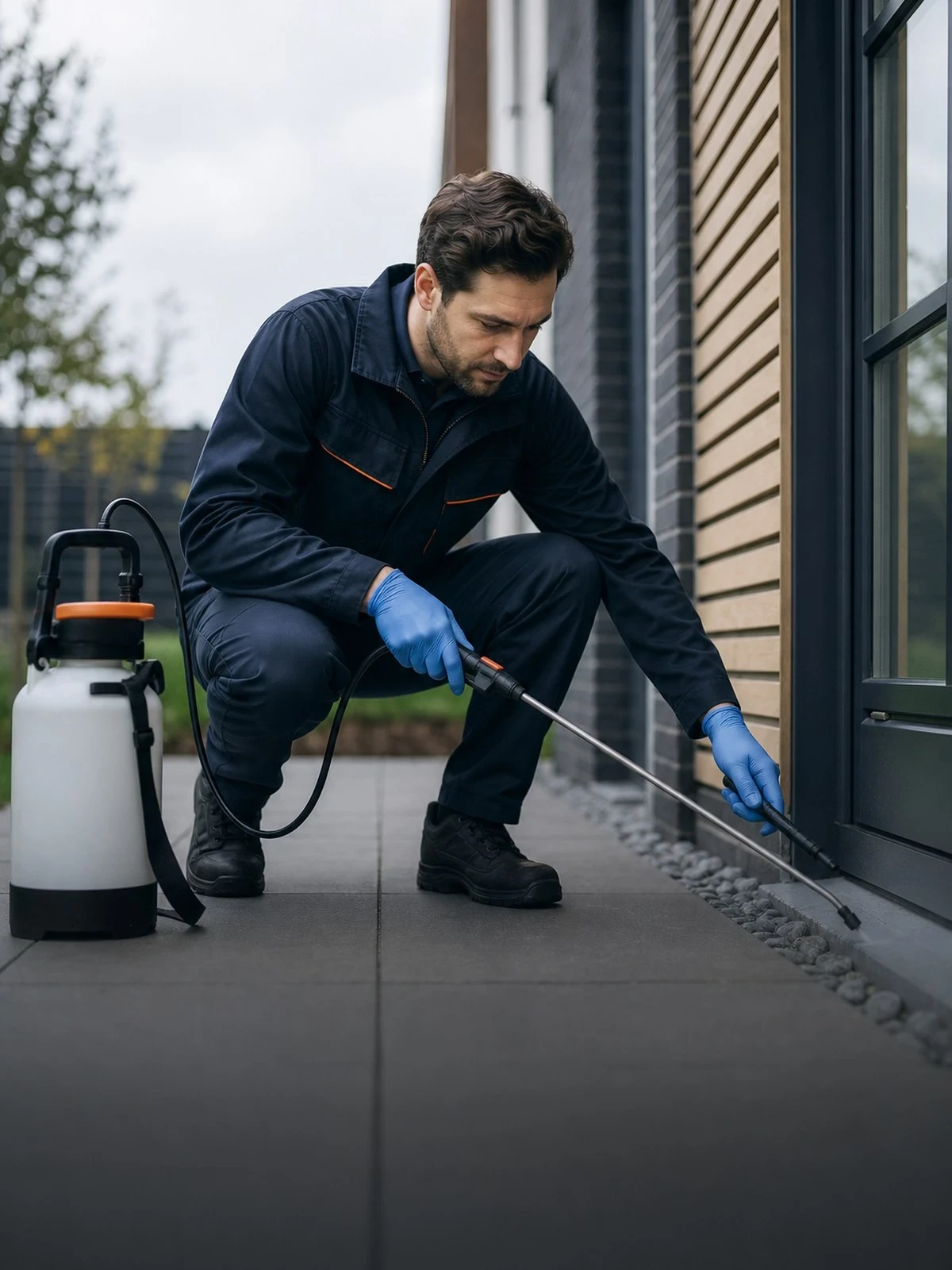
The public and employers' liability insurance pays for injury and property damage you cause to others. In pest control that damage rarely comes from a ladder falling over. It comes from a product ending up in the wrong place: a bait box within reach of a child or a dog, a space treatment after which residents are left with respiratory complaints, or residue in a food preparation area that means a batch of food has to be destroyed. Injury and destroyed goods belonging to someone else fall within cover, provided you worked in accordance with the authorisation and the label.
The second block is the environment. Almost every policy covers environmental harm only where it results from a sudden, uncertain event. Concentrate that leaks in the van and slowly seeps into the soil, or rinsing water that reaches surface water through a gully, falls outside it. Clean-up costs and soil investigation belong on environmental damage insurance, which has a cover structure of its own for it.
The third block is your own performance. If the infestation returns, a second treatment is a guarantee, not a loss. Your hours, your products and your journeys are at your own expense. The same applies to the space you are working in at that moment: you have it in your in your care, and if you damage that very floor or ceiling while drilling or injecting, that is excluded under the standard conditions.
This page deals with one situation. The full overview is on Compare public and employers' liability insurance (AVB).
Independent, personal, sorted quickly
We compare your business liability insurance (AVB) across dozens of insurers, explain where the real differences lie, and arrange the switch from start to finish — without you having to chase it yourself.
 Business liability insurance (AVB)
 Compare
 Get covered
Why arrange it through Finass Verzekert?
We look at the terms as well as the premium, and stay your point of contact when there is a claim.
Independent
We are not tied to one insurer and compare on the basis of an objective analysis of several companies.
One fixed adviser
You call or email someone who knows your file. No menu options, no changing call centres.
Switching without hassle
We cancel your old policy and align the start date, so you are never a day without cover.
Help with claims
We report the claim and monitor how it is handled. In urgent cases you can reach us on the emergency line.
What to look out for
Four points that weigh more heavily in pest control than the level of the sum insured.
Authorisation, label and professional competence
A biocide may only be used as authorised by the Dutch board for the authorisation of plant protection products and biocides. A higher dose, using indoors what is only permitted outdoors or carrying on without a valid certificate of competence makes liability under Article 6:162 of the Dutch Civil Code virtually indisputable. The insurer has moreover accepted your working method as the starting point. If you depart from it, 7:928 and 7:930 DCC come into play.
Pets and protected species
A dog that ingests a rodenticide produces a claim the insurer treats as property damage. The other extreme is more expensive: bats or stone martens in a cavity wall are protected by law. Anyone who drives them out or kills them without an exemption faces enforcement action, and administrative fines are not insured under any liability policy.
What falls outside the cover
Excluded are the space or installation you have in your in your care, gradually occurring soil and water pollution, the costs of a second treatment, fines from the NVWA or the labour inspectorate, asbestos you find in an old crawl space, intent under Article 7:952 of the Dutch Civil Code and damage caused with your van (Article 2 of the Dutch Motor Insurance Liability Act (WAM)).
Closure and the customer's loss of turnover
If a hospitality business has to close during or after a treatment, the owner claims lost turnover. If there is no injury and nothing is damaged, that is pure financial loss and the AVB is not intended for it. That claim belongs with professional indemnity insurance. If there is property damage, the consequential loss from it can be included.
What does your premium depend on?
- Annual turnover: the usual basis for a sole trader
- Methods used: bait, heat treatment or gaseous control
- Type of objects: homes, hospitality, agriculture or food processing
- Working in food environments: the chance of a batch being destroyed weighs heavily
- Environmental and care, custody and control cover: included or not, and up to what limit
- Sum insured and excess: per claim and per insurance year
Insurers weigh these details differently. That is where your saving is.
What is covered
| Situation | AVB | BAV |
|---|---|---|
| You drill an injection hole in a cavity wall and hit the resident's water pipe | Yes | No |
| The neighbours' cat dies after eating a poisoned mouse in the garden | Provided that | No |
| An engineer of the customer trips over your unrolled hose in the warehouse and breaks a wrist | Yes | No |
| The management plan you drew up turns out to be too light, so the customer fails his food safety audit | No | Yes |
| Your own fogging machine fails halfway through a treatment | No | No |
| The client charges a penalty under the contract because you overran the agreed treatment window | No | No |
As soon as a complaint is about your plan or your reporting instead of about injury or damaged property, the matter moves to the right-hand column.
Frequently asked questions
This is what people ask us most.
Is a customer's dog covered if it ingests poison?
If you are liable because you placed bait without shielding it, the insurer treats the vet's fees and the value of the animal as damage to someone else's property. The assessment turns on the placement: closed bait boxes, out of reach, and a warning to the resident. If you can show that the resident opened the box himself, liability shifts.
Does the policy pay for a second treatment if the infestation returns?
No. Carrying out your own work again is a failure to perform your contract and not an insured loss. Every liability insurance excludes the costs of putting right or redoing your own performance. What can be covered is the damage caused to other property by the lack of result, the customer's stock being eaten for instance.
And if concentrate ends up in the drain or the soil?
A sudden leak, a jerrycan that falls for instance, can fall under the environmental clause of the AVB. Pollution that has arisen gradually falls outside it. Cleaning up the soil under your own business premises is not liability at all but your own loss; environmental damage insurance exists for that. Report an incident immediately, because Article 7:941 of the Dutch Civil Code requires timely notification.
I work as a subcontractor for a large pest control company. Am I covered under them?
No, not automatically. Your client's policy insures his liability, not yours as an independent business. In practice that client in fact requires a policy of your own and a copy of it. Note too that your own injury is nowhere on this policy. Absence through an accident or illness is arranged with disability insurance.
Every situation is different. For these situations we have a separate page.
- Compare public and employers' liability insurance (AVB)The main page
- Liability insurance for a self-employed animal carerDog walking, key holding, animals in your care
- Liability insurance for a welder in the petrochemical industryWork permits, downtime, soil
- Liability insurance for a concrete firmFormwork, strength class, pump truck
- Liability insurance for a self-employed professional in the contracting tradeSubcontracting, care, custody and control, indemnity
- Liability insurance for a breakdown serviceOn-call rota, key management, emergency repairs
- Liability insurance for a pest control firmFumigation, confined spaces, contract conditions
- Liability insurance for a self-employed electricianSubcontracting, your own injury, care, custody and control
- Liability insurance for a self-employed professional in IT automationServer rooms, migrations, care, custody and control