

Liability
- Covered while coupled
- Under the car's third-party liability cover
- Uncoupled: no longer covered
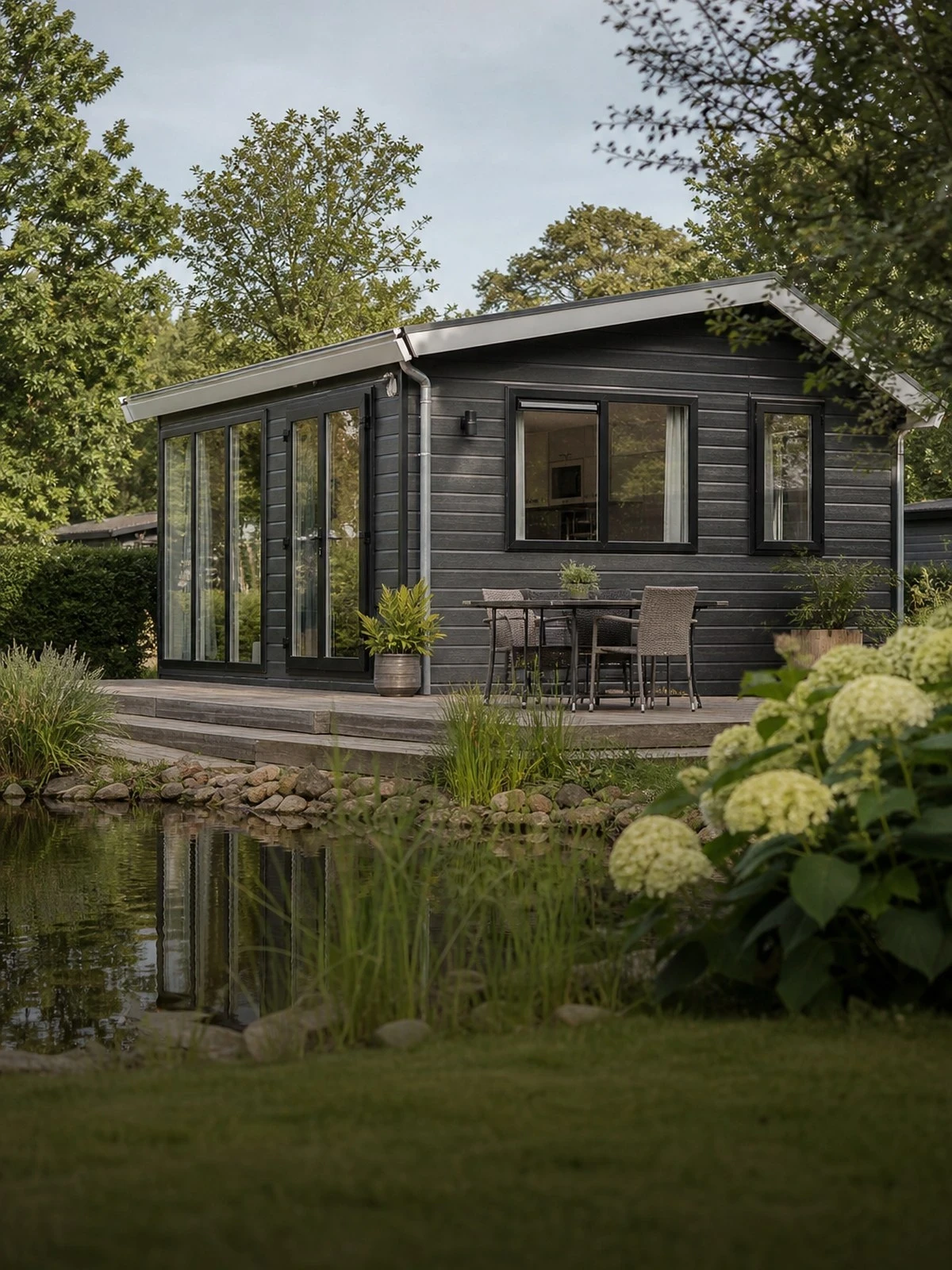
A chalet stands on a rented pitch on a park, which makes it neither a house nor a caravan. That in-between position determines which policy it falls under and which park rules affect your cover.
This page in another language: Nederlands · Deutsch · Українська
Work out for yourself what it would cost.
Enter your details; you will receive a proposal within one working day.
A premium indication, not personal advice. Prefer to talk it through? Call 072 - 509 24 56.
With a chalet, insurers look first at the construction and the siting. If it stands on fixed foundations, is connected to the drains and the mains, and can no longer be moved on its own, it is usually treated as a holiday home. If it stays on a chassis or on concrete slabs and can still be moved, it falls under the conditions for a static caravan. That choice determines whether you get buildings cover or unit cover, and which storm damage is included.
The second feature is the pitch. You own the chalet but not the land, and the park rules impose obligations about maintenance, draining the water outside the season, anchoring, and the use of gas bottles. Insurers almost always adopt those obligations as policy conditions. If you do not comply with them, there will be a discussion about cover when you claim.
What you leave inside is a third question. Chalet contents are paid out only to a limited extent and valuables are not automatically included. If you want to keep jewellery or a collection at the park, declare that separately.
We compare your holiday home insurance across dozens of insurers, explain where the real differences lie, and arrange the switch from start to finish — without you having to chase it yourself.
 Holiday home insurance
 Compare
 Get covered
The structure of the cover in three parts, with an overview per situation below.
Damage you cause to others with the trailer.
External causes beyond your control.
Including damage you cause yourself.
What is covered
| Situation | Third-party, fire and theft | Comprehensive |
|---|---|---|
| Theft after forced entry, with the prescribed lock | Yes | Yes |
| Fire and storm damage on the pitch | Yes | Yes |
| Hail damage to roof and walls | Provided that | Yes |
| Collision damage while manoeuvring | No | Yes |
| Contents in the caravan or trailer | Provided that | Provided that |
| Damp, wear and deferred maintenance | No | No |
A trailer or caravan is not an independent motor vehicle and therefore has no insurance requirement of its own. Damage you cause to others with it falls under the third-party liability cover of the towing vehicle, as long as the combination is coupled (Article 2 WAM). Once the trailer is uncoupled and has come to a standstill, that cover no longer applies.
This overview is general in nature and is not personal advice. What is actually covered, including exclusions, limits and the excess, is set out in the policy conditions and the insurance card (verzekeringskaart) of the insurer; you receive both before you take out cover. Taking out cover without advice? Then read what execution only means for you.
Insurers weigh these details differently. That is where your saving is.
We look at the terms as well as the premium, and stay your point of contact when there is a claim.
We are not tied to one insurer and compare on the basis of an objective analysis of several companies.
You call or email someone who knows your file. No menu options, no changing call centres.
We cancel your old policy and align the start date, so you are never a day without cover.
We report the claim and monitor how it is handled. In urgent cases you can reach us on the emergency line.
Customers rate our service on four aspects: personal service, service delivery, availability and the outcome. The reviews are collected and published by NH1816 and come from customers who have actually taken out a policy with Finass Advies B.V. or reported a claim.
Four points that make the difference between a policy that pays out and one that does not.
A chalet stands empty for most of the year, and the insurer knows it. Many policies limit cover in the months when nobody is staying there to fire, storm, lightning strike and explosion. Theft, water damage and vandalism then fall outside the cover. So ask explicitly after how many consecutive weeks that limitation starts, and whether a park with supervision or camera surveillance keeps the full cover in place.
Virtually every chalet policy requires you to drain the water pipes or maintain a minimum temperature as soon as the season ends. If a pipe bursts through frost in a chalet where the tap was left open, that is treated as a failure on your part and nothing is paid, not even for the consequential damage to floor and walls. Record when you drained the system, or have the park confirm it in writing; that confirmation is your evidence when you claim.
In a storm, it is rarely the roof of a chalet that suffers. It is the awning, the veranda, the shed and the free-standing store that go, and they are by no means always on the policy. Declare extensions, terrace canopies and garden sheds separately with their value. If the chalet is not anchored as the park rules require and it shifts in strong winds, the insurer may reduce or refuse the payout.
Outside the cover are wet rot, mould and gradual penetrating damp, because that is maintenance and not a sudden event. Wear of the roof covering and sealant joints, and the damage that follows from it, is not paid for either. Theft without signs of forced entry is accepted almost nowhere. If you let the chalet to third parties without declaring it, the capacity changes and the insurer can rely on Article 7:928 of the Dutch Civil Code professions.
This is what people ask us most.
That depends on the construction and the connections. A chalet on brick or concrete foundations, permanently connected to utilities and no longer movable in one piece, is usually insured as a holiday home. If it stays on its chassis or on paving slabs and can be taken off the pitch, static caravan conditions apply. Supply photographs and the siting details with your application; the insurer decides on that basis.
If a tree belonging to the park falls on your chalet, you report the damage to your own insurer. It pays out and then investigates whether the park owner is liable as the owner of a defective object. That route runs through the owner's liability and not through you. So always report the damage to your own policy first, and keep photographs of the situation.
Only if you declare it. Letting to changing guests materially alters the risk of water damage, fire and vandalism, and many personal chalet policies exclude it. If you let through the park or through a platform, state how many weeks a year. The insurer can then include a letting clause, usually with an excess for damage arising during a letting period.
Not automatically. Chalet contents form a separate section with their own sum insured, and outside the season the same limitation often applies as for the chalet itself. Valuables, cash and securities are normally excluded or covered only up to a low amount. Do not leave valuable items behind outside the season, or declare them separately so that a suitable section can be arranged for them.
Every situation is different. For these situations we have a separate page.
Request a quote without obligation. We will look at which insurer best matches your activities and your risk.
Prefer to call? 072 - 509 24 56, weekdays 09:00–17:00.
Claim on the road? Emergency line 06 - 55 20 40 72.
Finass Verzekert is a trading name of Finass Advies B.V. We advise on and arrange non-life insurance on the basis of an objective analysis of several insurers, and receive commission for this from the insurer, which is included in the premium. You pay no separate advice fee. Before you take out cover, we establish your wishes and needs.
You will find our licence, KvK and Kifid details and our complaints procedure at the foot of every page.
This page was compiled by Finass Verzekert (LinkedIn). Last updated on .
The information on this page is general in nature and is not personal advice.
Maandag- Vrijdag: 09:00- 17:00
We use cookies and similar technologies to improve your experience on our website.